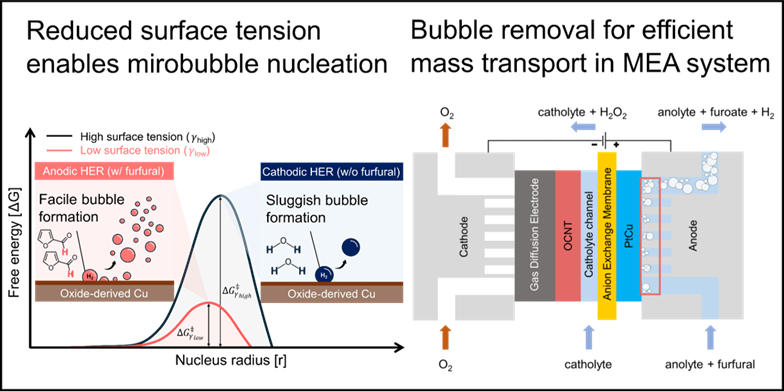
Confirmed that organic matter lowers the interfacial surface tension at the electrode, promoting the formation of microbubbles, and effectively eliminated bubble accumulation through electrolyte flow control — thereby realizing a system that operates without any applied external voltage for industrial-level hydrogen peroxide production.
A research team led by Professor Sunghak Park of the Department of Future Energy Engineering of Sungkyunkwan University, working jointly with research teams from Korea University and Northwestern University, has developed an innovative electrochemical system capable of producing eco-friendly hydrogen peroxide (H2O2) in large quantities and with high efficiency, without any external power supply. The findings were published in Energy & Environmental Science, a leading international journal in the energy and environment field.
Hydrogen peroxide is a chemical widely used across the paper and pulp industry, medicine and bio-related fields, and semiconductor cleaning, among others. However, most current production relies on large-scale anthraquinone processes, which demand high energy consumption and complex procedures. As a result, developing decentralized, eco-friendly methods for producing hydrogen peroxide has become an important challenge.
Electrochemical methods that convert oxygen directly into hydrogen peroxide have recently drawn attention, but existing systems suffer considerable energy loss due to the high potential and slow reaction rate required for the oxygen evolution reaction (OER). Research to date has focused mainly on catalyst development, while the effect of gas bubbles forming inside the electrolyzer has largely been overlooked.
To address this limitation, the research team focused on the movement of gas bubbles generated at the electrode surface where the chemical reaction takes place. Using ultra-high-speed camera imaging to observe the microelectrode surface, the team found that furfural, an organic reactant, lowers the surface tension of the solution and promotes the formation of microbubbles on the electrode surface. This was shown to significantly restrict mass transfer at the electrode surface.
The team introduced a strategy to precisely control electrolyte flow in order to facilitate bubble removal, achieving roughly a threefold increase in current density compared to existing conditions. In particular, in an optimized membrane electrode assembly (MEA) system, the team achieved an industrial-level current density of 331 mA cm⁻² without any external power supply, while maintaining hydrogen peroxide selectivity of about 90%. The system also recorded a hydrogen peroxide production rate of 5.617 mmol cm⁻² h⁻¹.
*Selectivity: refers to the yield of a specific desired product among the various products generated by a reaction.
This is a breakthrough achievement that enables the large-scale simultaneous production of eco-friendly hydrogen peroxide, along with hydrogen (H2)—a clean energy source for the future—and furoic acid, a high-value chemical feedstock, using only a spontaneous chemical reaction (a galvanic process) with no external electrical energy. Notably, electricity consumption was estimated at approximately 236 kWh per tonne of H2O2, markedly lower than that of existing electrochemical hydrogen peroxide production technologies.
Professor Sunghak Park said, "This study is significant in that it scientifically analyzes the long-overlooked problem of bubbles on the electrode surface in electrochemical processes, and secures a commercially viable production rate through the eco-friendly and simple method of controlling fluid flow." He added that the research "is expected to contribute to presenting new strategies applicable to sustainable, carbon-free electrochemical processes in the future."
This research was supported by the Ministry of Science and ICT's programs for building a cooperation platform among top-tier research institutions and supporting joint research, as well as its Basic Research Laboratory and Outstanding Young Researcher programs.