

Professor Kang Bosoek's Research Team Overcomes Charge Transport Limitations in Organic Electronic Materials Through Molecular and Interfacial Design
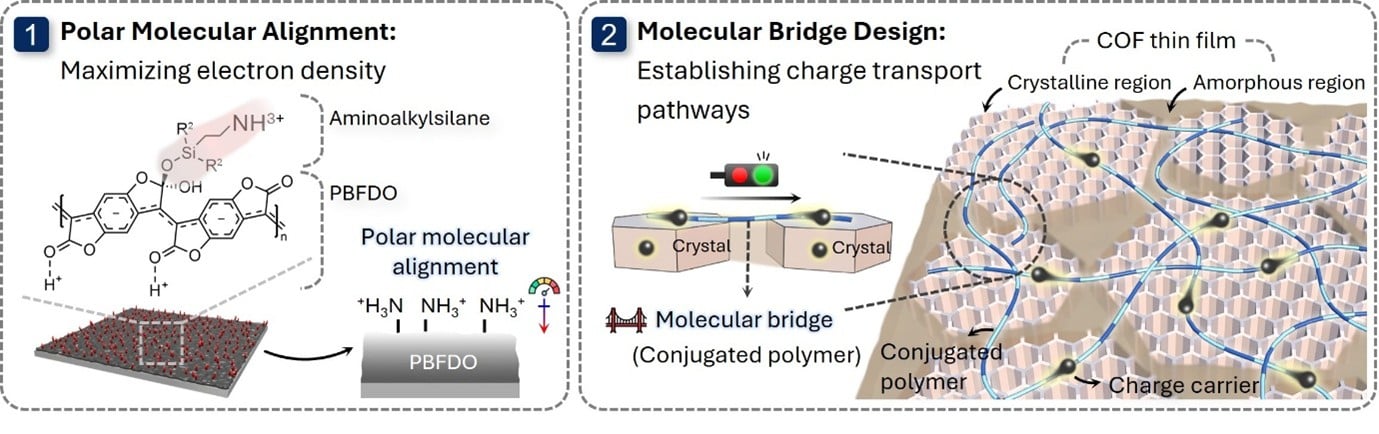
(1) Polar molecular alignment: maximizing electron density. (2) Molecular bridge design: establishing charge transport pathways.
Kim, SW., Seo, JM., Yoon, B. et al. Molecular bridge engineering in covalent organic frameworks for enhanced electronic transport. Nat Commun (2026). https://doi.org/10.1038/s41467-026-75122-5
A research team led by Professor Kang Bosoek of the SKKU Advanced Institute of Nano Technology(SAINT), Department of Nano Engineering, and Department of Semiconductor Convergence Engineering at Sungkyunkwan University has developed two new molecular design technologies to enhance the electrical conductivity of organic electronic materials. One technology generates a greater number of charge carriers within a polymer, while the other connects transport pathways so that charge can move without interruption. The findings were published respectively in the international journals Journal of the American Chemical Society and Nature Communications. The paper published in the Journal of the American Chemical Society was also selected as a Cover Article.
Organic semiconductors are lightweight and flexible materials expected to be used in next-generation displays, wearable electronics, and sensors. However, for practical use in electronic devices, their electrical conductivity must be improved—which requires generating a sufficient amount of charge and ensuring that the charge, once generated, can move rapidly through the material. Through two separate studies, the research team addressed these two challenges in a complementary way.
The first study developed a molecular-level design technology that generates a greater number of charge carriers within a polymer. The team covalently attached the polar molecule aminoalkylsilane to the n-type conducting polymer PBFDO, substantially increasing electron concentration. As the bonded polar molecules aligned in a consistent direction, they naturally induced electron generation without relying heavily on external dopants. As a result, the electrical conductivity of the thin film improved to over 3,000 S cm−1, achieving a high doping efficiency of up to approximately 1.79 free electrons per polymer repeat unit. This is the first study to raise the doping limit to a near-theoretical level, demonstrating potential applications across a range of organic electronic devices, including polymer electrodes and light-emitting devices.
The second study proposed a new strategy for designing the charge transport pathway itself. By thinly coating a conducting polymer onto a thin film of a two-dimensional covalent organic framework (2D COF), the team implemented a "molecular bridge" structure that connects charge transport pathways broken by the polycrystalline structure. This structure allows the conducting polymer to serve as a bridge linking separated COF crystals, enabling charge to move more smoothly. The optimized COF–conducting polymer heterostructure thin film showed an electrical conductivity improvement of 109 times compared to a single COF thin film, and approximately 10 times compared to a single conducting polymer thin film. The team also succeeded in fabricating a uniform, large-area thin film at the scale of a 2-inch wafer, and when applied to a nitrogen dioxide (NO2) gas sensor, the film detected concentrations as low as 74 ppb with a rapid response time of approximately 20 seconds.
Professor Kang Bosoek said, "This research addressed, at the molecular level, the two key factors that determine the performance of organic electronic materials—charge generation and charge transport," adding, "We plan to expand this research toward high-performance electronic devices by developing heterojunction structures with a variety of semiconductor materials."
The research team recently published a study in Nature Communications proposing a plateau transistor that maintains a constant current by leveraging the localization of polarons, the charge carriers in organic electronic materials. Building on this, the team is expanding its research scope beyond charge generation and transport to explore the use of charge states as a new information-processing function.
Advertisement