
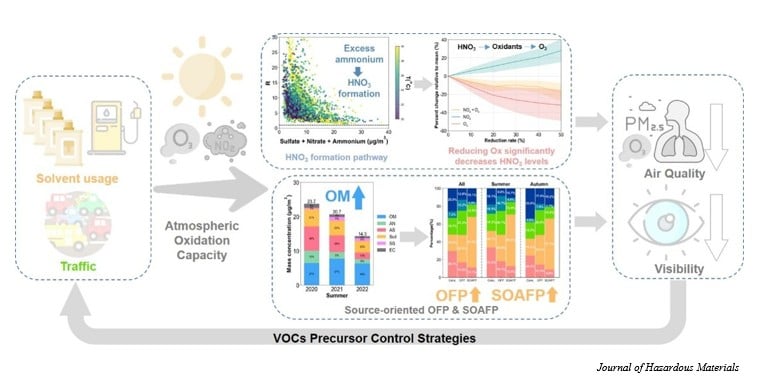

A three-year atmospheric study in central Taiwan finds that organic particles, formed largely from reactive vapors such as those released by industrial solvents, have overtaken the sulfate and nitrate salts from vehicle and factory exhaust as the leading cause of hazy skies. Because the region's air chemistry is "VOC-limited," cutting nitrogen oxide emissions from traffic alone can actually worsen nitrate haze, making industrial solvent control the more effective lever for clearer air.
Solvent and traffic emissions fuel the atmosphere's chemical reactivity in central Taiwan, driving up organic haze particles and secondary pollutants (nitrate and SOA) that cloud the region's air and reduce visibility.
Chen, T.-L. et al., Journal of Hazardous Materials 510 (2026) 142131. © 2026 Elsevier B.V.
Taiwan's air has gotten measurably cleaner over the past decade, yet in many towns the hazy, milky-white sky that blurs mountains and city skylines has not cleared at the same pace. A research team led by Prof. Ta-Chih Hsiao from Graduate Institute of Environmental Engineering at National Taiwan University set out to find out why.
For three years, from 2020 to 2022, the team continuously monitored the air in Taichung, a mixed urban-industrial region in central Taiwan, tracking the fine particles (PM2.5) that scatter and absorb sunlight and cause haze. They measured not just how much particulate matter was in the air, but exactly what it was made of, down to the size and chemistry of individual particles.
The results reveal a shift in what is dirtying Taiwan's skies. At the start of the study in 2020, salts formed from vehicle and industrial exhaust, such as ammonium sulfate and ammonium nitrate, were the main culprits behind hazy days. By 2022, however, organic particles had become the single largest contributor, accounting for up to 52% of the light-blocking effect in summer. The study is published in Journal of Hazardous Materials.
These particles form when volatile organic compounds (VOCs), reactive vapors released by vehicles, factories, and especially industrial solvents, react in sunlight. Crucially, the team found that reducing nitrogen oxides (NOx), a pollutant produced mainly by vehicles and factories and a common target of clean-air policy, does not always help.
In autumn, cutting NOx by half was calculated to raise nitrate haze levels by nearly 30%. This happens because, once ammonia is abundant in the air, as it is in this region, the amount of haze-forming nitrate depends less on how much NOx is emitted and far more on how "oxidizing" the atmosphere is, that is, how actively sunlight and reactive chemicals convert pollutants into particles.
In fact, daytime nitrate formation proved roughly three times more responsive to this oxidizing capacity than to NOx levels. Removing NOx can, paradoxically, make the air chemistry even more reactive.
Using chemical fingerprinting of dozens of airborne compounds, the researchers traced the VOCs driving this reactive chemistry back to their sources. They found that emissions from industrial solvents, used in coatings, paints, and other manufacturing processes, contributed 57% of the potential to form these haze-causing organic particles, more than vehicle exhaust.
The findings point to a more targeted fix. Rather than focusing solely on traffic emissions, regulators should also prioritize reducing solvent vapors from factories, for instance by encouraging a shift to water-based coatings, to cut both the reactive atmospheric chemistry and the organic haze it produces.
"Our data show that visibility in this region is no longer just a story about NOx and vehicle exhaust – industrial solvent vapors are now writing a big part of that story, and controlling them is essential to seeing clearer skies again," says corresponding author Prof. Ta-Chih Hsiao.
The study was carried out with National Sun Yat-sen University, together with collaborators at National Central University, China Medical University, National Taipei University of Technology, Academia Sinica, and NASA's Goddard Space Flight Center.
Prof. Ta-Chih Hsiao's email address: [email protected]
The lab of Prof. Hsiao linked to https://www.ntuaerosol.com/
Advertisement