

Water-based electrochemical devices could help convert low-temperature waste heat into electricity. However, much remains unknown about how they work, and detailed measurements at National Taiwan University are now revealing their inner workings and genuine operational efficiency.
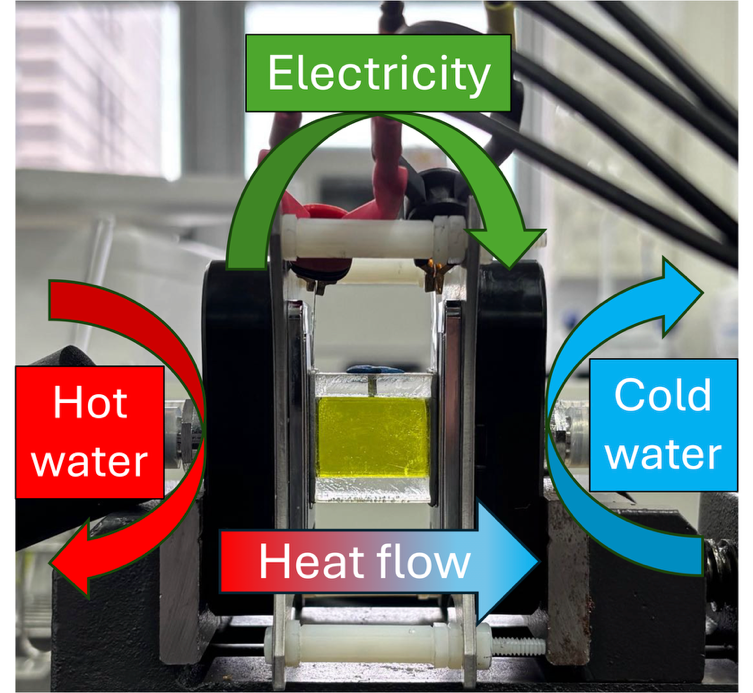
The simple thermocell (a cube containing the water-based electrolyte), which can turn a temperature gradient into electricity – without moving mechanical parts – but the process needs to complete with internal heat transfer.
National Taiwan University
Most electricity is generated by using heat to produce steam, which then turns a turbine. Although this approach performs exceptionally well in the high-temperature, superheated-steam regime, we currently lack widely applicable technologies that can exploit the much more abundant resource of low-temperature heat.
This heat is released into the environment by industry, buildings, data centers, humans, etc. and is even produced when sunlight warms an ordinary surface. The individual temperature differences may be relatively small, but the enormous quantity and widespread availability of this heat make it an important potential source of sustainable electricity.
Thermogalvanic cells, or thermocells for short, offer a potentially simple and sustainable solution. These devices use two electrodes and a water-based electrolyte to convert a temperature difference directly into electricity. It does not require any moving, mechanical parts. Unlike many conventional solid-state thermoelectric devices, which can depend on costly, scarce and toxic elements, thermocells can be constructed from comparatively abundant and sustainable materials.
However, this abundance of water also creates a fundamental problem. Water transfers heat readily, particularly when temperature differences cause the liquid to circulate. This convection can carry large quantities of heat directly from the hot side of the device to the cold side without generating additional electricity. Efficiency is the ratio of electricity produced compared to heat transferred; too much heat transfer will remove the temperature gradient, lowering electricity production.
Most previous studies have not directly measured this heat flow while the cell is generating power. Instead, they have estimated it using methods taken from the solid-state thermoelectric community. These methods assume that heat moves through a stationary material and therefore do not capture the additional heat carried by a moving liquid. Applying them to a water-based thermocell can consequently produce excessively high apparent efficiencies.
Researchers at National Taiwan University have developed a method for simultaneously measuring the real electrical power and total heat flux of a thermocell under operating conditions. By reducing the complex processes occurring inside the cell to a small set of directly measured values, the researchers could determine how the device would perform under conditions closer to a practical application. The study is published in Energy Conversion and Management.
In some cases, conventional calculations closely matched the actual efficiency. In others, they produced efficiency values almost 30 times too high. Additionally, direct measurement revealed different trends. Changes that appeared to improve performance under the established calculation method did not necessarily improve genuine performance.
For example, increasing the distance between the electrodes appeared beneficial using the conventional method, but direct measurements showed the opposite trend. This means that some design strategies identified through earlier methods may not produce better devices under real operating conditions.
The researchers found that one of the most influential design choices was also one of the simplest: the orientation of the cell relative to gravity. Tilting the cell to the optimum incline angle of 60° suppressed the large-scale circulation responsible for excessive heat transfer while retaining enough movement to transport the chemical species required for continuous electricity generation. This increased the directly measured Carnot-relative efficiency, without requiring new materials, membranes or complicated cell structures.
The team is now extending the approach to devices placed between hot and cold air, such as across a wall panel or door. These systems are intended to harvest temperature differences from the surrounding environment and generate sufficient electricity to operate small electronic devices. Controlling the orientation of the internal cells has proved critical to achieving simple but effective improvements in their real performance.
“Thermocells are attractive because they can be remarkably simple and can consist mostly of water, but that water can also carry a great deal of unwanted heat through the device. By measuring the real power and total heat flow simultaneously, we obtained simple numbers that reveal what is actually happening during operation. We found that some apparently good design choices were not good at all when assessed realistically, while simply changing the orientation relative to gravity produced a major improvement,” says corresponding author Prof. Leigh Aldous of Department of Chemical Engineering at National Taiwan University.
“We believe that our laboratory being able to measure reliable, total device performance will give this technology a much clearer path towards commercial application.”
The email of Prof. Leigh Aldous: [email protected]
Aldous group linked to https://leighaldousgroup.com/
Advertisement