
Space sciences
News
21 Oct 2026
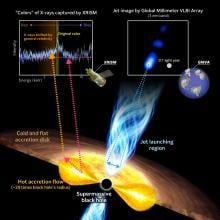
A research team has solved an astrological puzzle, identifying the conditions that allow a rapidly feeding supermassive black hole to launch a powerful relativistic jet.
01 Oct 2026
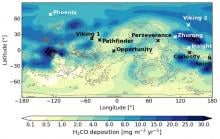
Billions of years ago, rain may have helped shape where the chemistry of life could begin on Mars. A new study maps the delivery of formaldehyde, an important prebiotic molecule, to the surface. The map could help guide future Mars missions searching for signs of the planet’s early organic evolution.

04 Sep 2026
Mapping interacting galaxies reveals how turbulence can suppress star formation

24 Aug 2026
New study of James Webb Space Telescope images suggests that little red dots are not simply single points of light but likely exist within compact star-forming galaxies.

13 Aug 2026
Black hole "blast", Bacteria-detecting robot, A crab's tale, Sensors that remember, and Silk in cycling. Plus submission deadline for 2027 magazine. Read all in the latest Editor's Choice.
29 Jul 2026
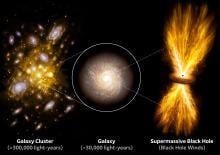
Despite our knowledge of supermassive blackholes far from complete, astronomers have long known that they produce violent winds. But a recent discovery has shown that these winds are more powerful than previously thought, 100 times more powerful, to be precise. High-precision observations of gas surrounding a black hole 3.4 billion light-years from Earth showed that the winds carry energy across distances of approximately 300,000 light-years, impacting surrounding galaxies.
17 Jul 2026
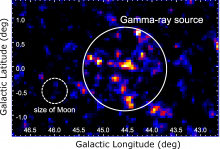
An accelerator of the highest-energy protons in our galaxy has been identified; it could help scientists better understand the nature of these fast-moving particles that fill the space between stars.
06 Jul 2026
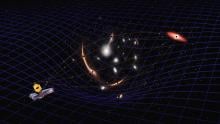
An international team including Professor Meng GU of the Hong Kong Institute for Astronomy and Astrophysics (HKIAA) at The University of Hong Kong (HKU) has directly measured the mass of an inactive supermassive black hole in the early Universe for the first time.
06 Jul 2026
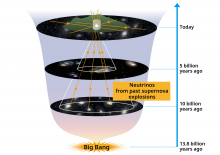
Located 1,000 meters underground in Japan, the Super-Kamiokande observatory strains to detect the faintest of signals amongst all sorts of noise: ghost-like neutrino particles. A recent analysis of 5,000 days of data provides an exciting, world-first indication of a flux of neutrinos called Diffuse Supernova Neutrino Background (DSNB) – emitted by supernovae over cosmic history.
30 Jun 2026
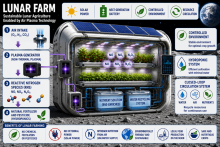
Rice grown on the Moon? No, this is not something out of science fiction, but a future possibility thanks to a plasma technology developed by Tohoku University and JAXA. The plasma technology synthesizes gas from atmospheric air and turns it into a nitrogen-based fertilizer. Researchers also tested the fertilizer on rice seedlings planted in a lunar soil simulant, finding that the fertilizer released critical minerals from the Moon's soil while suppressing harmful ones. The technology is portable and energy-efficient, meaning it can even be used here on Earth for a more sustainable form of rice farming.

18 Jun 2026
Sweet power nanogenerator, Cosmic fossil, Dopamine and Alzheimer's link, Sustainable 3D printing, Quantum dots for brain diseases, Smart trolley and Bamboo and bone. Read all in the latest Editor's Choice. Plus SciCom Coffee talk: Inside a University Merger.
15 Jun 2026
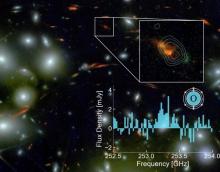
Astronomical observations provide new insights into how galaxies formed and grew during the Universe's first billion years
12 Jun 2026
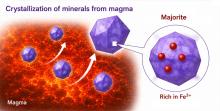
High-pressure experiments show that majorite can store moderate amounts of ferric iron.
11 Jun 2026
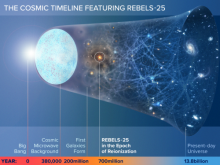
NSF VLA and ALMA observations detect enormous cold molecular gas reserves in a distant galaxy seen 13 billion years ago, a study involving Hiroshima University reports.
28 May 2026
The LIGO–Virgo–KAGRA Collaboration published today a new catalog of gravitational wave events. A total of 161 events, detected between April 2024 and the end of January 2025, have been added to the collection, bringing the total number of gravitational wave signals detected to date to 390. Among the most significant findings are: evidence for the existence of second-generation black holes, the most precise sky localization ever achieved for a gravitational wave source, and the first measurement of three vibrational modes of a black hole. A wealth of results that marks the coming of age of gravitational astronomy.
15 May 2026
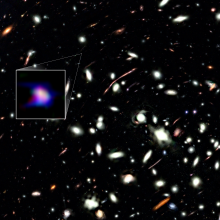
An international team led by Associate Professor Kimihiko Nakajima of Kanazawa University has captured a rare look at the early universe. Using the James Webb Space Telescope (JWST *1) and the power of a gravitational lensing (*2) in space, the team achieved a definitive characterization of LAP1-B, an ultra-faint galaxy from 13 billion years ago. Expanding upon initial detections, this new study utilized deep JWST spectroscopy to reveal a record-breaking low oxygen abundance (*3) -- merely 1/240th that of the Sun. This chemically primitive state, coupled with an elevated carbon-to-oxygen ratio and a dominant dark matter halo, suggests that LAP1-B is the long-sought "ancestor" of the mysterious fossil galaxies found near our Milky Way today, providing a historic window into the earliest, most primitive stages of galaxy assembly.
14 May 2026
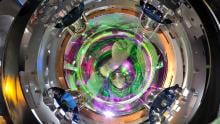
The LIGO–Virgo–KAGRA (LVK) detector network has a new trick up its sleeve to improve the instruments’ sensitivity to gravitational waves: it’s called Astrophysical Calibration and it plays a role similar to auto-tune in music production.
05 May 2026
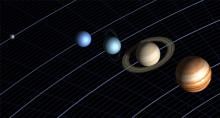
Observations of a distant object beyond Pluto suggest that it is surrounded by a thin atmosphere, potentially fuelled by ice volcanoes or produced by the impact of a comet-like body.

14 Apr 2026
A mysterious layer of particles that occupies the lower regions of Venus’s atmosphere has long puzzled astronomers. However, a research team has finally solved the mystery of the “lower haze,” discovering that the haze comes from cosmic dust left by shooting stars that constantly rain down on Venus.
23 Mar 2026
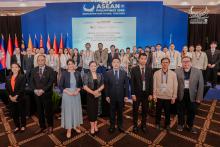
The Philippine Space Agency (PhilSA), in partnership with the United Nations Office for Outer Space Affairs (UNOOSA) and Thailand’s Geo-Informatics and Space Technology Development Agency (GISTDA), convened the ASEAN Space Situational Awareness (SSA) and Space Traffic Management (STM) Seminar-Workshop on 12-13 March 2026 in Manila.

17 Mar 2026
The complete set of nucleobases found in terrestrial DNA and RNA have been detected in samples returned from the asteroid Ryugu, offering insights into the early Solar System's chemistry.
10 Mar 2026
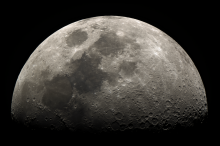
Observations of the Rimae Bode region on the Moon reveal five distinct types of terrain and identify several potential landing sites for China’s first crewed mission, according to research published in Nature Astronomy.

06 Mar 2026
Kelli canines, Healthy fats in rice, Mercury and Earth in chorus, AI lights up materials discovery, Radiation detection with phones and Down to one. Read all in the latest Editor's Choice. Plus Women's Month 2026.
04 Feb 2026
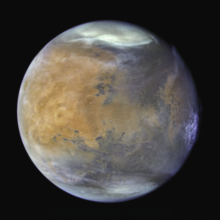
We may be closer to unravelling the mystery of how the dry, arid Mars used to be covered in water from new research that focuses on an unexpected event (a powerful dust storm) at an unexpected time (Northern Hemisphere summer).

29 Jan 2026
Sticky life beginnings. Precarious pitcher plant, Breaking the cobalt "cage", Toxic algae killer & “Pure-bred” stem cell medium. Read all in the latest Editor's Choice. Plus Asia Research News 2026 is out now and SciCom Coffee talk by Rachael Smith at Wellcome Sanger Institute.
18 Jan 2026
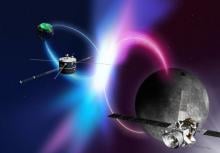
An international team from Kanazawa University (Japan), Tohoku University (Japan), LPP (France), and partners has demonstrated that chorus emissions, natural electromagnetic waves long studied in Earth’s magnetosphere, also occur in Mercury’s magnetosphere exhibiting similar chirping frequency changes. Using the Plasma Wave Investigation instrument aboard BepiColombo’s Mercury orbiter Mio, six Mercury flybys between 2021 and 2025 detected plasma waves in the audible range. Comparison with decades of GEOTAIL data confirmed identical instantaneous frequency changes. This provides the first reliable evidence of intense electron activity at Mercury, advancing understanding of auroral processes across the solar system.
12 Dec 2025
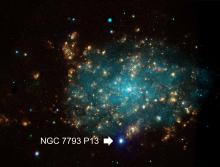
Over 10 years of monitoring

09 Dec 2025
Brain atlas, From perfume to plastic, Stable solar power, Plant aging switch, Anti-cancer droplets, Greener gold, Extreme star factory and How research shapes sustainability policy. Read all in the latest Editor's Choice.
01 Dec 2025
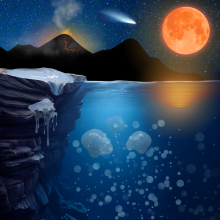
Surface-bound gels may have provided the structure and chemistry for life to take root on Earth, and perhaps beyond
19 Nov 2025
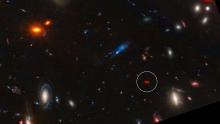
Astronomers have uncovered a previously unknown, extreme kind of star factory by taking the temperature of a distant galaxy using the ALMA telescope. The galaxy is glowing intensely in superheated cosmic dust while forming stars 180 times faster than our own Milky Way. The discovery indicates how galaxies could have grown quickly when the universe was very young, solving a long-standing puzzle for astronomers.
Events

09 Sep 2021 to 10 Sep 2021
Earth-Life Science Institute (ELSI) will launch a new Master-PhD course on origin-of-life science and astrobiology at Tokyo Institute of Technology. The five-year ELSI course is open for domestic and international students who wish to tackle fundamental questions in natural science such as the origin and evolution of living planets. ELSI will provide financial support (as salary of a research assistant) for all the students, except for ones who are going to be supported by JSPS DC fellowships (Japan) or equivalent fellowships.
Researchers
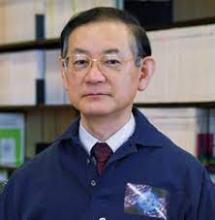
Ken’ichi Nomoto is a visiting senior scientist at Kavli IPMU and Professor Emeritus at The University of Tokyo. He is one of the best experts in the world in astronomy and astrophysics, particularly on stellar evolution and supernovae. He was awarded the Order of the Sacred Treasure by the Japanese government in 2020.
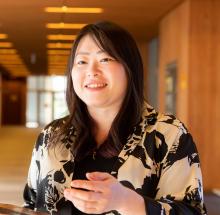
Miho Katsuragawa is a specially appointed project researcher at Kavli IPMU. Her areas of expertise include experimental physics, detector/instrument development, medical application of gamma-ray imaging, and high energy astrophysics.

Jia Liu is the Director of the Center for Data-Driven Discovery and associate professor at CMB Group at Kavli IPMU. Her research integrates data science techniques in the study of large-scale structures of the universe (dark matter, halos, filaments, voids).

Elisa Ferreira is Assistant Professor at the Kavli IPMU and at the Institute of Physics of the University of São Paulo. Her research deals with the interface between cosmology, astrophysics, and high energy physics, focusing mostly on dark energy and dark matter.
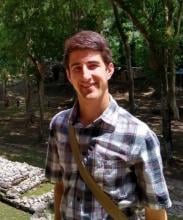
Mr. Brian Katona is an engineer supporting the technical aspects of the Office of Service-Learning’s initiatives in Humanitarian Technology, Entrepreneurship and Social Innovation. He is interested in sharing his expertise with people to help build meaningful and impactful technological and social solutions.

Tony Z. Jia is a researcher at Japan’s Earth-Life Science Institute (ELSI), based at the Tokyo Institute of Technology. His research focuses on astrobiology, prebiotic chemistry, and origins of life.
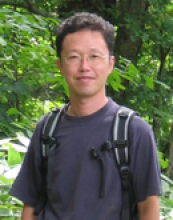
Takeshi Horinouchi is a professor at the Faculty of Environmental Earth Science, Hokkaido University, Japan.

Department of Earth Science, Graduate School of Science, Tohoku University, Japan.
Giants in history

Chinese electron microscopy specialist Li Fanghua (6 January 1932 – 24 January 2020) facilitated the high-resolution imaging of crystal structures by eliminating interference.

Haisako Koyama (1916 – 1997) was a Japanese solar observer whose dedication to recording sunspots – cooler parts of the sun’s surface that appear dark – produced a sunspot record of historic importance.
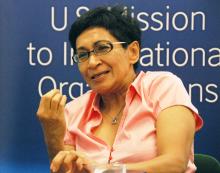
Malaysia’s first astrophysicist, Mazlan binti Othman (born 11 December 1951) was instrumental in launching the country’s first microsatellite, and in sending Malaysia’s first astronaut, Sheikh Muszaphar Shukor, into space.
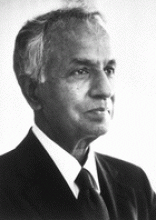
Subrahmanyan Chandrasekhar (19 October 1910 – 21 August 1995) was an Indian astrophysicist who studied the structure and evolution of stars.
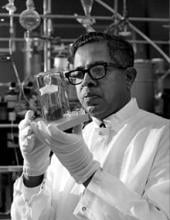
Cyril Andrew Ponnamperuma (16 October 1923 – 20 December 1994) was a Sri Lankan chemist who was interested in the origins of life on Earth. His research in chemical evolution showed how inanimate molecules may have given rise to the building blocks of life – a process known as abiogenesis.