
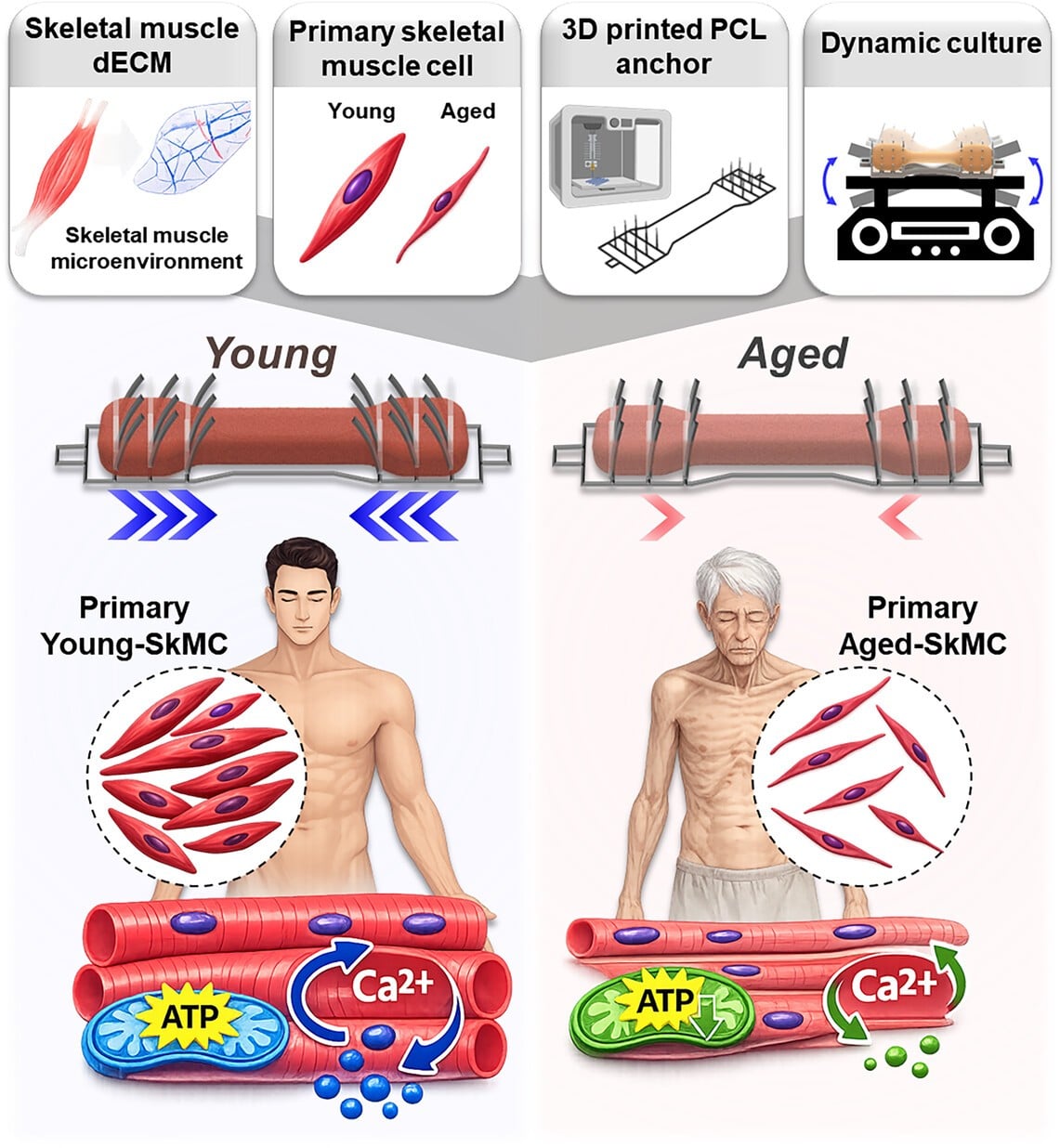

- Research teams led by Professor Minseok S. Kim of the Department of New Biology at DGIST and Professor Dong-Woo Cho of POSTECH create 3D muscle microtissues using human cells
- Platform expected to play a key role in developing treatments for “sarcopenia,” aligning with the FDA's shift toward non-animal testing methods; study selected as the Front Cover article of Small Science
□ A research team led by Professor Minseok S. Kim of the Department of New Biology at DGIST (President Kunwoo Lee), in collaboration with a research team led by Professor Dong-Woo Cho of the Department of Mechanical Engineering at POSTECH, has developed a "biomimetic 3D skeletal muscle microtissue model" capable of simultaneously replicating and evaluating age-related changes in human skeletal muscle and the decline in actual muscle contractile function.
□ Skeletal muscles, which are attached to bones and enable body movement, are crucial for metabolic regulation. "Sarcopenia," characterized by age-related declines in muscle mass and function, reduces mobility and severely undermines quality of life in old age. However, previous research has been constrained by substantial biological differences between animal models and humans, while conventional methods of culturing cells on flat (2D) dishes have remained ineffective in fully replicating the three-dimensional movements and contractile function of actual human muscles.
□ The joint research team addressed this challenge by using human muscle cells obtained from two male donors aged 17 and 68, respectively. The team mixed the muscle cells with a biomaterial (decellularized extracellular matrix) that serves as a structural scaffold for muscle tissue, then cultured the mixture in tiny 3D-printed molds to create 3D artificial muscle microtissues in which the cells were uniformly aligned in a single direction, as in actual muscle tissue.
□ Comparative analysis of the 3D muscle tissues produced in this manner revealed that tissues derived from the older donor's cells had thinner muscle fibers, exhibited less cell fusion, and showed higher levels of inflammation than those derived from the younger donor's cells. Particularly, the tissues exhibited not only impaired mitochondrial function, which is responsible for energy production, but also retarded calcium responses that trigger muscle contraction and significantly reduced muscle force (contractile force) in response to electrical stimulation. These findings demonstrated that the actual human aging process was faithfully replicated in the 3D tissues.
□ This study is significant as it goes beyond merely observing changes in cell morphology or genes, enabling the simultaneous evaluation of morphological and molecular changes in muscle, as well as contractile force, within a single 3D experimental platform. Particularly, as the U.S. Food and Drug Administration (FDA) has recently revised its regulatory framework (under the FDA Modernization Act 2.0) to allow drug approval applications without animal testing, the artificial muscle model developed in this study, which accurately reflects human physiological characteristics, is expected to be valuable in the future development of treatments for sarcopenia.
□ "The significance of this study lies in establishing a foundation for faithfully replicating age-related changes using human-derived cells and evaluating both cellular-level changes and actual muscle contractile function," stated Professor Minseok S. Kim of the Department of New Biology at DGIST. "Given the increasing global interest in human-centered nonclinical testing methods that can replace animal experiments, we aim to refine this model into a valuable research tool for identifying the causes of muscle aging and accurately validating the efficacy of candidate therapeutics."
□ Meanwhile, this research was supported by the National Research Foundation of Korea (NRF), with Sohae Yang, an integrated master's–doctoral student in the Department of New Biology at DGIST, and Dr. Jeong Sik Kong of the Department of Mechanical Engineering at POSTECH serving as co-first authors. The findings were selected as the front cover article in the international journal Small Science in recognition of their technological and academic value.
Advertisement