

–Professor Sungwon Lee’s team at DGIST develops “nano-on-nano” technology that overcomes the sweating and discomfort associated with conventional sensors
–Expected to be applied to next-generation wearable devices suitable for extended wear, from industrial settings to everyday life
–Published in the internationally renowned journal Advanced Fiber Materials
□ A research team led by Professor Sungwon Lee of the Department of Physics and Chemistry at DGIST (President Kunwoo Lee) developed a hierarchical “nano-on-nano” structure by directly growing graphene nanowalls (GNWs) on polymer nanofibers and successfully used the structure to enhance the sensing performance of wearable gas sensors. It is expected that the technology will be applied to next-generation wearable sensors for real-time monitoring of individuals’ breathing environments or hazardous gases in industrial settings.
□ Recently, there has been a growing interest in wearable sensors that can be attached to the skin or masks to detect hazardous gases in the surrounding environment in real time. For extended wear, these sensors must be lightweight and flexible, while allowing air and moisture to pass through. Additionally, they must be capable of rapidly detecting even trace amounts of gases. Nanomeshes made of polymer nanofibers offer excellent breathability and flexibility but have limitations in terms of surface area and functionality. Particularly, because polymers are vulnerable to heat, it is difficult to directly form functional carbon nanomaterials such as graphene, which require high-temperature processing, on their surfaces.
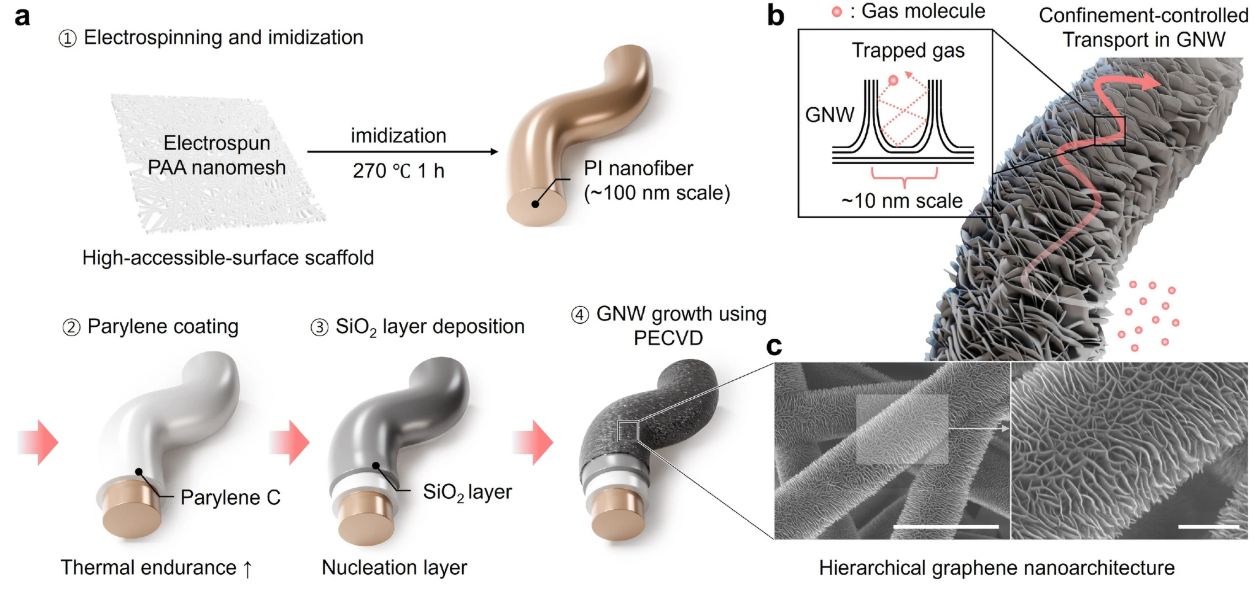
□ To overcome these limitations, the research team developed a technique for directly growing graphene nanowalls on the surface of a three-dimensional nanomesh comprising heat-resistant polymer nanofibers. By using low-temperature plasma chemical vapor deposition (CVD) and heat-resistant nanofibers, the team successfully formed vertically oriented graphene nanowalls along the surfaces of the fibers while preserving the morphology of the nanofibers. This substantially increased the surface area available for interaction with gases while maintaining the breathability and flexibility of the nanomesh.
□ Particularly, the research team identified that the graphene nanowalls not only increase the sensor’s surface area but also create a “confinement effect” that causes gas molecules to remain longer in the narrow spaces between the nanowalls. Experiments and gas transport simulations showed that within the hierarchical graphene nanowalls, the travel paths and local collisions of gas molecules increase, resulting in more active interactions between the graphene surface and gas molecules. The team also applied the developed sensor to an actual wearable mask platform and confirmed that it enables long-term gas monitoring while maintaining high breathability and flexibility.
□ “This study is significant in that it transcends the conventional approach of simply increasing a sensor’s surface area and presents a new design principle for enhancing sensing performance by controlling the movement of gas molecules themselves within nanostructures,” said Professor Sungwon Lee. “The ‘nano-on-nano’ technology, which directly forms functional nanostructures on polymer nanomeshes, could be applied in the future to enhance the performance of not only gas sensors but also various breathable wearable electronic devices.”
□ This study was jointly conducted by Ph.D. student Hyeokjoo Choi from Professor Sungwon Lee’s research team at DGIST and researchers from Chungnam National University, Hanbat National University, Kyungpook National University, the Gumi Electronics & Information Technology Research Institute, and the Korea Institute of Industrial Technology. The findings were published in the international journal Advanced Fiber Materials in August 2026.
Advertisement
Advertisement