
□ A joint research team led by Professor Su-Il In of the Department of Energy Science and Engineering at DGIST (President Kunwoo Lee) and Professor William A. Goddard III of the California Institute of Technology (Caltech) has significantly improved the performance of a sunlight-driven photocatalyst for converting carbon dioxide into methane by integrating two distinct cocatalysts and elucidating the underlying mechanism.
□ Carbon dioxide is one of the principal greenhouse gases driving climate change. Accordingly, research has increasingly shifted from merely reducing CO₂ emissions toward technologies that convert it into valuable resources, including fuels and chemical feedstocks. Among these approaches, photocatalyst technology, which harnesses solar energy to transform CO₂ into useful products, has drawn considerable attention.
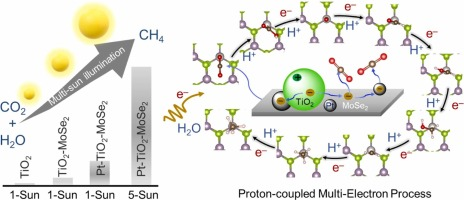
□ The research team synthesized a ternary photocatalyst, designated as “Pt/TiO₂-MoSe₂,” by integrating two-dimensional molybdenum diselenide (MoSe₂) and platinum (Pt) nanoparticles onto the surface of titanium dioxide (TiO₂), a benchmark photocatalyst. The two cocatalysts were designed to perform complementary functions, enabling the efficient transfer of photogenerated electrons to the CO₂ reduction reaction.
□ Because of its layered structure, MoSe₂ is prone to aggregation and deformation, making it difficult to maintain catalytic stability. To overcome this limitation, the researchers precisely engineered the heterojunction interface between TiO₂ and MoSe₂, enabling continuous electron transfer from TiO₂ to MoSe₂, thereby stabilizing the inherently unstable 1T-MoSe₂ structure while enhancing both catalytic activity and durability.
□ In addition, the incorporated platinum nanoparticles rapidly captured photogenerated electrons, thereby accelerating the reduction process. Within this synergistic dual-cocatalyst system, MoSe₂ provides a favorable reaction microenvironment for CO₂ activation, whereas platinum facilitates rapid electron transfer.
□ The newly developed photocatalyst achieved a methane yield of 17.81 μmol/g in a solar-concentrating reactor. This corresponds to an approximately threefold increase over performance under standard illumination and a 65-fold improvement compared with conventional TiO₂ photocatalysts. Through both experimental validation and theoretical calculations, the team confirmed that the increased photon flux from light concentration and efficient charge transfer across the catalyst interfaces are key drivers of the enhanced methane production.
□ Professor Su-Il In stated, “The significance of this study lies in stabilizing the highly active yet unstable metallic 1T-MoSe₂ phase through interface engineering using dual cocatalysts, while also decoding the mechanisms underlying multi-electron reduction reactions. We expect that this technology will contribute significantly to future carbon recycling and utilization platforms capable of converting CO₂ into environmentally friendly fuels and value-added chemical feedstocks using solar energy.”
□ This research was supported by the Nano & Material Technology Development Program of the National Research Foundation of Korea (NRF). The findings were published in Applied Catalysis B: Environment and Energy, an international academic journal published by Elsevier.