

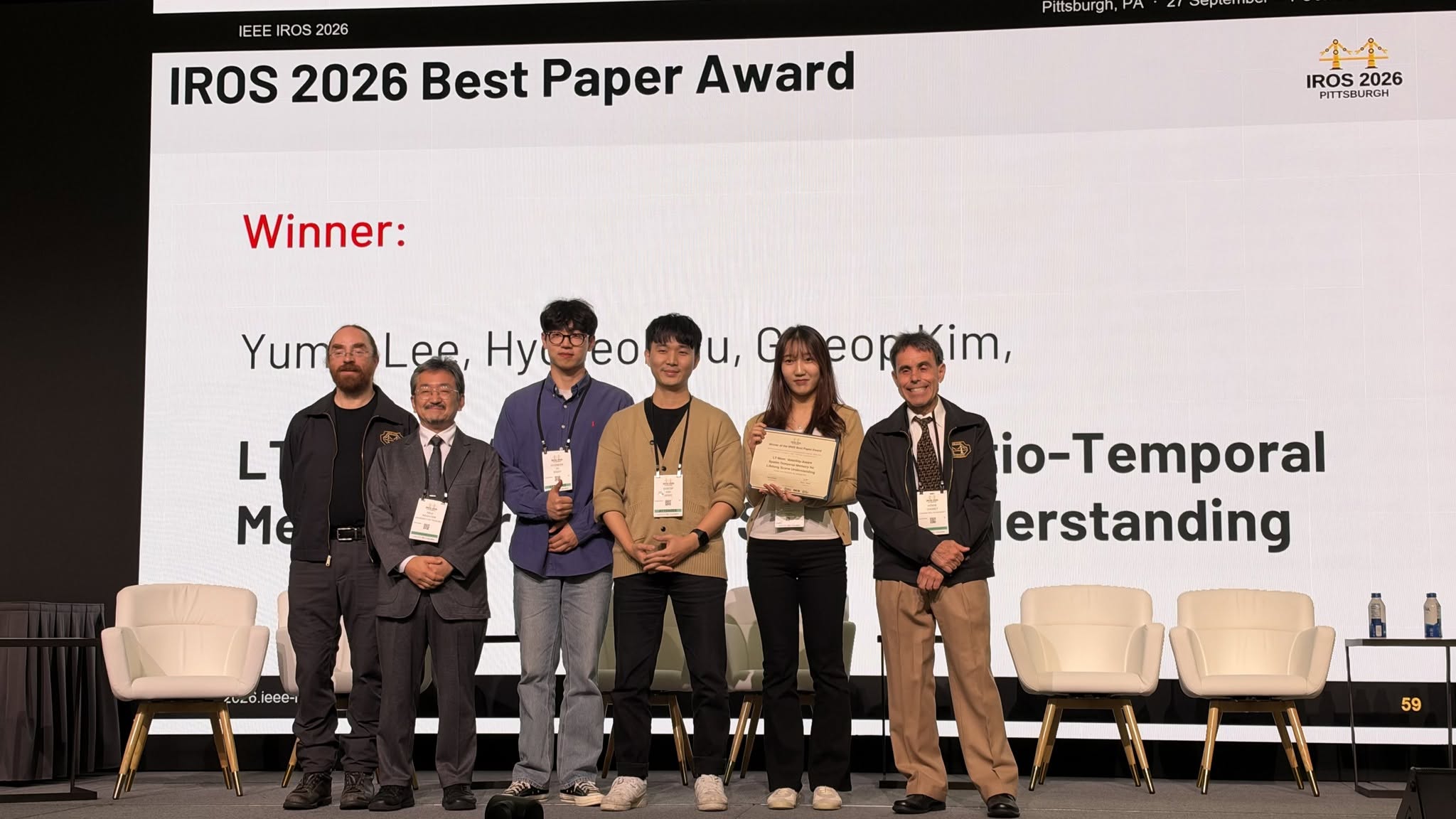
□ A research team led by Professor Giseop Kim of the Department of Robotics and Mechatronics Engineering at DGIST (President Kunwoo Lee) received the Best Paper Award at IEEE/RSJ IROS 2026, one of the world’s most prestigious international conferences in intelligent robotics.
□ IROS is a leading international conference that covers the latest advances across the field of robotics, including autonomous driving, robot perception, and artificial intelligence. Of the 1,933 papers submitted to this year’s conference, a research paper by Professor Kim’s team was selected as the sole recipient of the Best Paper Award, earning global recognition for the originality and excellence of its robot perception and memory technologies for understanding environments that change over extended periods.
□ The limitation of conventional robotics technology is that it either loses past information when updating maps to their latest state or fails to recognize objects observed at different times as the same object. To address this limitation, the research team developed “LT-Mem,” a new long-term memory system for robots that accumulates and remembers the history of changes in object locations as a robot visits the same space multiple times.
□ The system is built on MR.ScaleMaster, a video-based mapping technology developed by the research team. Using only video captured by a robot without separate sensors such as LiDAR, the technology links observations made at different times to consistent three-dimensional spatial coordinates. This enables the robot to distinguish between a chair that is frequently moved and furniture that has remained in the same place for a long time, and to independently answer complex questions such as “Where has this chair been over time?” based on its past memories.
□ In particular, this study dramatically reduced the data-processing burden on artificial intelligence by combining precise spatial perception with systematic memory management. Compared with conventional large language model approaches that require vast amounts of video records to be reinterpreted each time, the system achieved significantly higher reasoning performance while using only about one-sixteenth as much data (tokens). The research team also proposed a new evaluation framework (LT-VQA) for systematically assessing robots’ long-term memory capabilities, laying a solid foundation for relevant research.
□ “This study has opened up the possibility of long-term autonomous systems in which robots go beyond having only a fragmentary perception of the current space and can accumulate and understand changes over time through experience,” said Professor Giseop Kim of DGIST. “We expect this technology to play a key role in advancing robots that need to operate for extended periods in complex environments, such as household service robots and logistics and facility management robots.”
□ Meanwhile, this research was supported by the Outstanding Young Researcher Program and Basic Research Project of the Ministry of Science and ICT and the National Research Foundation of Korea, as well as the AI Star Fellowship Program of the Institute of Information & Communications Technology Planning & Evaluation (IITP). Professor Giseop Kim served as the corresponding author, with master’s student Yumin Lee as the first author and integrated M.S.-Ph.D. student HyoSeok Ju as a co-author.