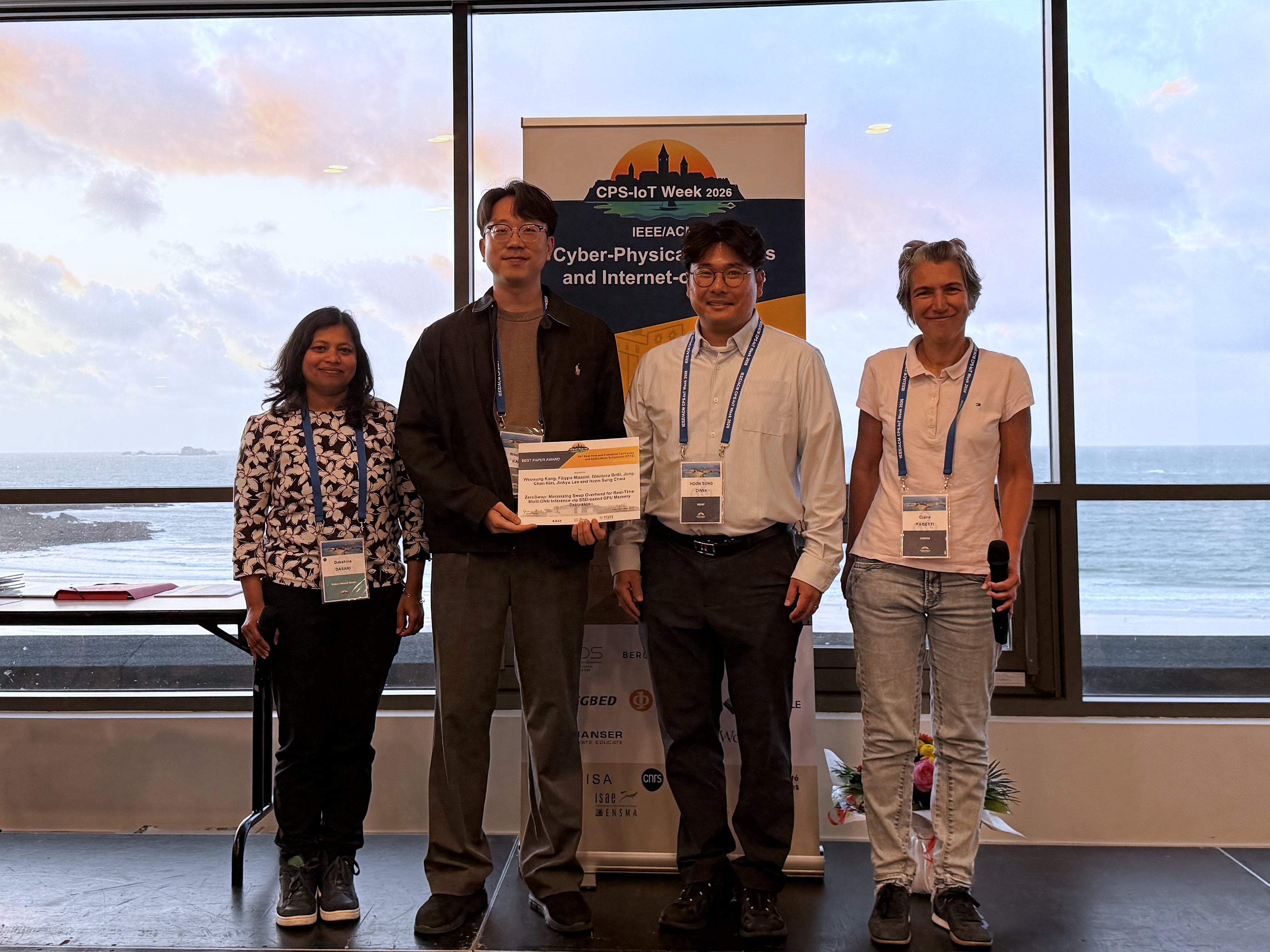
□ A research team led by Prof. Hoon Sung Chwa of the Department of Electrical Engineering and Computer Science at DGIST (President Kunwoo Lee) received the Best Paper Award at IEEE RTAS 2026,[1] the world’s leading international conference on real-time systems. In particular, Prof. Chwa is the first researcher in the conference’s 32-year history to win the Best Paper Award for two consecutive years, demonstrating Korea’s exceptional research competitiveness on the global stage.
□ RTAS, organized by the Institute of Electrical and Electronics Engineers (IEEE), is one of the world’s two leading conferences covering core technologies for systems that require both high safety and instantaneous responsiveness (real-time performance), such as autonomous vehicles, industrial robots, and aerospace control systems. At RTAS 2026, held in France, the paper by Prof. Chwa’s research team was honored as the sole recipient of the Best Paper Award among the 108 papers submitted worldwide.
□ The award-winning paper proposes “ZeroSwap,” a novel technology designed to address the GPU memory constraint issue, a critical limitation of small, low-power devices (embedded AI systems) operating in real-world environments, such as autonomous vehicles, intelligent robots, and smart cameras. The latest AI systems must simultaneously run multiple AI models to perform complex functions, including object recognition, trajectory prediction, and situational assessment.
□ However, compared with large-scale servers, these compact devices suffer from severe limitations in memory capacity and computing resources, making computational delays inevitable when multiple models are executed simultaneously. In systems such as autonomous driving or robotic control systems, where split-second real-time decision-making is essential, such delays represent a critical issue that can directly lead to catastrophic safety accidents.
□ To address this challenge, the research team developed a technology that utilizes solid-state drives (SSDs) as an extension of the graphics processing unit (GPU) memory. While transferring data to and from storage devices typically causes significant lags, ZeroSwap reduces this latency to virtually zero. Even under extreme conditions in which memory demand exceeded the available physical memory capacity, the technology effectively suppressed the increase in latency to an average of just 3.6% and demonstrated an innovative achievement by reducing AI task response time by up to 3.2 times.
□ “The significance of this research lies not simply in increasing device memory capacity, but in demonstrating that complex multi-model AI functions can be executed reliably and without latency even in resource-constrained embedded environments,” stated Prof. Hoon Sung Chwa of the Department of Electrical Engineering and Computer Science at DGIST. “We shall continue to advance this technology as a core foundational technology for embedded AI industries where real-time performance and safety are essential, including autonomous driving, smart manufacturing, and intelligent robotics.”
□ This research was conducted with support from the National Research Foundation of Korea (NRF), the Institute for Information and Communications Technology Planning and Evaluation (IITP), and the AI Star Fellowship Program. Dr. Woosung Kang, a Postdoctoral Researcher at DGIST, served as the first author. The impact of the achievement was further heightened through collaboration among researchers from Korea and abroad, including Prof. Filippo Muzzini and Dr. Gianluca Brilli of the University of Modena and Reggio Emilia, Italy; Prof. Jong-Chan Kim of Kookmin University; and Prof. Jinkyu Lee of Yonsei University.
[1] IEEE RTAS 2026: May 12–14, 2026