
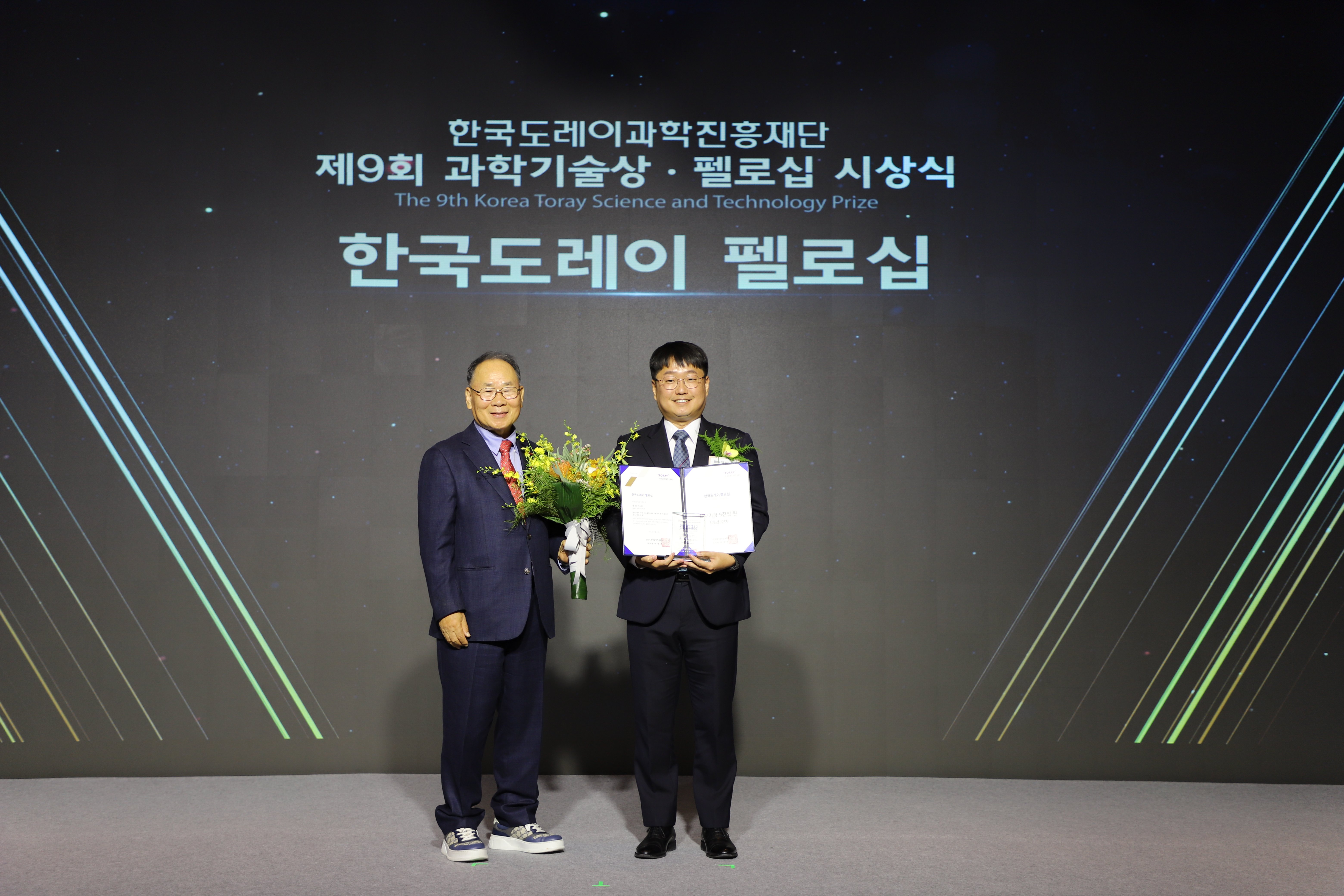
□ DGIST (President Kunwoo Lee) announced that Professor Intek Song of the Department of Physics and Chemistry has been named one of the fellowship’s emerging scientists in the Basic Research category of chemistry and materials for the 9th Korea Toray Fellowship, organized by the Korea Toray Science Foundation. The award ceremony was held on October 21 at the Seoul Garden Hotel in Mapo-gu, Seoul.
□ The Korea Toray Fellowship is a prestigious program that identifies and provides extensive support to outstanding emerging scientists undertaking creative research projects with high potential for advancement in the fields of chemistry and materials. With his selection, Professor Intek Song will receive KRW 50 million annually for the next three years, totaling KRW 150 million in research funding, enabling him to devote himself further to innovative basic scientific research.
□ Professor Intek Song was selected for a basic research project under this fellowship with the topic “Elucidating Proton-Electron Coupled Transport in Metal-Tunable Hydrogen-Bonded Coordination Polymers.” So-called “mixed protonic-electronic conductors,” in which proton and electron transport are coupled, enable new physical and chemical behaviors that are difficult to achieve with conventional electronic or protonic conductors alone. As a result, they are attracting attention as advanced new materials expected to drive the next-generation information electronics industry.
□ Professor Song will conduct in-depth research to systematically control the design and composition of “hydrogen-bonded coordination polymers (HBCPs)”: porous materials in which organic compounds and metal ions are regularly interconnected. Through this research, he aims to precisely analyze the complex interactions that occur as electrons and protons move within the material and, ultimately, establish the fundamental principles for actively controlling proton–electron coupling (PEC), which is the central objective of the project.
□ This research is expected to have a significant impact on future industrial technologies beyond simply advancing basic academic knowledge. Once the properties of mixed proton–electron conduction are clearly elucidated, the findings could be widely applied as core foundational technologies for various advanced devices, including “biomimetic electronic devices” that mimic the operating principles of human nerves or the brain to perform advanced computations with low energy consumption, as well as high-performance energy conversion materials.
□ “It is particularly meaningful to have the direction and potential value of our research on hydrogen-bonded coordination polymers, which we have been diligently pursuing in our laboratory, recognized once again through my selection for this fellowship,” said Professor Intek Song of DGIST’s Department of Physics and Chemistry. “I will do my utmost to clearly elucidate the mechanisms behind the novel conduction phenomena arising from the interaction of protons and electrons within a single material and secure innovative foundational technologies that can lead to practical industrial applications.”
□ Meanwhile, DGIST continues to provide multifaceted support to enable its emerging researchers to devote themselves to creative and challenging basic scientific research. The institute plans to continue producing outstanding research achievements that address fundamental challenges in science and technology and contribute to the nation’s future industrial competitiveness.