


Researchers use a novel approach to simultaneously induce and observe atomic rearrangements in real time, discovering a rare form of silver with unusual properties.
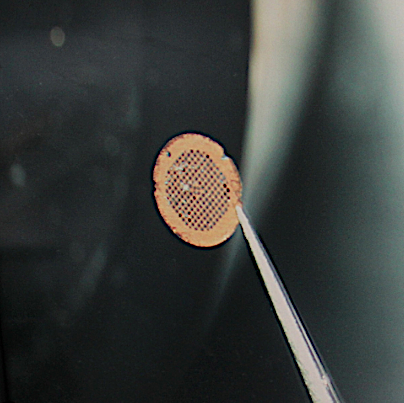
Silver nanoparticles produced from the decomposition of silver iodide using an electron microscopy grid.
Megha Kalra
How atoms are arranged in a material shapes many of its properties. The same carbon atoms, for example, can form diamond and graphite depending on how they are arranged, giving rise to materials with vastly different chemical and physical properties. Now, researchers at Hokkaido University have discovered a new crystal structure of silver with unusually high chemical reactivity. The findings, published in Nano Letters, could open new avenues for exploring materials with desirable properties.
Silver normally forms a repeating cube-shaped structure, with atoms located at each of the cube’s eight corners and at the center of each face. This arrangement is known as a face-centered cubic crystal structure and is common among metals, including aluminum, copper, and gold. In the new study, researchers observed that under certain conditions, silver atoms can adopt a simple cubic structure, in which the atoms occupy only the eight corners of a cube that repeats in three dimensions.
Simple cubic structures are exceptionally rare among elements. The only other example is of the radioactive element polonium found in 1966. In this study, researchers used an electron beam to trigger the decomposition of silver iodide, observing the newly formed silver atoms arrange themselves into a previously unreported simple cubic structure.
At the nanoscale, where materials measure just a few billionths of a meter, structures that are unstable in larger materials can sometimes emerge temporarily. Studying these structures gives researchers an opportunity to discover materials with unique properties that are not found in their conventional forms.
Under high-vacuum conditions, the new simple cubic silver behaved differently from ordinary silver. While conventional face-centered cubic silver remained stable, simple cubic silver gradually oxidized to form silver oxide. This indicated unusually high chemical reactivity in the new structure.
“It was surprising to find that such a low-density structure could form in a pure metal crystal,” says first author Dr. Masaya Sakakibara. “We expected silver nanoparticles to form when silver iodide decomposes under electron beam irradiation, but we didn’t expect them to adopt a simple cubic structure.”
The team used a transmission electron microscope (TEM) both to trigger the chemical transformation of silver iodide and to observe the process at the atomic scale. A TEM uses a beam of electrons with wavelengths shorter than visible light, allowing it to reveal individual atoms. By combining the ability to induce chemical change with real-time atomic-scale imaging, the researchers could directly observe how the new silver crystal structure emerged. “Within 100 seconds of its formation, it began to transform into silver oxide,” adds Sakakibara.
“This is a new approach to discovering previously unknown crystal structures, which could also help us develop materials with novel properties in the future,” says Professor Yuki Kimura, co-author of the study and head of the Low Temperature Nanomaterial Science Laboratory at Hokkaido University. “Going forward, we will continue investigating the physical and chemical properties of simple cubic silver in greater detail and extend this approach to other elements and compounds.”
Advertisement