

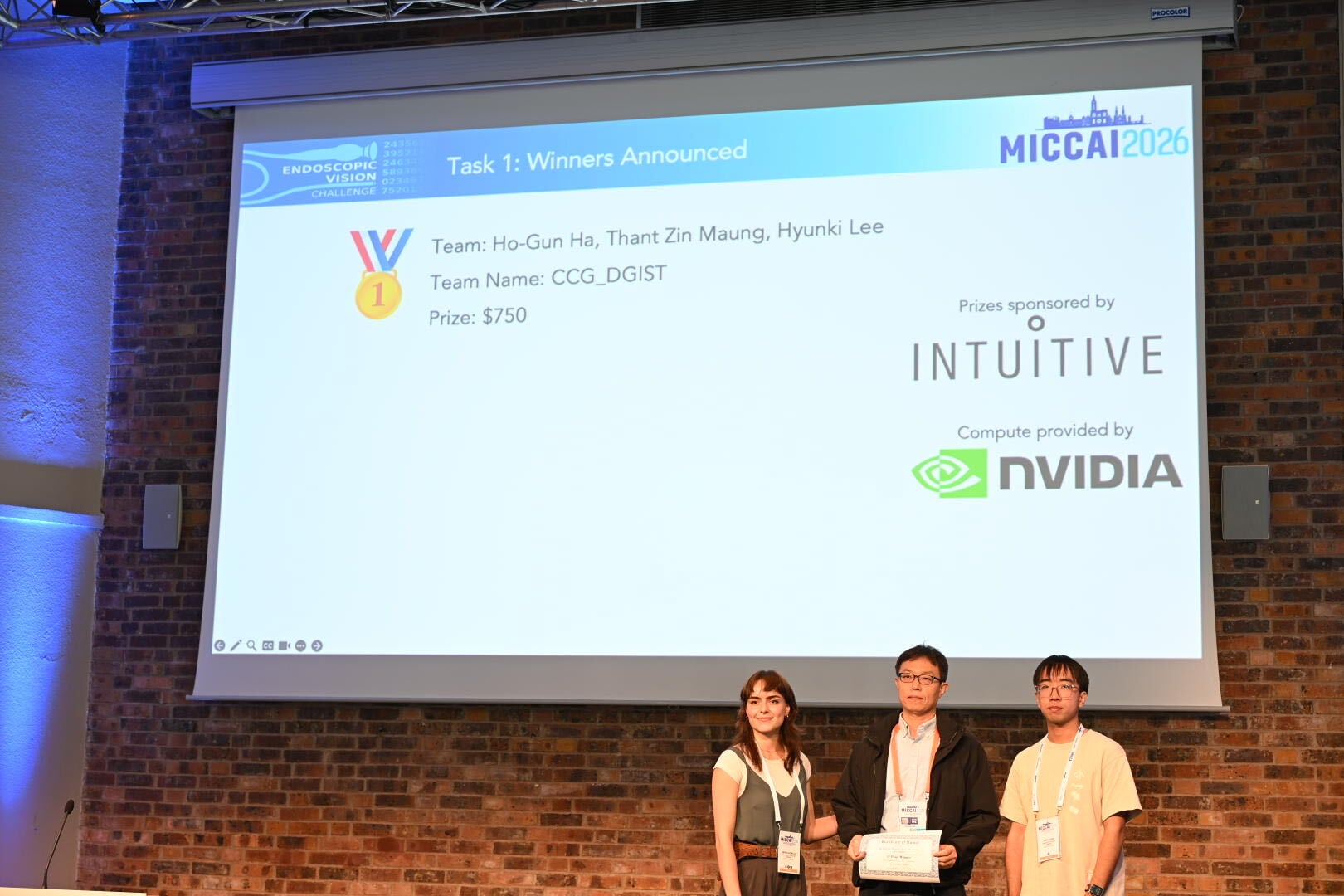
□ A research team led by Principal Researcher Hyunki Lee of the Division of Intelligent Robot at DGIST (President Kunwoo Lee) (concurrently serving as Head of the AX Research Group for Robotics), comprising researcher Hogun Ha and undergraduate student Thant Zin Maung, secured first place in the EndoVis Challenge, a side event of MICCAI 2026 (International Conference on Medical Image Computing and Computer-Assisted Intervention)[1], one of the world's most prestigious academic conferences on medical image processing.
□ This achievement demonstrates the excellence of AI-based endoscopic medical image processing technology on the global stage. After securing second place in 2024 and first place in 2025, the research team again won first place in the “iMED Challenge 3D Camera Pose Estimation” category this year, setting a remarkable record of winning awards for three consecutive years. This achievement once again demonstrated that DGIST’s endoscopic vision AI technology is truly world-class.
□ Co-sponsored by Intuitive and NVIDIA, this year’s challenge evaluated core technologies for robot-assisted minimally invasive surgery. Participants competed to determine how accurately they could estimate, frame by frame, the relative poses of two cameras using video footage captured by two independent endoscopes, in order to implement real-time surgical navigation systems and autonomous robotic control.
□ Endoscopic video footage captured in actual surgical environments is subject to numerous unpredictable challenges, including a narrow field of view, deformation of organs (soft tissues) caused by patient breathing or manipulation of surgical instruments, strong reflections from surgical lighting, smoke, and bleeding. Consequently, accurately estimating 3D camera poses is considered a critical technical challenge in computer vision.
□ To overcome this challenge, the research team developed a proprietary AI framework that combines an existing "visual localization-based deep learning model" with Dense Matcher technology, which precisely matches fine feature points in images. This technology dramatically reduced the analysis errors caused by deformation of organ surfaces or light reflections when applying an existing AI model (ViT) to endoscopic video footage, delivering accurate camera pose estimation performance even in the presence of complex variables during surgery.
□ “We will accelerate research toward the practical application of the technology developed in this study through close clinical collaboration with regional hub hospitals, so that it can be used in actual robotic surgery settings and patient treatment,” said Principal Researcher Hyunki Lee of DGIST. “We will continue to advance our research to help DGIST become a global hub for medical image processing and artificial intelligence research.”
[1] Event dates and location: September 27–October 1, 2026, France