
This study demonstrated a new strategy for engineering the surface and functional properties of 2D SrTiO₃ perovskite nanoplatelets through the hydrothermal transformation of Aurivillius phase Bi₄Ti₃O₁₂ nanoplatelets. We successfully synthesised both heterostructural SrTiO₃/Bi₄Ti₃O₁₂ photocatalyst which exhibited significantly higher H2 evolution rate than those of traditional heterojunction photocatalysts.
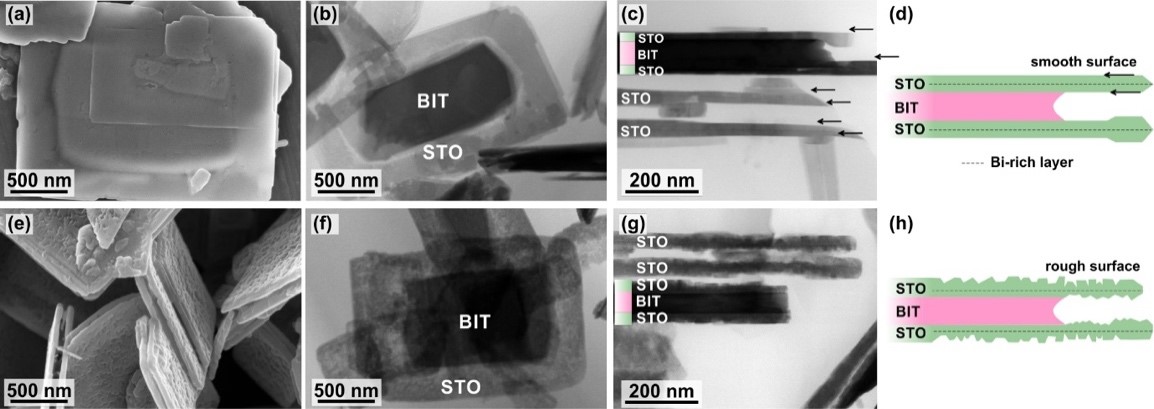
SEM and STEM micrographs of the representative SrTiO3/Bi4Ti3O12 platelets. STO: SrTiO₃; BIT: Bi₄Ti₃O₁₂
Chemical Engineering Journal
Over the past 20 years, green hydrogen produced using sunlight has gained considerable attention as a promising pathway towards a low-carbon future. Among the various solar-driven methods for H2 production, the photocatalytic process stands out for its simplicity, low cost, and suitability for scaling up.
Forming 2D/2D chemically bonded epitaxial heterostructures, which combine two semiconductors with suitable band-edge positions to enable a direct Z scheme charge transfer, is one strategy that simultaneously tackles several photocatalytic challenges. The hydrothermal topochemical process was performed from precursors, Bi4Ti3O12 platelets and SrCl2×6H2O, in an autoclave.
Published in Chemical Engineering Journal, this study sheds light on the steering of the Bi₄Ti₃O₁₂-to-SrTiO₃ hydrothermal transformation to precisely control the surface roughness and photocatalytic properties of the 2D/2D epitaxial heterostructural SrTiO₃/Bi₄Ti₃O₁₂ nanoplatelets.
The main benefits include a lower recombination rate, faster interfacial charge transfer, quicker charge transfer to the surface, and maintained high redox ability. The significantly improved photocatalytic activity of the rough, high-surface-area nanoplatelets is undoubtedly attributed to the presence of more active sites.
The enhanced H₂ evolution is attributed rougher platelets and achieved substantially higher rates of H2 generation up to 2950 ×g-1×h-1. A large specific surface area with more active sites plays a significantly more important role in activity than heterojunction formation alone.
“The outcome of the present study highlights the importance of understanding and mastering the synthesis process in detail for preparing any nanostructural functional material. The formation of 2D/2D heterostructural nanoplatelets demonstrated the feasibility of developing 2D nanoplatelets increased quantum efficiency and achieved new benchmarks in photocatalytic water-splitting,” says co-corresponding author Jeffrey C.S. Wu, distinguished professor of chemical engineering at National Taiwan University.
Prof. Jeffrey C.S. Wu's email address: [email protected]
Advertisement