
Roadside ultrafine particle emissions create narrow, high-pollution zones and age-specific cancer risks. Mapping these hotspots highlights the need for targeted barriers and urban designs to protect vulnerable populations.
People living, walking or studying near busy roads may experience very different pollution exposures even within the same neighborhood. A new study from National Taiwan University shows that tiny traffic particles can form localized “hotspots” around street canyons, intersections, elevated expressways and freeway interchanges, meaning that one fixed air-quality station may overlook the places where exposure is highest. The study is published in Journal of Hazardous Materials.
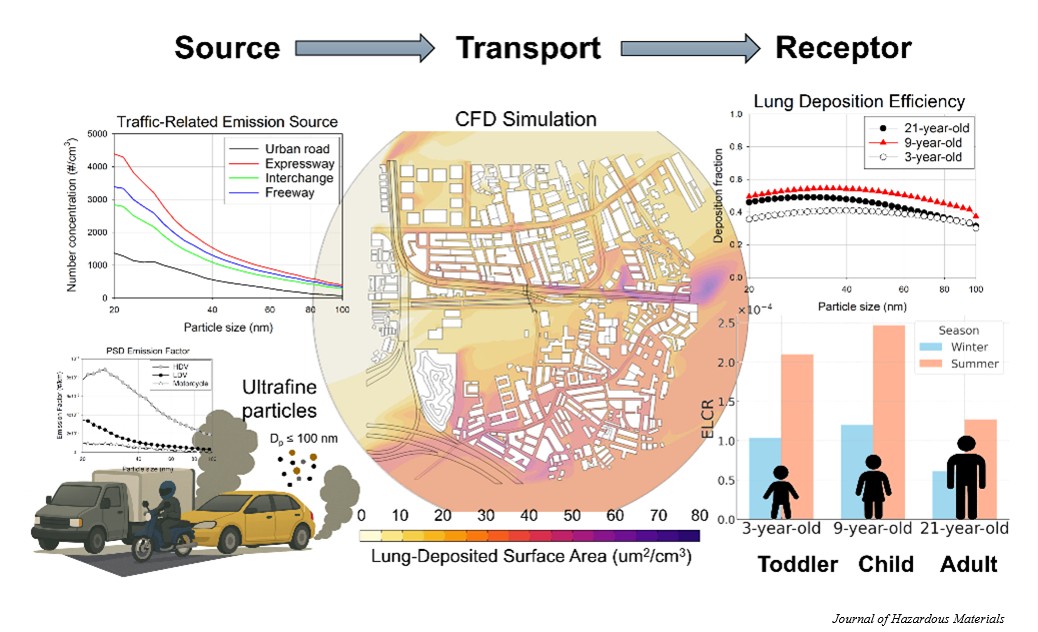
The research team focused on a dense 1.2 km by 1.2 km area in Zhonghe District, New Taipei City. Instead of treating the area as one average grid, they built a detailed computer model that included buildings, roads, elevated corridors, seasonal wind directions and different traffic periods. The model tracked traffic-related particles smaller than 100 nanometers, which are far smaller than a human hair and can reach deep into the lungs.
The results show that ground-level roads produced narrow but intense exposure bands close to sidewalks and curbside areas. Elevated expressways and interchanges behaved differently: their emissions were more diluted near the ground, but winds and building wakes could carry them farther and bring them down into residential or pedestrian spaces. During peak traffic, the average modeled lung exposure was higher in summer than in winter, and the highest estimated potential risk appeared near busy road segments and intersections.
The study also found that children can be more vulnerable than adults under the same outdoor conditions because their breathing rate and body weight lead to a higher dose per kilogram of body mass. Nine-year-old children showed the highest estimated potential lifetime cancer risk in the simulations. The authors emphasize that these estimates are indicators for comparing locations and scenarios, not direct predictions of cancer cases.
“Our study shows that health risks from traffic pollution are not evenly spread across a city. They can change from one street corner to another, so targeted action near roads, intersections and elevated corridors is essential,” says corresponding author Dr. Ta-Chih Hsiao, professor of environmental engineering at National Taiwan University.
Prof. Ta-Chih Hsiao's email address: [email protected]
The lab of Prof. Hsiao linked to Aerosol LAB