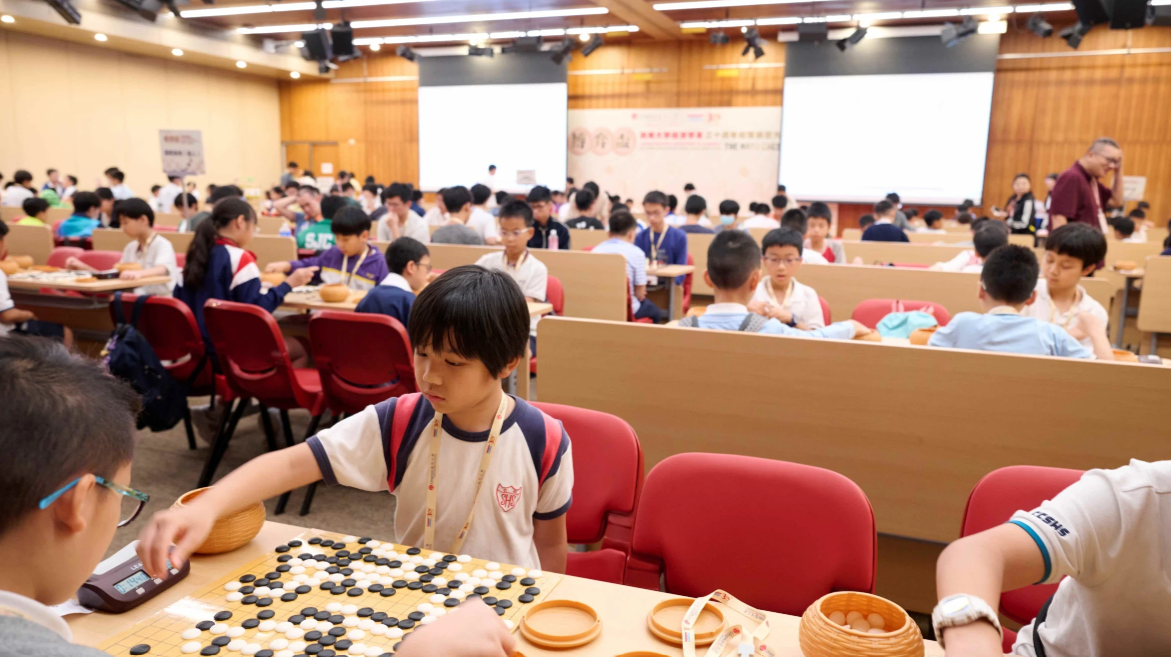
The Nash Chess Cup, organised by the Department of Economics at Lingnan University, attracts over 300 talented young players from more than 70 primary and secondary schools in the Hong Kong SAR.
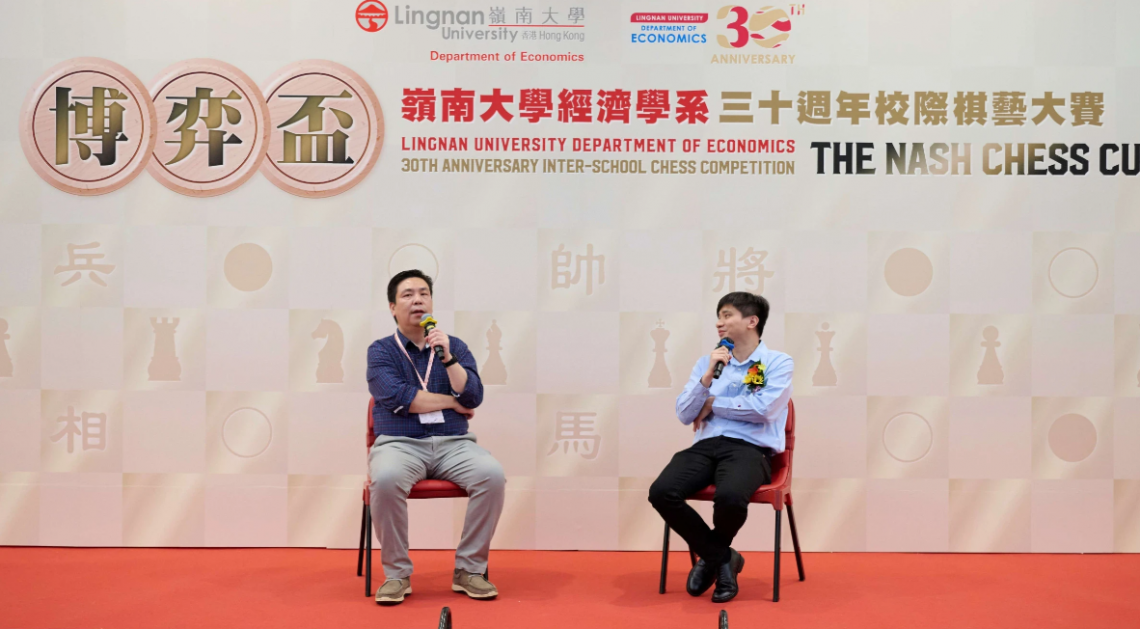
The organisers hold a special guest dialogue session entitled "Game Theory and Games", featuring Mr Wong Hok-him (right), Chinese chess International Grandmaster and a member of the bronze medal-winning Hong Kong, China team at the Hangzhou 2022 Asian Games, and Prof Gary Wong Wai-chung (left), Assistant Professor of Teaching of the Department of Economics at Lingnan University, who shared their insights with students.
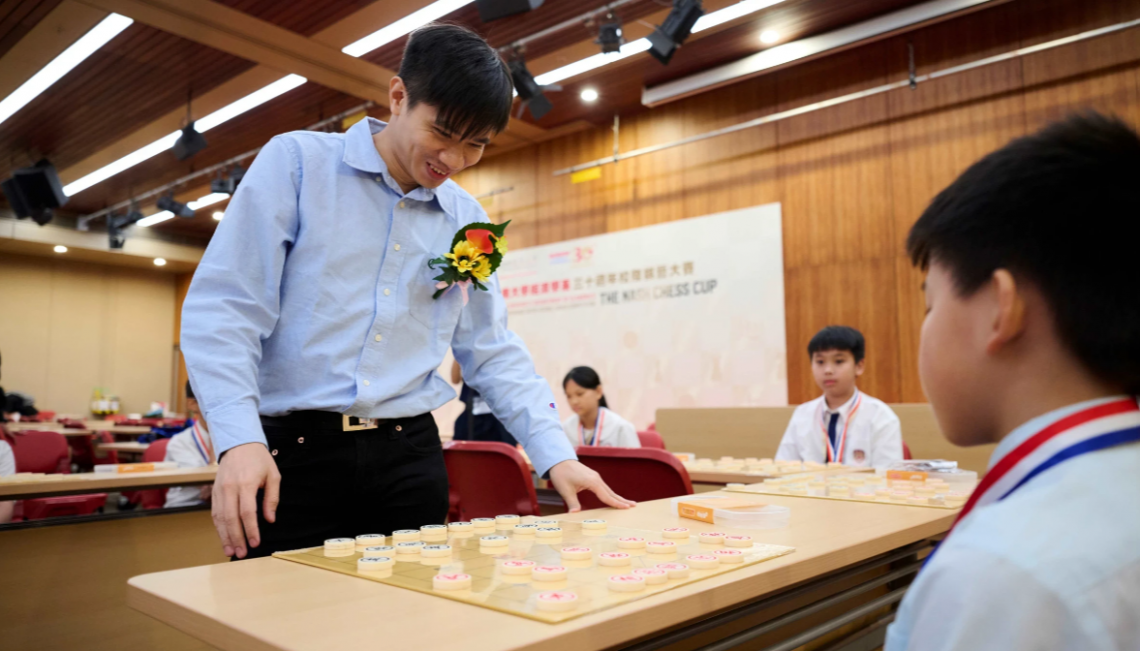
Mr Wong Hok-him plays exhibition matches with Lingnan University staff and students, coaching young players and members of the University.
The three categories of board games featured in The Nash Chess Cup were chess, Chinese chess (Xiangqi) and Go across lower primary, upper primary, and secondary school categories, as well as individual and team competitions for tertiary students. More than 300 young players competed at the same venue, putting their thinking and strategic skills to the test across the boards, and demonstrating their intense concentration and good sportsmanship.
Chinese chess International Grandmaster Wong Hok-him discusses game theory and the games of life
As well as the competitions, to inspire attendees, the organisers arranged a special guest dialogue session entitled "Game Theory and Games", featuring Mr Wong Hok-him, Chinese chess International Grandmaster and a member of the bronze medal-winning Hong Kong, China team at the Hangzhou 2022 Asian Games, and Prof Gary Wong Wai-chung, Assistant Professor of Teaching of the Department of Economics at Lingnan University, who shared their insights with students.
Prof Gary Wong Wai-chung explained that in the Chinese language, the original meaning of "game theory" refers to playing chess against an opponent and engaging in contests of intelligence. In modern economics, "Game Theory" is similarly translated into Chinese. At first glance, economics may appear to be inseparable from markets, supply curves, and financial data, while board games may seem to be nothing more than competitions played on a small board. However, the two share profound similarities at their core. Essentially, both are about making rational decisions in an environment full of uncertainty while anticipating and adapting to the choices of others. Game theory in economics studies rational strategies in interactive decision-making, and chess provides the most direct and vivid illustration of game theory.
Game theory in economics studies how to make the best choices under conditions of uncertainty. Is this principle also reflected in board games? Mr Wong offered his distinctive insights based on practical experience, pointing out that although the public generally believes that chess involves countless variations and is full of unknowns, the reality is quite different, "In top-level competitions, there is actually very little uncertainty, because both players are exceptionally good at calculating and can predict their opponent's next moves accurately."
If both players can anticipate their opponent's moves, what ultimately determines the outcome of a game? Mr Wong concluded that “the ultimate deciding factor is the players' psychological state.” When both players are evenly matched in terms of technical and calculation skills, their ability to remain calm and not hesitate under immense pressure often becomes the decisive factor determining victory or defeat, highlighting a fundamental difference between AI and humans: emotional stability is an absolute strength of AI, but it is often a physiological and psychological weakness of humans when they are under extreme pressure.
The impact of the AI wave on the chess world and how to harness it
In response to the impact that AI has had on the chess world in recent years, Mr Wong offered two key insights: "Even if someone who knows absolutely nothing about chess is given the most powerful AI in the world, they will still be unable to make use of it." Accumulating knowledge and understanding the fundamentals have always been prerequisites for making effective use of tools. "The key to using AI to improve one's chess skills is to understand the reasoning behind the way AI plays chess, rather than simply memorising the moves it teaches you."
Prof Wong agreed strongly, and added that although nowadays many students also use AI for research and assignments, educators can still easily distinguish between their different abilities, and the key lies in the "depth and breadth" of students’ thinking, which enables them to assess the quality of the work: "AI is responsible for answering questions, while outstanding students know how to ask the right questions."
Passion that AI cannot calculate and the value of being human
During the personal sharing session, Mr Wong looked back on a major decision he had faced: whether to take an ordinary job with a stable income or embark on the highly risky path of becoming a professional chess player.
He remarked jokingly that if he had consulted AI back then, after weighing the return on investment of becoming a professional chess player against the risk of failure and the enormous effort required, AI would probably have advised him to choose a stable job rather than a career in chess.
Prof Wong then explained that this illustrates the fundamental difference between humans and AI perfectly, and is also at the heart of human value. AI can only perform cold, rational calculations based on data and probabilities, whereas humans have passion, courage, and determination. Every choice in life is a game in itself. When facing challenges and the unknown, it is precisely the spirit of daring to step outside one's comfort zone and put one's intentions into action that enables people to achieve things that data cannot predict.
Mr Wong also took part in chess exhibition matches with Lingnan University staff and students, and coached young players and members of the University.
The Department of Economics at Lingnan University said that by organising The Nash Chess Cup to mark its 30th anniversary, it hopes to provide students throughout the Hong Kong SAR with a high-level platform for intellectual exchanges. The competition showed young people’s outstanding talents in board games, and combined the excitement of strategic thinking in economics and intellectual sports. The competition also aims to inspire the younger generation to pursue their dreams with courage as they face the games and challenges of life.