
Dr Tong Hao, Postdoctoral Fellow of the Division of Artificial Intelligence of the School of Data Science at Lingnan University, is the sole global recipient of the 2026 IEEE Computational Intelligence Society Outstanding PhD Dissertation Award.
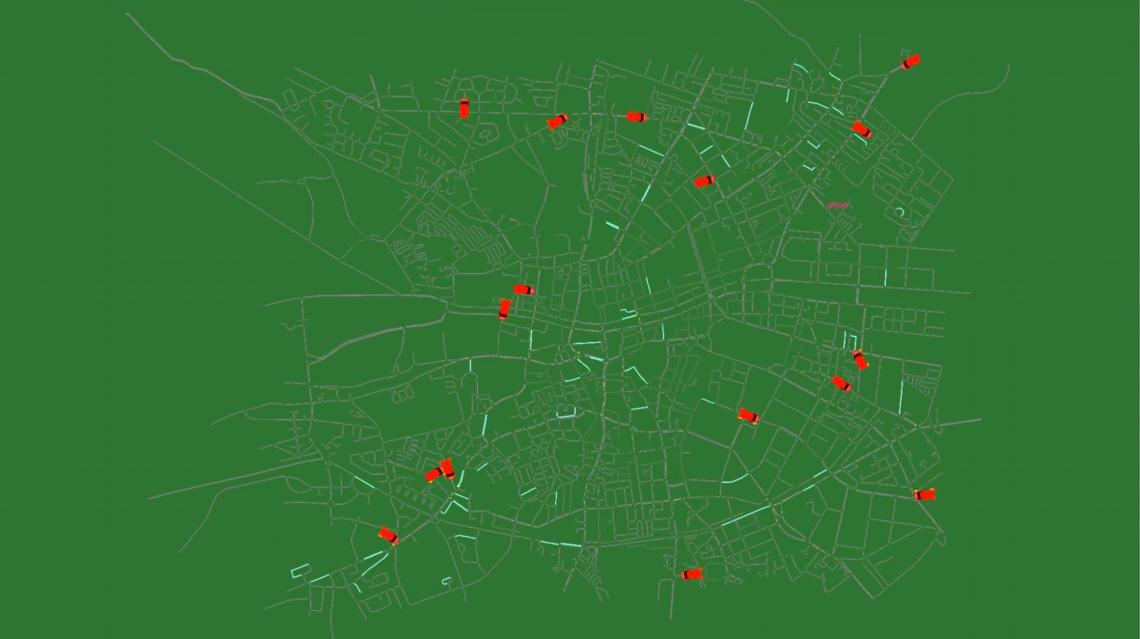
To address the limitations of traditional fleet routing models in handling unexpected incidents, Dr Tong has proposed a novel framework of the Dynamic Capacitated Arc Routing System. Leveraging the state-of-the-art optimisation algorithms he has developed, the system re-plans routes in real time under dynamic traffic and task conditions, generating intelligent adjustment strategies within tens of seconds to significantly increase fleet productivity.
The research team validated the system with real road environments and live traffic data, and results show that it maintains robust performance in multiple scenarios, including busy city centres and suburban areas, and peak and off-peak hours, as well as adding unexpected tasks, achieving notable reductions in overall service time. Moreover, it effectively balances workloads among fleet members, minimising excessive delays caused by traffic congestion or surges, and avoids route adjustments increasing staff workload.
Dr Tong explained that the experimental results demonstrate a strong potential for real-world application. Beyond logistics and delivery, the system may be extended to a wide range of smart city services, such as waste collection, bike-sharing, infrastructure inspection, and emergency response. Future developments may integrate real-time traffic sensors, artificial intelligence (AI), and big data analytics to further advance intelligent urban systems worldwide.
“Both garbage trucks and delivery drivers often rely on predetermined routes, which may be severely disrupted by accidents or unexpected events. Our system is designed to ensure both reliability and efficiency. By applying advanced optimisation algorithms, it helps fleets avoid unnecessary detours and improves route precision. The findings also show potential for reducing fuel consumption and carbon emissions, contributing to global agendas in smart cities and carbon neutrality and advancing sustainable development.”
He added that the system is especially promising for densely populated cities such as Hong Kong, where road capacity is limited and efficient transportation vital. Future research will focus on improving system stability under high task inflows, and simplifying the user interface to make it more accessible for operators and practitioners.