

Chemical structures, electrostatic potentials and molecular dipoles of CbzNaph, JJ24 and the proposed cross-linked target product. The resulting –NH groups are positioned near the electron-rich 7H-dibenzo[c,g]carbazole skeleton, which enables the cross-linked target molecules to have significantly improved molecular dipoles to regulate the work function of substrate more effectively. B. The proposed cross-linking mechanism between CbzNaph and JJ24. C. The DFT calculation for the reaction path and Gibbs free energy between CbzNaph and JJ24. D. The PiFM images are acquired at 2,100 cm−1 for the substrates coated with CbzNaph and JJ24 before and after thermal annealing at 160 ℃ for 15 min. Scale bars, 1 μm.
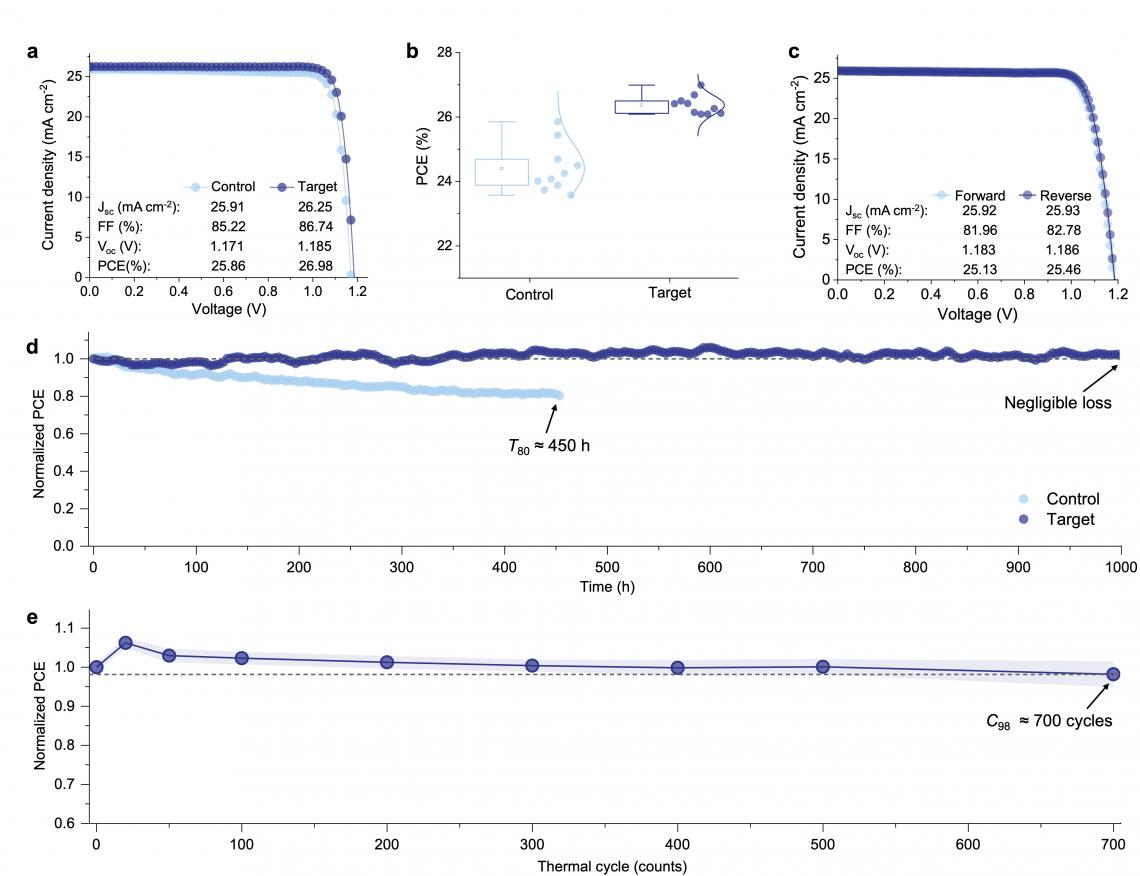
Current density-voltage (J–V) characteristics of the control and target champion PSC. B. Box plots of the PCE of the control and target PSCs (10 devices). C. J–V curves of the champion 1 cm2 PSC based on cross-linked SAM-HSL. D. Long-term operational stability of the encapsulated PSCs at MPP tracking under continuous 1-sun equivalent illumination at 85 ℃ in ambient air with a relative humidity of 70-80 per cent, complied with the ISOS-L-2 protocol. The initial efficiencies of the control and target PSCs are 23.69 per cent and 24.54 per cent, respectively. E. Efficiency tracking of encapsulated target cells subjected to repetitive thermal cycling between −40 ℃ and 85 ℃. The initial efficiency of the encapsulated PSC is 24.58 per cent.

Recently, Prof Wu Shengfan, Assistant Professor at the School of Interdisciplinary Studies at Lingnan University, worked with teams from the City University of Hong Kong, the Shenzhen Institute of Advanced Technology of the Chinese Academy of Sciences, and Jilin University to develop a "self-assembled monolayers (SAMs) stabilisation strategy" to significantly improve the high-temperature operational stability of efficient PSCs, thereby upgrading the commercial viability of perovskite-based photovoltaics. Prof Wu is a co-corresponding author of this study, which was published in Nature, the first time that the Lingnan School of Interdisciplinary Studies has published an article in Nature as co-corresponding author.
The joint research team designed a crosslinkable SAM molecule (named JJ24) and assembled it with a hole-selective SAM molecule (named CbzNaph). After annealing at 160°C, JJ24 forms stable covalent bonds with the alkyl chains of neighbouring CbzNaph molecules, which brings three key benefits: first, it greatly enhances the conformational stability of SAM molecules, suppressing perovskite degradation induced by substrate exposure; second, it improves the orientation and dipole moment of SAM molecules, and down-shifts the work function of the substrate, increasing charge extraction and reducing energy losses; third, it helps solute dispersion in SAM precursor solution and improves the SAM compactness on substrates to add to the reproducibility and scalability of the devices.
Based on this novel strategy, the inverted PSCs achieved a power conversion efficiency (PCE) of 26.98 per cent, with a third-party certified efficiency of 26.82 per cent. Under the stringent stability testing standards set by the International Electrotechnical Commission (IEC) (i.e. ISOS-L-2 protocol), the cells maintained their efficiency without degradation after 1,000 hours of continuous operation, and retained over 98 per cent of their initial efficiency after 700 thermal cycling tests between -40°C and 85°C.
"The breakthrough lies in simultaneously achieving nearly 27 per cent energy conversion efficiency and long-term continuous operation without efficiency degradation under 85°C high-temperature conditions," explained Prof Wu. “Furthermore, our experimental results show that this strategy is applicable to various mainstream SAM molecules, demonstrating good universality and excellent scalability in enlarging solar cell areas. This should allow the practical deployment and application of large-area perovskite solar modules within the next 3-5 years.”
The research findings were published in Nature on 17 September, titled "Toughened self-assembled monolayers for durable perovskite solar cells". This scientific work represents the first breakthrough for the School of Interdisciplinary Studies and Lingnan University in a top international academic journal. It shows the School's and University's research capabilities in renewable energy technologies, and lays an important foundation for the industrialisation and large-scale application of next-generation PV technology.