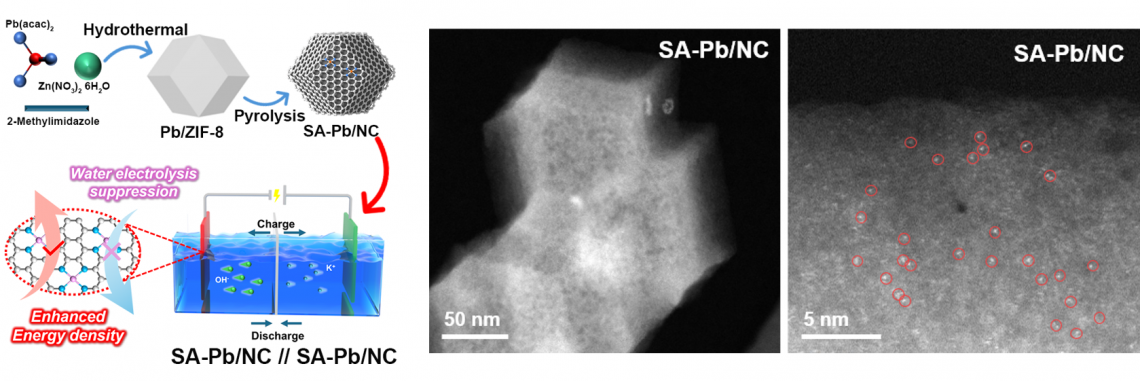
▲ Design concept and single-atom atomic structure of the SA-Pb/NC electrode.
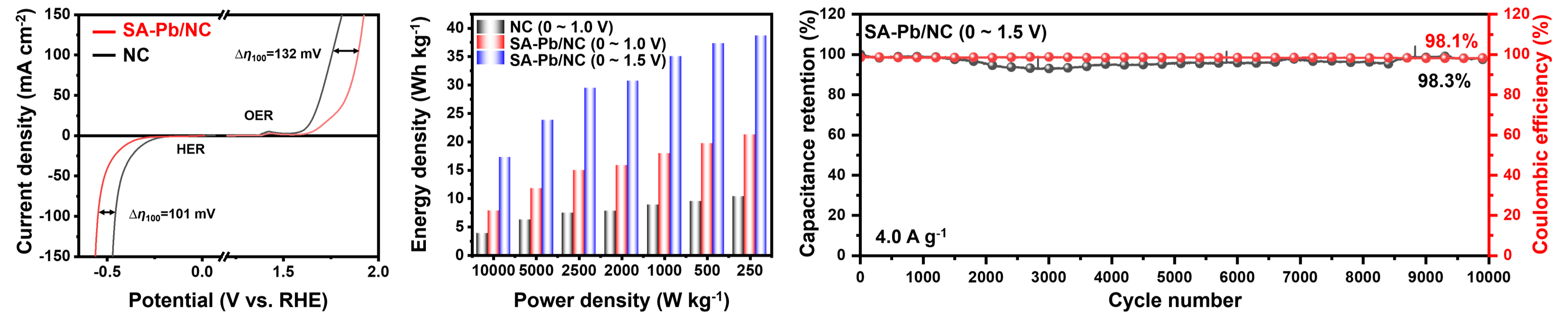
▲ Water-splitting suppression characteristics and energy storage performance of the SA-Pb/NC electrode.
A research team led by Professor Jung Kyu Kim from the Department of Chemical Engineering at Sungkyunkwan University (SKKU) (co-first authors: Ph.D. candidates Dong Zhang and Jong Hun Kim), in collaboration with Professor Min-Cheol Kim of Sookmyung Women’s University, announced the development of a novel electrode material that overcomes the chronic limitation of low operating voltage in aqueous electrolyte-based supercapacitors and significantly improves their energy density.
Aqueous supercapacitors have drawn strong attention due to their eco-friendliness, lack of explosion risks, rapid charge/discharge capabilities, and long cycle life. However, at voltages above a certain threshold, a water-splitting reaction occurs—where water decomposes into hydrogen and oxygen instead of storing electrical energy. This behavior has constrained improvements in energy storage performance through voltage extension. Moreover, the hydrogen gas produced during this process shortens device lifespan and poses safety risks.
To address this issue, the research team developed a novel electrode (SA-Pb/NC) by precisely introducing single atoms of the p-block element lead (Pb) onto a nitrogen-doped carbon (N-doped carbon) matrix. Through various structural analyses and Density Functional Theory (DFT) calculations, the team confirmed that Pb atoms are uniformly dispersed at the atomic level, forming a Pb-N coordination structure with nitrogen. This configuration maintains smooth transport of K+ ions (the charge carriers) while effectively weakening the binding affinity with water-splitting reaction intermediates, thereby suppressing unwanted side reactions.
As a result, the SA-Pb/NC electrode achieved a specific capacitance of 530.07 Fg-1, approximately twice that of conventional electrodes. It operated stably at an expanded operating voltage of up to 1.50 V, delivering a high energy density of 38.67Whkg-1 at a high power density of 375 Wkg-1—representing an approximately 3.7-fold improvement over conventional electrodes.
Furthermore, the introduction of single Pb atoms effectively suppressed water splitting, resulting in zero hydrogen gas detection even after 48 hours of continuous operation. The electrode also maintained 98.3% of its initial performance after more than 10,000 charge-discharge cycles, demonstrating exceptional stability and durability.
Professor Jung Kyu Kim noted:
"We presented a novel electrode design strategy that selectively suppresses water-splitting reactions at the electrode surface and secures high energy density by precisely controlling p-block elements at the atomic scale. This research demonstrates that high operating voltage and high energy density can be achieved simultaneously while preventing gas generation, which is expected to accelerate the commercialization of next-generation aqueous energy storage devices that offer both safety and high performance."
This research was supported by national grants from the Ministry of Science and ICT (MSIT), including the Mid-Career Researcher Program, the AEM Water Electrolysis Technology Development Project, and the Infrastructure Support Project for Early-Career Researchers. The study was published online on March 30, 2026, in Advanced Energy Materials (Impact Factor: 25.5), a world-leading journal in the field of energy devices.
Advertisement