
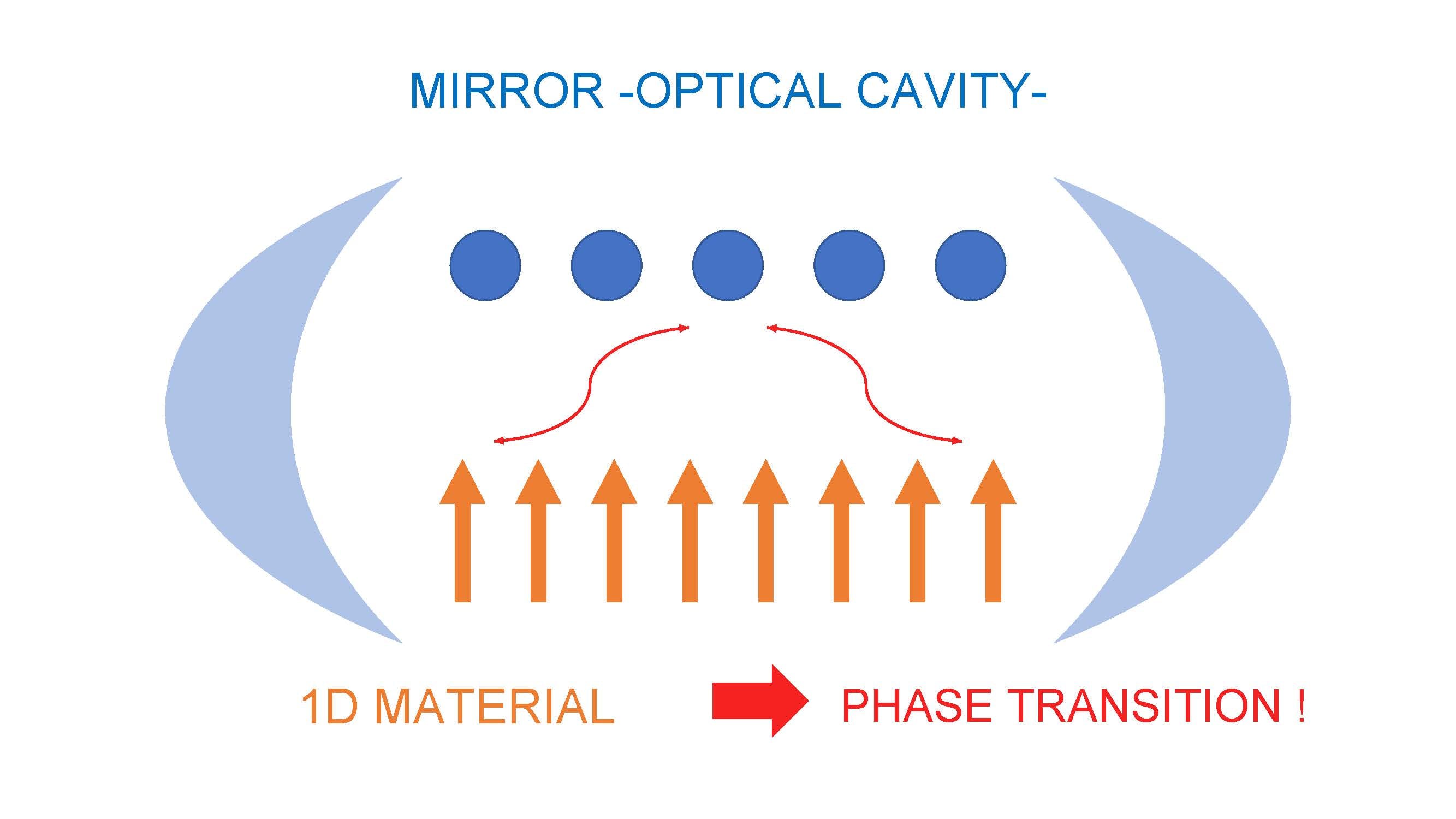

Proves light can create new phase transitions with materials
Cavity photons create long-range interactions between spins, causing magnetic order and a macroscopic light field at finite temperature.
YOKOHAMA National University
A research team wanted to better understand how the forces between particles inside a material change. They discovered that by confining one-dimensional classical spin chains inside a mirror box cavity with light they could force these magnetic particles to organize and undergo a phase transition. Their work provides the simplest exactly solvable examples showing that light can create new phase transitions with materials.
Their research was published in the journal Physical Review Research on May 11, 2026.
In 1925, Ernst Ising showed that a single one-dimensional chain of small magnetic particles with nearest-neighbor interactions does not exhibit a magnetic phase transition at finite temperatures. This is called the Ising chain. However, scientists today know that magnetic phase transitions can occur in two or more dimensions, positioning the Ising model as a simple, crucial math tool for studying how large groups of interacting particles behave. In addition, scientists are using cavity systems where matter and light are trapped and strongly interact with each other, leading to the possible discovery of new phenomena in physics.
In the last decade, the ultra-strong coupling of light-matter has moved from theoretical concepts to a variety of experimental systems. These experimental systems include phonons, intersubband transitions in semiconductor quantum wells, superconducting circuits, organic molecules, electron cyclotron motion, and magnons. This progress in these experimental systems has shown scientists the possibility of potential applications in both physics and chemistry.
Scientists have had a special interest in observing the superradiant phase transition, which is the spontaneous buildup of a coherent electromagnetic field under thermal equilibrium due to light-matter coupling.
The research team pursued a minimal interacting route, investigating an exactly solvable cavity-coupled 1D classical model. A superradiant phase transition occurs, providing the team with the simplest solvable interacting 1D example. The construction they chose makes the mechanism explicit, showing how photon-mediated fully connected coupling, along with intrinsic interactions, produces superradiance at a specific temperature. The classical spin model allowed the researchers to determine the finite-temperature superradiant phase transition exactly in the thermodynamic limit.
Other recent studies conducted on cavity-coupled 1D systems have focused on the behavior at absolute zero temperature, while in this study, the research team explored the exact properties at finite temperatures. “We wanted to understand how interactions inside matter affect a superradiant phase transition at thermal equilibrium,” said Motoaki Bamba, an associate professor at YOKOHAMA National University’s Faculty of Engineering. Most simple models do not include these interactions, although they are present in real materials. “We therefore studied a one-dimensional Ising spin chain coupled to a single cavity photon mode. The spin chain has no finite-temperature phase transition on its own, so we asked if cavity light could cause a phase transition in the spin chain.”
The central finding of the team’s work is that this 1D system does undergo a second-order magnetic phase transition when it is coupled to a cavity photon field. “The main message is that cavity photons can create long-range interactions among all the spins,” said Bamba. These interactions allow a one-dimensional spin chain to develop magnetic order and a macroscopic light field at finite temperature. “We derived the magnetization, photon number, and critical temperature analytically. Because the model is exactly solvable, it provides a clear reference for studying more complex light-matter systems,” said Bamba.
Looking ahead, the team wants to include energy loss and study more realistic systems. “Possible experimental platforms include superconducting-qubit arrays and one-dimensional magnets coupled to sub-terahertz cavities. Our ultimate goal is to understand and control equilibrium phases of light and matter and to help guide experiments toward new quantum optical technologies,” said Bamba.
The research team consists of Shuntaro Otake and Motoaki Bamba. Otake works at The University of Tokyo and YOKOHAMA National University. Bamba works at YOKOHAMA National University.
The research is funded by the Research Foundation for Opto-Science and Technology, Japan Society for the Promotion of Science, and KAKENHI.
###
YOKOHAMA National University (YNU) is a leading research university dedicated to academic excellence and global collaboration. Its faculties and research institutes lead efforts in pioneering new academic fields, advancing research in artificial intelligence, robotics, quantum information, semiconductor innovation, energy, biotechnology, ecosystems, and smart city development. Through interdisciplinary research and international partnerships, YNU drives innovation and contributes to global societal advancement.
Advertisement