
- DGIST Professor Daehee Park’s team identifies “competition for resources (skill conflict)” within AI, paving the way to prevent performance degradation in integrated models
- Prediction and planning integrated into a single compact model, improving both tasks while maintaining the same model size
- Research accepted at the prestigious ECCV 2026, with results demonstrated with support from NVIDIA
□ A research team led by Professor Daehee Park of the Department of Electrical Engineering and Computer Science at DGIST (President Kunwoo Lee), in collaboration with a research team from KAIST, has developed a learning technique that enables a single compact AI model to simultaneously predict the movements of people nearby and plan safe navigation paths for robots while reducing performance degradation in both tasks. The research has been accepted for presentation at ECCV 2026, one of the world’s three leading international conferences in computer vision, and will be presented at the conference in Malmö, Sweden, from September 10 to 12.
□ A robot navigating through a crowded environment must simultaneously predict the future trajectories of people nearby and plan a safe path that avoids collisions. Performing these two tasks using separate AI models requires significant computational resources and memory, making deployment on real-world robots challenging. Therefore, a technology that enables a single compact AI model to simultaneously perform both tasks is required.
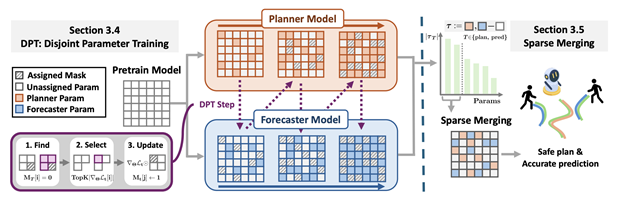
□ However, when multiple functions are incorporated into a single model, they may rely on overlapping model parameters, causing interference during training and resulting in degraded performance. The research team defined this phenomenon occurring between motion prediction and path planning as “Skill Conflict” and confirmed its effects through actual experiments.
□ To address this issue, the research team developed “Disjoint Parameter Training (DPT),” which enables each function to be trained primarily using different parts of the AI model. Thereafter, the team selected only the parts essential to each function and combined them into a single model, keeping the model compact while allowing the two functions to operate simultaneously without interfering with each other.
□ Performance evaluations using representative datasets in robot motion, such as JRDB and JTA, revealed that the proposed method predicted the movements of people nearby more accurately than existing methods while also reducing robot path errors and the likelihood of collisions. Additional experiments applying the method to autonomous driving AI demonstrated improved performance, confirming its potential for application across various fields of Physical AI, including robotics and autonomous driving.
□ “AI that moves through physical environments, such as robots and autonomous driving systems, must make multiple decisions simultaneously with limited computing resources,” stated Professor Daehee Park. “This study addresses the performance degradation that occurs when multiple functions are incorporated into a single compact AI model, and we plan to apply the technology to real-world robots to validate its potential for practical use.”
□ DGIST master’s student Taewon Seo and undergraduate researcher Seonae Jeon participated in the study, with Professor Daehee Park serving as the corresponding author. The study, titled “Unified Prediction and Planning via Conflict-Aware Disjoint Parameter Training,” was conducted with support from the NVIDIA Academic Hardware Grant Program.
Advertisement