

Fig. 1
Our neural parametric model for leaves, NeuraLeaf, represents shapes of various leaf species and natural 3D deformation. Our model represents the leaves' flattened shape and their 3D deformation in disentangled latent spaces.
Revolutionizing plant modeling with AI for precision agriculture and beyond
Osaka, Japan - Researchers at The University of Osaka have developed a groundbreaking computer graphics (CG) model, NeuraLeaf, capable of representing a wide variety of plant species and their deformations using a single, unified model. This innovative approach leverages deep learning to overcome the limitations of traditional manual modeling, opening doors for advancements in agriculture, plant science, and breeding.
Creating realistic CG models of leaves has always been challenging. Plant leaves exhibit remarkable diversity in shape and frequently undergo deformations due to growth, environmental factors, or disease. Traditional methods often required manual creation of individual models for each species and deformation, a time-consuming and labor-intensive process.
This new method utilizes deep learning, trained on a combination of existing 2D leaf image datasets and a newly acquired 3D dataset capturing various leaf deformations. NeuraLeaf disentangles the base shape of a leaf, which varies between species, from its 3D deformations, such as wilting or curling. This allows the model to accurately represent both the species-specific characteristics and dynamic changes in leaf shape using distinct parameters.
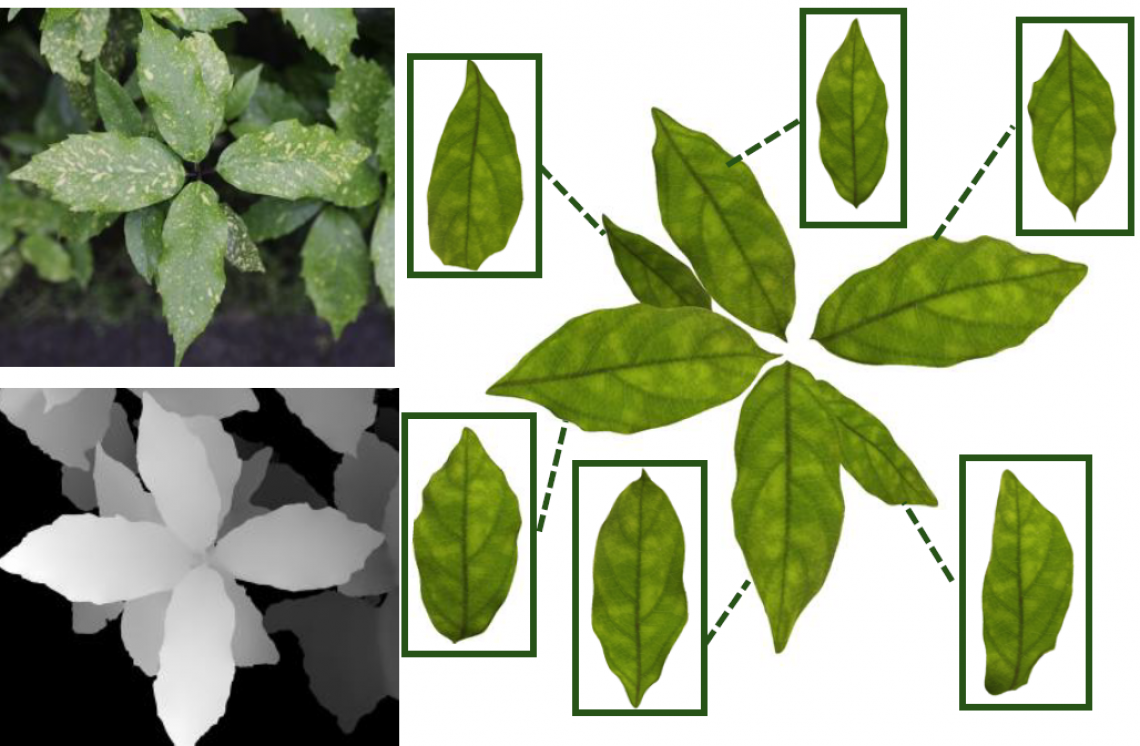
Fig. 2
Our method enables the instance-wise reconstruction of leaves via fitting to real-world observations, besides pure CG modeling.
The ability to accurately capture and track detailed changes in leaf shape has significant implications for agriculture. By fitting the NeuraLeaf model to real-world observations, researchers can monitor the growth and health of individual plants with unprecedented precision. This has the potential to improve growth prediction, enable early disease detection, and optimize resource management in agricultural practices. Furthermore, NeuraLeaf could become a valuable tool in plant breeding and scientific research.
Dr. Fumio Okura, who led the research, states, "This work is part of our 'PlantTwin' project, aimed at creating digital twins of plants. We believe this technology will revolutionize agriculture and plant science by enabling growth simulation, breeding evaluation, and a deeper understanding of plant morphology." This groundbreaking research has been accepted as a highlight paper at the prestigious IEEE/CVF International Conference on Computer Vision (ICCV) 2025.
###
About The University of Osaka
The University of Osaka was founded in 1931 as one of the seven imperial universities of Japan and is now one of Japan's leading comprehensive universities with a broad disciplinary spectrum. This strength is coupled with a singular drive for innovation that extends throughout the scientific process, from fundamental research to the creation of applied technology with positive economic impacts. Its commitment to innovation has been recognized in Japan and around the world. Now, The University of Osaka is leveraging its role as a Designated National University Corporation selected by the Ministry of Education, Culture, Sports, Science and Technology to contribute to innovation for human welfare, sustainable development of society, and social transformation.
Website: https://resou.osaka-u.ac.jp/en