


Next generation quantum computers hold so much promise - but it takes an enormous amount of tests to develop them. To speed up this process, researchers found a method that can read quantum states at ultra-fast speeds.
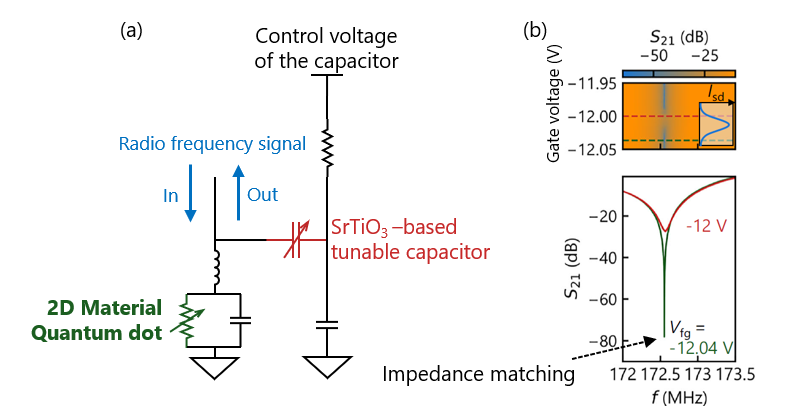
(a) Schematic of the measurement circuit used in this study. (b) Radio-frequency reflectometry response measured as a function of the 2D-material-based quantum dot gate voltage after optimizing the variable capacitor.
Motoya Shinozaki et al.
Quantum computers represent an exciting next step in the fast-paced evolution of technology. Using quantum bits (qubits), they have the potential to run certain calculations exponentially faster than conventional computers. However, developing and fine-tuning quantum computers requires an enormous number of repetitive tests. To accelerate the overall timeline of quantum technology development, we need a method that can read quantum states at ultra-fast speeds.
A research team from Tohoku University and the National Institute for Materials Science (NIMS) has made a breakthrough that enables ultra-sensitive, high-speed charge detection in 2D-material-based quantum devices necessary to accelerate this development. It brings us one step closer to the realization of next-generation quantum computers, which could eventually revolutionize industries like medicine, logistics, and cybersecurity.
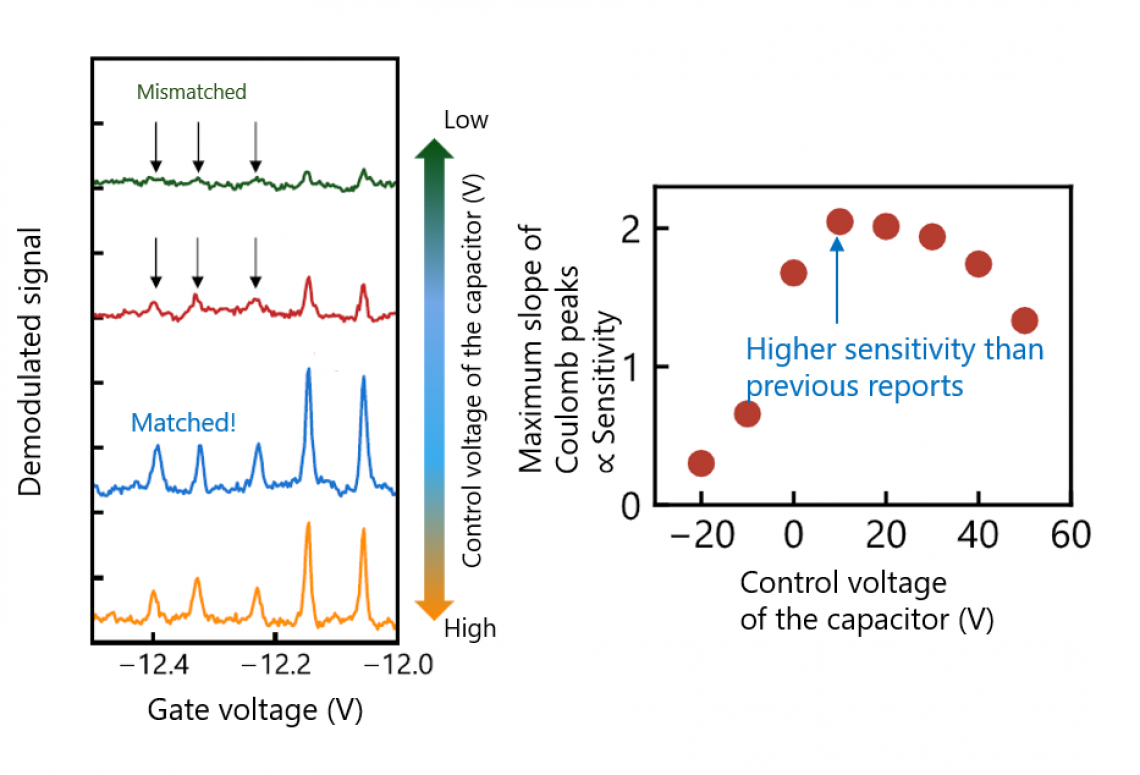
The research study successfully solves a technical bottleneck in quantum physics: the inability to measure high-resistance 2D-material-based quantum devices at high speeds. The team achieved this by integrating a variable capacitor made from strontium titanate (SrTiO₃) into a high-frequency resonant circuit. This configuration accomplished near-perfect impedance matching with highly resistive 2D-material-based quantum devices, allowing the researchers to clearly capture "Coulomb oscillations"- the explicit signals of electrons entering and leaving a quantum dot one by one. Crucially, the system remains stable under a perpendicular magnetic field, a condition mandatory for operating spin-valley qubits.
(a) Coulomb oscillations measured while varying the capacitance of the variable capacitor. Oscillations that were not detectable under impedance-mismatched conditions became clearly resolved under impedance-matched conditions. (b) Maximum slope of the observed peaks plotted as a function of capacitance. The slope reaches its maximum under the impedance-matching condition, enabling highly sensitive charge detection.
Motoya Shinozaki et al.
"By applying strontium titanate-based variable capacitors to 2D-material-based quantum devices, we achieved near-perfect impedance matching, even under the perpendicular magnetic fields," says Associate Professor Tomohiro Otsuka at Tohoku University's Advanced Institute for Materials Research (WPI-AIMR). "This unlocks charge detection sensitivity that equals or surpasses conventional quantum dot sensors. It provides a powerful new platform for high-speed qubit readouts in 2D materials."
This innovation directly solves a long-standing bottleneck in quantum physics. While 2D materials like bilayer graphene hold immense promise for creating stable qubits with exceptionally long coherence times, the high electrical resistance of quantum devices made from these materials has historically blocked sensitive high-frequency measurements. Without a way to match impedance, fast and accurate state readout was considered difficult.
"Evaluating quantum states quickly is essential, but the high resistance of 2D materials got in the way," Otsuka explains. "Because qubit development requires massive amounts of repetitive statistical measurements, a fast readout technique acts as an essential catalyst. This foundational technology will significantly accelerate the overall research and development cycle of 2D-material-based quantum devices."
The study was published online in the journal npj 2D Materials and Applications on August 20, 2026.
Advertisement
Advertisement