

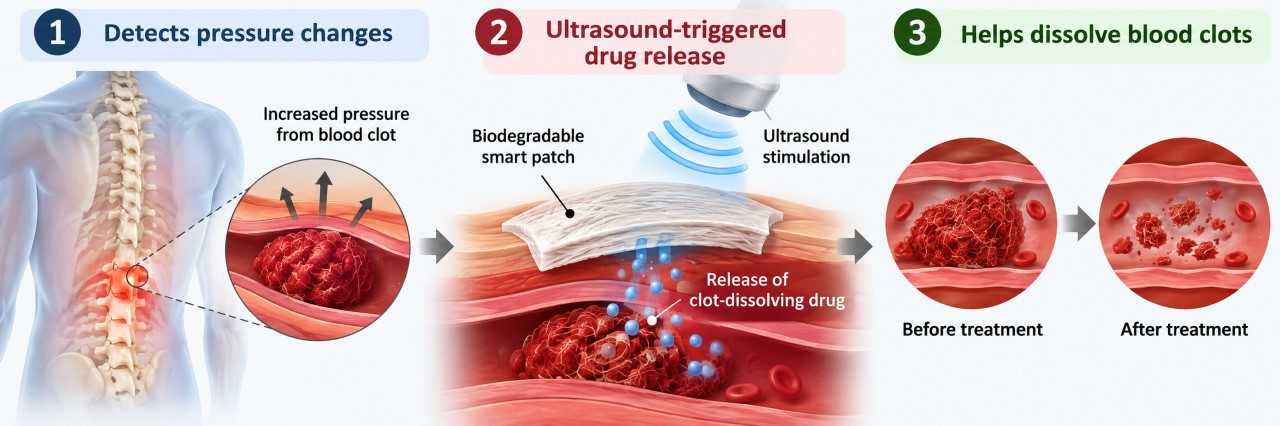

Researchers have developed a biodegradable smart patch that detects pressure changes and releases blood clot-dissolving medication when activated by ultrasound. Laboratory tests demonstrated sensitive pressure monitoring, controlled drug release, and approximately 70% blood clot degradation, highlighting its potential for future medical applications.
Schematic illustration of a biodegradable smart patch designed to monitor pressure changes associated with spinal blood clots. When activated by ultrasound, the patch releases a clot-dissolving drug (urokinase) to help break down blood clots. This innovative approach combines pressure monitoring and targeted drug delivery in a single platform, offering a promising strategy for managing blood clot-related complications.
National Taiwan University
Blood clots that develop after spinal surgery can lead to serious complications. When blood accumulates around the spinal cord, it may increase pressure on surrounding nerves, potentially causing severe pain, muscle weakness, or even paralysis. Early detection and timely treatment are therefore essential. However, continuously monitoring these complications remains challenging, and conventional treatments may require additional surgery.
To address this problem, an international research team led by Prof. Zong-Hong Lin at National Taiwan University has developed an innovative biodegradable smart patch that combines pressure monitoring with ultrasound-triggered drug delivery. This technology offers a promising approach to detecting pressure changes and delivering treatment directly to affected areas.
The patch is made from extremely thin fibers composed of a biodegradable polymer and glycine, a naturally occurring amino acid. These fibers exhibit a special property called piezoelectricity, allowing them to generate electrical signals when subjected to mechanical pressure. By monitoring these signals, the patch can detect changes in pressure without requiring an external power source for sensing.
In laboratory experiments, the patch demonstrated excellent pressure sensitivity, producing electrical signals of approximately 8 volts under an applied pressure of 80 pascals. This capability highlights its potential for monitoring pressure changes associated with blood clot formation.
Beyond monitoring, the researchers incorporated urokinase, a medication that helps dissolve blood clots, into the inner structure of the fibers. When ultrasound is applied from outside the body, the fibers respond by releasing the medication in a controlled manner. This approach could potentially allow treatment to be delivered when needed while reducing unnecessary drug release.
The experimental results were encouraging. Under ultrasound stimulation, the patch released approximately six times more urokinase than under unstimulated conditions. In laboratory blood clot experiments, the system achieved approximately 70% clot degradation, demonstrating the potential of combining pressure sensing and controlled drug delivery in a single biodegradable device.
Although further animal studies and clinical evaluations are necessary, this research represents an important step toward developing smart medical materials capable of both monitoring and treating complications associated with blood clots.
"Our goal is to develop intelligent biomaterials that can do more than simply monitor physiological conditions. By combining self-powered sensing with ultrasound-controlled drug delivery, we hope to create a new generation of medical devices that can detect potential complications and support timely, localized treatment. This technology could eventually help improve patient safety and reduce the need for additional invasive procedures," says co-corresponding author Zong-Hong Lin, distinguished professor and chair of the Department of Biomedical Engineering at National Taiwan University.
Prof. Zong-Hong Lin’s email address: [email protected]
Smart Biomaterials and Bioelectronics Lab of Prof. Lin linked to
Advertisement