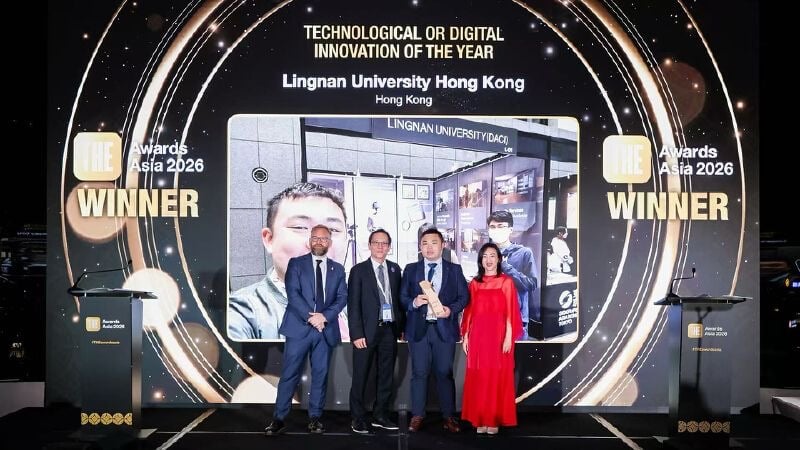
Dr Tobby Kan Shiu-tao, Senior Lecturer of the Department of Digital Arts and Creative Industries at Lingnan University (second from right), led the development of the Transforming film education through interactive game – CineSim, which wins the Technological or Digital Innovation of the Year award at the Times Higher Education Awards Asia 2026.
CineSim is the world’s first film production simulation education software to be developed and successfully commercialised by a university team. Led by Dr Tobby Kan Shiu-tao, Senior Lecturer of the Department of Digital Arts and Creative Industries at Lingnan University, the project took two years to complete, and received approximately HK$800,000 in funding from the University Grants Committee (UGC). Built on the principle of educational equity, the system permits students and creators to learn about film production, lighting, and cinematography even without access to equipment through a simulated digital environment, overcoming the limitations of traditional film sets and resources. CineSim has received multiple innovation awards, including a Bronze Medal at the International Exhibition of Inventions Geneva and a Silver Award at the 5th Asia Exhibition of Innovations and Inventions.
The judging panel of the Times Higher Education Awards Asia 2026 stated that the CineSim project stands out for its innovative approach, which integrates theory and practice to provide comprehensive support for film education. It also allows outputs to be exported for teaching and pre-visualisation purposes. This virtual reality solution reduces reliance on expensive equipment, offering a scalable and relatively cost-effective model, and enabling instructors to recreate scenes from classic films and television dramas so that students can analyse directorial decisions interactively.
The panel was greatly impressed by CineSim’s educational ecosystem and its innovative application of technology, which bridges the gap between cost and accessibility in hands-on film education so that students can practise in realistic production environments, build confidence, and increase practical capabilities. Now that the system has been made publicly available, its impact can extend to a much wider potential community.
Dr Kan said he was deeply honoured to receive the award, and that the team has worked from the initial concept of integrating film education, creative practice, and technology through to repeated testing and refinement to develop this inspiring interactive teaching tool. He added that this digital innovation not only upgrades students’ learning experience, but also removes geographical and resource constraints through the Internet, and empowers learners around the world.
CineSim integrates Unreal Engine 5 and immersive virtual reality technologies to create very realistic virtual film sets. Users of the free version can create content across 15 preset 3D scenes, including Hong Kong-themed settings like traditional cha chaan tengs and public housing estates, while learning core filmmaking skills such as composition, lighting design, camera movement, and storyboarding. The system allows day and night scene switching, character movement adjustment, and camera control, as well as outputs for teaching and presentation. The full version also includes FBX 3D model import functionality, enabling users to incorporate AI-generated models and further expand creative possibilities.
During the development phase, the team invited about 200 Lingnan students to participate in testing and provide feedback as the user experience was continuously refined. CineSim is now available free of charge to all Lingnan staff and students, as well as to secondary schools and the industry through workshops for local creative talent. On the international market, the software is available on global digital distribution platform Steam, with a VR version scheduled for release in the second quarter of this year.
Dr Kan added that CineSim lowers the barrier to the entry and cost of film production significantly, supporting the sustainable development of Hong Kong SAR’s film industry. Even schools with limited resources can offer these courses, while industry practitioners are able to use CineSim for pre-production simulation and shot planning, reducing manpower requirements and production costs. Dr Kan also pointed out that the system unites academic and creative thinking, and can be combined with the visual arts to advance interdisciplinary learning, innovation, and technology education in the Hong Kong SAR.
In recent years, Lingnan University has achieved considerable success in education technology innovation. Last month, it produced a record result at the 51st International Exhibition of Inventions Geneva, winning a total of 14 awards, and more than doubling last year’s outcome. At its debut at the Silicon Valley International Invention Festival in August last year, the University also received 14 awards, becoming the Hong Kong SAR institution with the highest number of awards and gold medals. This demonstrates Lingnan’s commitment to integrating technology into education and advancing its “Liberal Arts plus Technology” strategy, further strengthening its leadership in innovation within higher education in Asia.
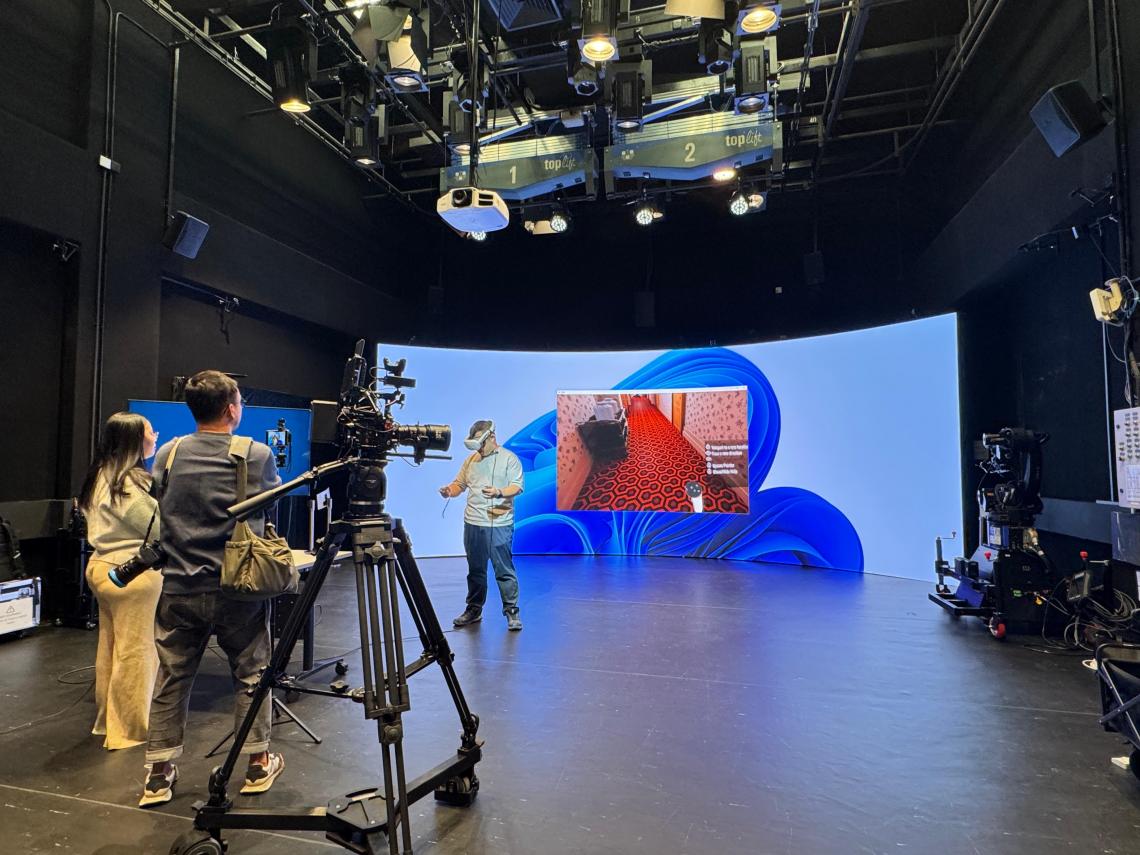
The judging panel of the Times Higher Education Awards Asia 2026 praises CineSim for effectively bridging the cost and accessibility gap in hands-on film education, enabling students to practise in realistic production environments and build confidence and practical skills.