Fig. 1
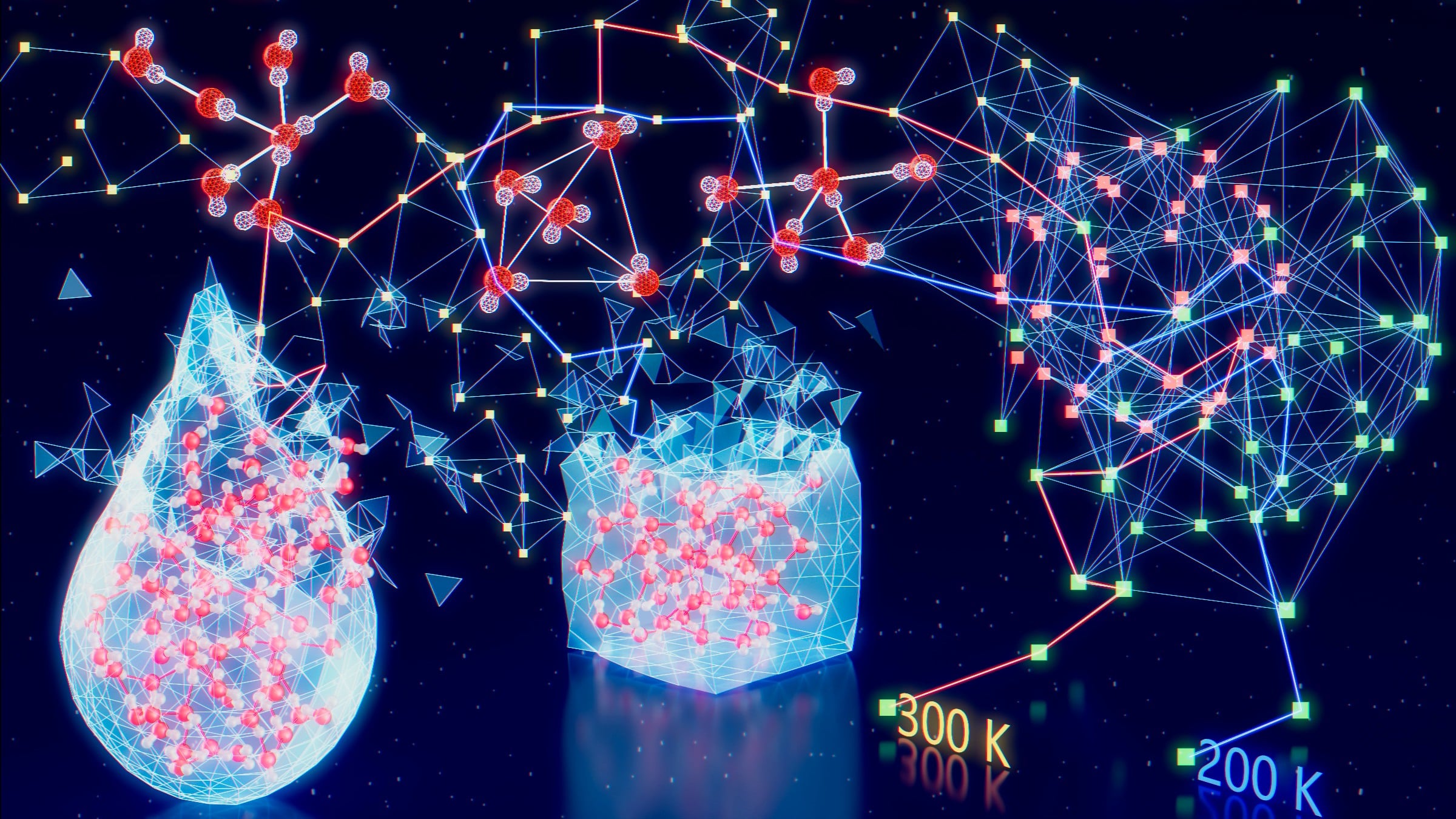
Schematic illustration of this study: artificial intelligence predicts temperature from molecular configuration of water.
Researchers at the University of Osaka use AI to evaluate a systematic framework to describe molecular order in liquid water
Osaka, Japan – Water is the most abundant liquid on the Earth’s surface; and it is highly anomalous compared to other liquids, as it expands upon freezing. The anomalies in water have been linked to how its microscopic structure changes with temperature and pressure. However, there is no systematic scheme for characterizing these structural changes.
Now, researchers at the University of Osaka have used artificial intelligence (AI) to evaluate characterization frameworks. The AI model is part of a unified framework for comparing and estimating structural descriptors for supercooled water. This exciting discovery was reported in Communications Chemistry.
For water to freeze, molecules need to order themselves into a structured lattice such as ice. Molecules need to attach to a foundation, known as a nucleation site, to grow into a solid phase. Impurities in water or scratches inside a container can serve as nucleation sites.
Consequently, water in a smooth, clean container can be cooled below its freezing point without solidifying. This state is called supercooled water.
Anomalous behavior in water becomes more pronounced with supercooling. Anomalies have been explained in terms of a transition between two competing states, a high-density liquid (HDL) and a low-density liquid (LDL). At the microscopic level, order in water arises from a network of intermolecular hydrogen bonds changing continuously over time. With increasing temperature, the collapsed HDL structures dominate over open LDL structures.
Various structural descriptors have been introduced to characterize the local order in water, such as the tetrahedral bond order and the local density. As these descriptors were proposed independently, they differ qualitatively in dimensions and scales, and encode different structural information. This makes it difficult to systematically compare descriptors to assess their relative importance.
“Past studies have shown that using machine learning to classify and understand structural data is effective,” explains corresponding author Kang Kim. “We specifically wanted to incorporate a neural network model into this study to evaluate how accurate the descriptors were at capturing key structural information, in a way that is like human cognition.”
The network inputs were structural data for supercooled water obtained from computer experiments, known as molecular dynamics simulations. To be capable of recognizing patterns in the data, a trial and error approach was employed by the network.
“The network used what it had learned to compare how 16 descriptors differentiated between LDL and HDL structures at different temperatures,” reports Nobuyuki Matubayasi, senior author. “In this way, we determined the most efficient descriptors.”
The findings could be used to further our understanding of the relationship between structural fluctuations and thermodynamic states of water. The insights gained may help us understand where the anomalous properties of water originate from, and develop improved structural descriptors.
###
The article, “Machine learning evaluation of structural descriptors for supercooled water,” was published in Communications Chemistry at DOI: https://doi.org/10.1038/s42004-026-02097-1
About The University of Osaka
The University of Osaka was founded in 1931 as one of the seven imperial universities of Japan and is now one of Japan's leading comprehensive universities with a broad disciplinary spectrum. This strength is coupled with a singular drive for innovation that extends throughout the scientific process, from fundamental research to the creation of applied technology with positive economic impacts. Its commitment to innovation has been recognized in Japan and around the world. Now, The University of Osaka is leveraging its role as a Designated National University Corporation selected by the Ministry of Education, Culture, Sports, Science and Technology to contribute to innovation for human welfare, sustainable development of society, and social transformation.
Website: https://resou.osaka-u.ac.jp/en