Fig. 1
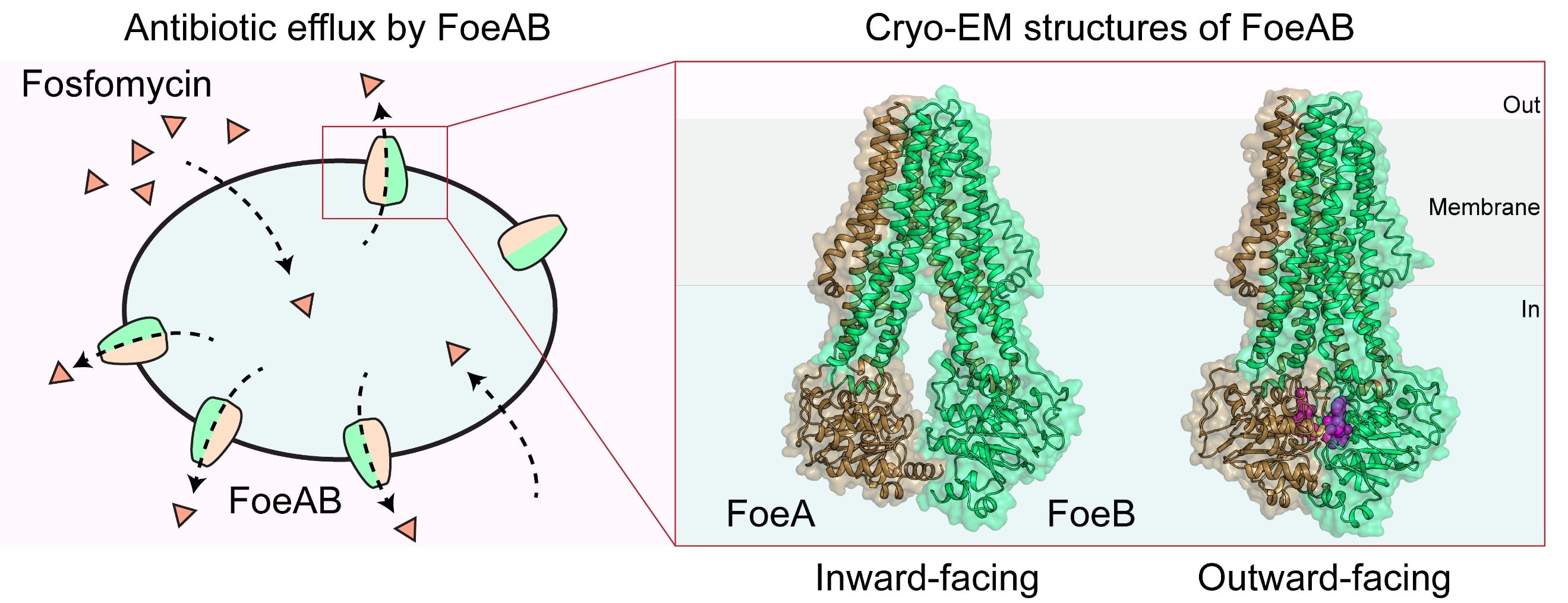
Schematic of fosfomycin transport by the streptococcal ABC transporter FoeAB
Researchers uncover how bacteria pump an antibiotic out of their cells, offering new clues to drug resistance
Osaka, Japan - Bacteria can survive antibiotics in several ways, including by pumping the drugs out of their cells before they can take effect. Researchers at the University of Osaka have discovered a previously unknown mechanism that allows the bacterium responsible for many cases of pneumonia and meningitis to export the antibiotic fosfomycin. The findings reveal how this molecular pump works and could help researchers better understand drug resistance and develop new ways to combat resistant bacteria.
The bacterium, Streptococcus pneumoniae, a major cause of pneumonia and meningitis, can develop resistance to antibiotics, yet many of its drug-export systems remain poorly understood. By systematically examining transport proteins in the bacterium, the researchers identified an uncharacterized protein complex, which they named FoeAB. Producing more FoeAB made bacterial cells more resistant to fosfomycin.
The team then isolated FoeAB from a related bacterium, Streptococcus thermophilus and placed it in artificial membranes, demonstrating directly that the protein transports fosfomycin. Using cryogenic electron microscopy, they also captured FoeAB in two different shapes, one open toward the inside of the cell and another open toward the outside. These structures revealed key regions involved in recognizing the antibiotic and suggest how the pump changes shape to take up fosfomycin and release it outside the cell.
“Drug efflux pumps have been studied for many years because of their importance in antibiotic resistance,” says corresponding author Dr. Atsushi Taguchi. “Discovering a new pump directly involved in antibiotic export and uncovering how it works is an important step toward understanding drug resistance.”
Fosfomycin had not previously been identified as a substrate of a bacterial drug efflux pump, highlighting a previously unrecognized diversity in how bacteria remove harmful compounds. Better understanding these systems could ultimately help guide new strategies to overcome drug resistance and develop more effective treatments for bacterial infections.
###
The study was published in Proceedings of the National Academy of Sciences on August 28, 2026 at DOI: https://doi.org/10.1073/pnas.2535933123.
About The University of Osaka
The University of Osaka was founded in 1931 as one of the seven imperial universities of Japan and is now one of Japan's leading comprehensive universities with a broad disciplinary spectrum. This strength is coupled with a singular drive for innovation that extends throughout the scientific process, from fundamental research to the creation of applied technology with positive economic impacts. Its commitment to innovation has been recognized in Japan and around the world. Now, The University of Osaka is leveraging its role as a Designated National University Corporation selected by the Ministry of Education, Culture, Sports, Science and Technology to contribute to innovation for human welfare, sustainable development of society, and social transformation.
Website: https://resou.osaka-u.ac.jp/en