
A new study from Taiwan combines consumer behavior research and life cycle assessment to design reusable cup systems that people are more willing to use. The findings show that convenience and incentives strongly shape participation, while well-designed reusable cup systems can still reduce environmental impacts compared to single-use cups.
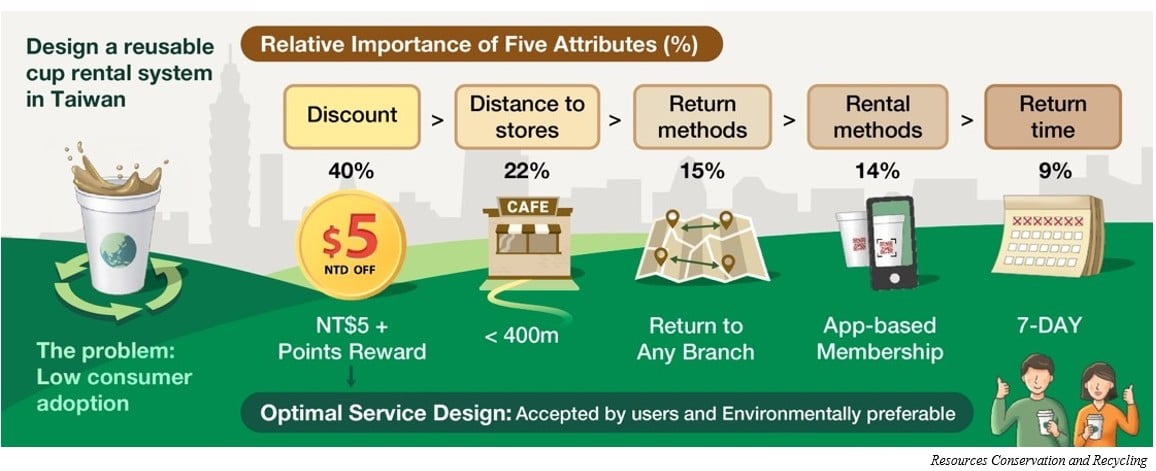
Consumer preferences for reusable cup rental systems in Taiwan. Discount incentives and convenient return options were the most important factors influencing adoption. The preferred service design included a NT$5 discount with reward points, return within 400 m, return to any branch, app-based membership, and a 7-day return period.
Resources, Conservation and Recycling
Every year, billions of disposable beverage cups are used worldwide, contributing to growing plastic waste and resource consumption. In Taiwan alone, around 4 billion single-use beverage cups are used annually, driven in part by the popularity of takeaway drinks. While reusable cup rental programs have expanded in recent years, many consumers still hesitate to use them regularly.
A new study from researchers at National Taiwan University, National Sun Yat-sen University, National Cheng Kung University, and Waseda University explored how reusable cup systems can be designed to better match consumer preferences while maintaining environmental benefits. The study was published in Resources, Conservation and Recycling.
The research combined two approaches. First, the team conducted a nationwide consumer survey in Taiwan using choice-based conjoint analysis, a method commonly used to study how people make decisions between different product or service options.
More than 1,000 participants evaluated reusable cup rental systems with different combinations of incentives, return methods, return times, and travel distances. The researchers then used life cycle assessment to compare the environmental impacts of these reusable cup systems with conventional single-use paper cups.
The results showed that financial incentives and convenience were the most important factors influencing whether people would choose reusable cups. Consumers strongly preferred systems offering a small discount combined with reward points. Flexible return options also mattered. Participants favored being able to return cups to any branch rather than only the original store, and they preferred return locations within walking distance. Longer return periods were also considered more convenient, with seven days emerging as the most acceptable balance between flexibility and system efficiency.
From an environmental perspective, reusable cups generally performed better than single-use paper cups across most impact categories, particularly for greenhouse gas emissions and fossil resource use.
However, the environmental performance depended heavily on how the system was operated. Frequent reuse and high circulation rates were critical to maintaining environmental advantages. Cleaning processes and transportation logistics contributed significantly to impacts, meaning poorly managed systems could reduce some of the expected environmental gains.
The study highlights that designing successful circular systems requires understanding both human behavior and environmental performance. Rather than focusing only on materials, the researchers argue that convenience, accessibility, and operational design are equally important for making reusable systems work in practice. The findings may help governments, beverage chains, and reusable cup service providers develop systems that are easier for consumers to adopt while still reducing waste and emissions.
“Reusable systems cannot succeed through environmental messaging alone. Consumers need systems that are convenient, flexible, and fit naturally into daily life. Our study shows that when user preferences are integrated into environmental assessment, it becomes possible to design circular systems that are both practical and sustainable,” says first and co-corresponding author Prof. Hsin-Tien Lin in the Department of Mechanical Engineering at National Taiwan University.
Prof. Hsin-Tien Lin's email address: [email protected]
Advertisement