
By combining demand-driven life cycle assessment with a multi-objective optimisation framework, researchers identified potential optimal solutions for reusable bubble tea packaging systems under actual market demand conditions. The results show that material selection and low reuse frequency dominate both economic costs and environmental impacts, while durability and logistics become increasingly important as reuse frequency increases.
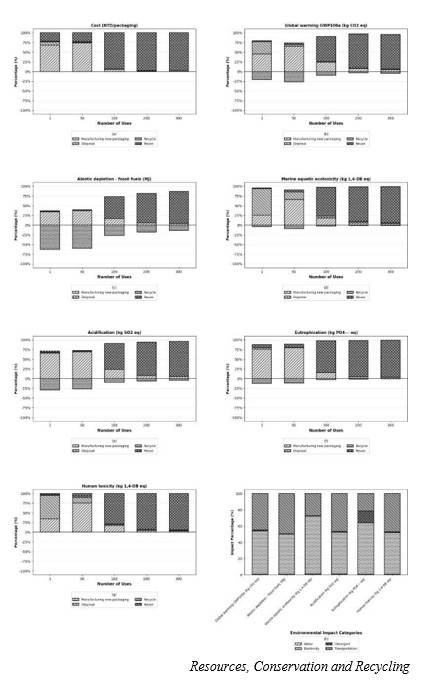
Environmental burden of a reusable PP bubble tea cup across different usage frequencies. Each stacked bar shows the contribution from four stages: manufacturing (diagonal lines), disposal (dotted), recycling (grid), and reuse operations (cross-hatch), across seven environmental dimensions.
At low usage, manufacturing and disposal dominate (75–95% of total burden), making a rarely-used reusable cup worse than a single-use alternative. Beyond 100 uses, the burden shifts decisively to reuse operations, driven by electricity (40–50%) and transportation (35–45%). At this point, material choice matters far less than durability, cleaning efficiency, and logistics optimization. Panel (h) further breaks down the reuse stage, showing that electricity and transportation are the dominant contributors across most impact categories, while detergent use is the primary driver of eutrophication.
Resources, Conservation and Recycling
Background
As environmental awareness continues to rise, reusable tea packaging has become an increasingly common practice for reducing single-use cups. However, the economic costs and environmental performance of reusable packaging systems have not yet been fully evaluated under actual market demand conditions across their entire life cycle.
Methodology
The research team in the International Degree Program in Climate Change and Sustainable Development (IPCS) at National Taiwan University has developed a demand-driven life cycle assessment (LCA) framework to evaluate both single-use and reusable tea packaging systems, covering stages from raw material production and manufacturing to distribution, use in bubble tea shops, and end-of-life treatment. The team further applied a multi-objective optimisation framework to analyse the trade-offs between economic costs and environmental performance across different optimal solutions under the actual market demand conditions of bubble tea shops in Taipei.
Key findings
The research, published in Resources, Conservation and Recycling, found that reusable polypropylene (PP) packaging can reduce environmental impacts only when each cup is reused at least 120 times to offset the environmental burdens associated with manufacturing. Reusable PP packaging systems begin to outperform single-use designs more substantially beyond 300 uses. At higher usage frequencies, the major environmental burdens shift from manufacturing processes to issues related to durability and logistics within reusable systems, including washing and transportation.
Furthermore, the optimal solutions generated by our models were reviewed by reusable cup companies in Taipei to evaluate the applicability of the demand-driven LCA and multi-objective optimisation framework. These companies acknowledged that environmentally friendly solutions generally require higher investment under current market conditions. However, they also highlighted practical constraints that may limit the achievable number of reuse cycles, including appearance degradation, cup loss, and physical damage leading to premature retirement.
“Reusability alone does not guarantee environmental benefit: usage frequency is the real deciding factor,” said IPCS graduate student Yan-Ruei Huang and corresponding author Prof. Yu-Kai Liao.
Prof. Yu-Kai Liao's email address: [email protected]
Advertisement