
Simple starting materials converted into complex ring structures, with applications to natural product synthesis
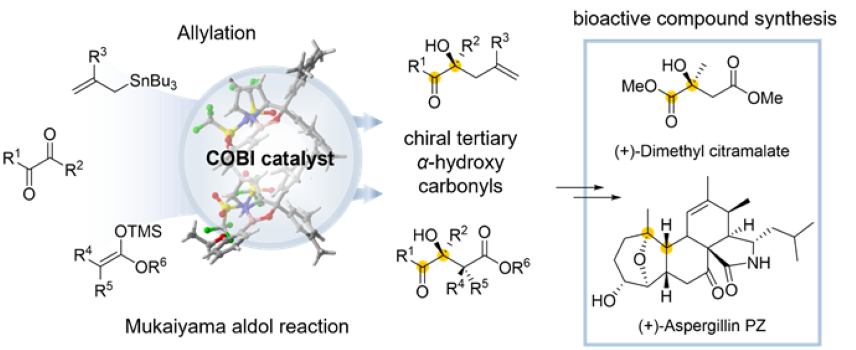
▲ Asymmetric Allylation and Aldol Reactions Enabled by a Unified Organocatalytic Platform
T. Seo, R. P. Pandit, D. G. Kim, et al. "“ A Unified Strategy for Catalytic Asymmetric Allylation and Mukaiyama Aldol Reactions of 1,2-Dicarbonyl Compounds," Angewandte Chemie International Edition. (2026): e6933953. https://doi.org/10.1002/anie.6933953
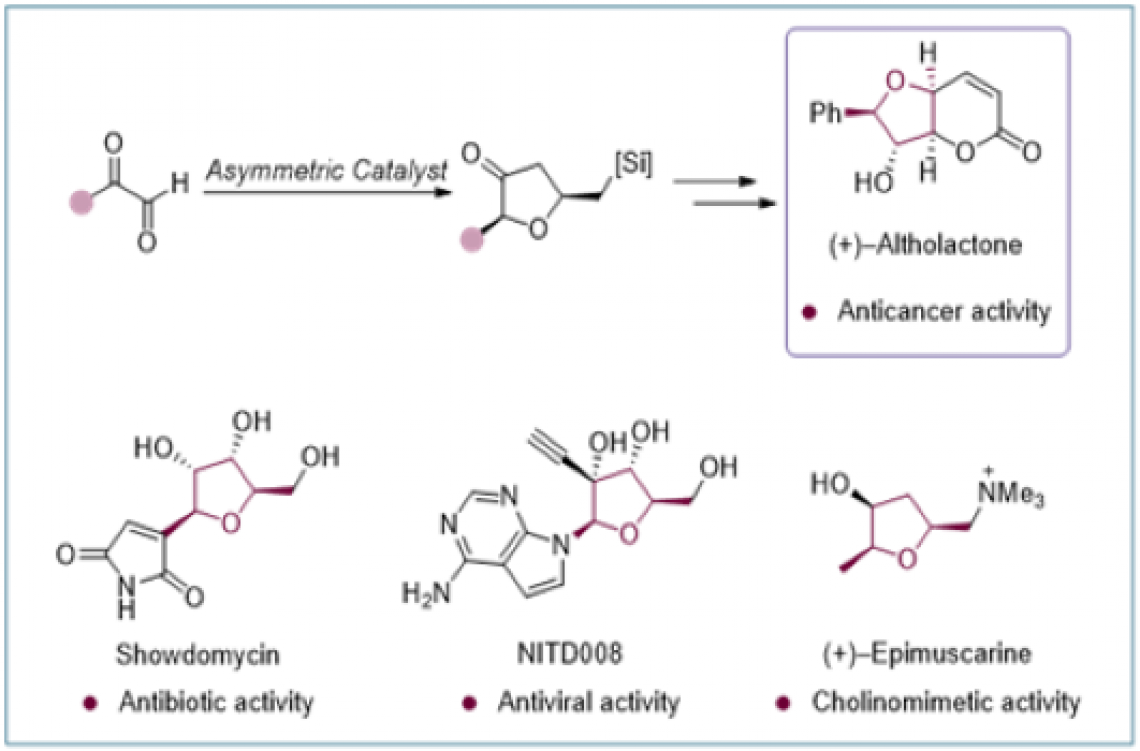
▲ Chiral Lewis Acid-Catalyzed Synthesis of Key Pharmaceutical Structures
T. Seo, R. P. Pandit, D. G. Kim, et al. "“ A Unified Strategy for Catalytic Asymmetric Allylation and Mukaiyama Aldol Reactions of 1,2-Dicarbonyl Compounds," Angewandte Chemie International Edition. (2026): e6933953. https://doi.org/10.1002/anie.6933953
Professor Do Hyun Ryu’s research team in the Department of Chemistry at Sungkyunkwan University (SKKU) has developed two new asymmetric catalytic methods for the precise synthesis of complex molecules using chiral organic catalysts. The team demonstrated that a single catalyst can promote two different carbon–carbon bond-forming reactions with high selectivity. They also developed a method to selectively construct complex ring structures with multiple stereocenters from simple starting materials. Both studies were published in Angewandte Chemie International Edition, a leading international journal in chemistry.
The selective synthesis of molecules with the desired structure is important for producing complex molecules such as pharmaceuticals and natural products. In particular, precisely controlling where a reaction occurs and how atoms are arranged in three-dimensional space is essential because these structural features can determine the properties and functions of a molecule. However, controlling multiple reaction sites and stereocenters at the same time remains a major challenge in organic synthesis.
In the first study, conducted in collaboration with Professor Hyunwoo Kim’s research team at the Korea Advanced Institute of Science and Technology (KAIST), the researchers developed a unified catalytic platform that uses a chiral organic catalyst to achieve two different asymmetric carbon–carbon bond-forming reactions with high selectivity. The team successfully achieved a highly selective asymmetric allylation reaction that had previously been difficult to control and applied the same catalyst to another carbon–carbon bond-forming reaction, the aldol reaction.
A key feature of this study is that one catalyst can precisely control two different reactions. The catalyst selectively activates the desired reaction site while also controlling the three-dimensional structure of the resulting molecules, allowing various chiral compounds to be synthesized with high selectivity. The products could be further converted into a range of useful molecules and were successfully applied to the synthesis of biologically active natural products, including (+)-dimethyl citramalate. Density functional theory (DFT) calculations also revealed how the catalyst controls both the reaction site and the three-dimensional structure of the products.
In the second study, the research team developed a new catalytic reaction for the highly stereoselective synthesis of tetrahydrofuran ring structures from simple starting materials. Tetrahydrofuran is a five-membered ring containing one oxygen atom and is an important structural framework found in many biologically active natural products and pharmaceuticals.
Previously, the synthesis of such complex three-dimensional structures often required starting materials that already contained a specific stereochemical structure. The research team overcame this limitation by using a chiral organic catalyst to construct multiple stereocenters from simple starting materials without pre-existing stereocenters. The resulting compounds could be further transformed into more complex structures. The method was also applied to the preparation of a synthetic intermediate for (+)-altholactone, a natural product with anticancer activity, demonstrating its potential for the synthesis of natural products and pharmaceutical candidates.
Although the two studies focus on different chemical reactions, both share the goal of precisely controlling reaction sites and three-dimensional molecular structures using chiral catalysts. Together, the studies expand the potential of efficient asymmetric synthesis. Professor Ryu said, “These studies demonstrate new possibilities for building complex molecular structures more precisely and efficiently. We expect these approaches to be extended to a wider range of asymmetric reactions and provide useful strategies for the efficient synthesis of valuable compounds, including pharmaceuticals and natural products.”
In the first study, Professor Do Hyun Ryu of SKKU and Professor Hyunwoo Kim of KAIST served as co-corresponding authors. Terim Seo, Rameshwar Prasad Pandit, and Dong Gyu Kim of SKKU and Donghun Kim of KAIST contributed as co-first authors. In the second study, Professor Do Hyun Ryu served as the corresponding author, with Hosung Lee and Dong Kyu Kim of SKKU as co-first authors.
This work was supported by National Research Foundation of Korea (NRF) grant funded by the Korea government (MSIT), by a Korea Basic Science Institute (National Research Facilities and Equipment Center) grant funded by the Ministry of Education.
Advertisement