
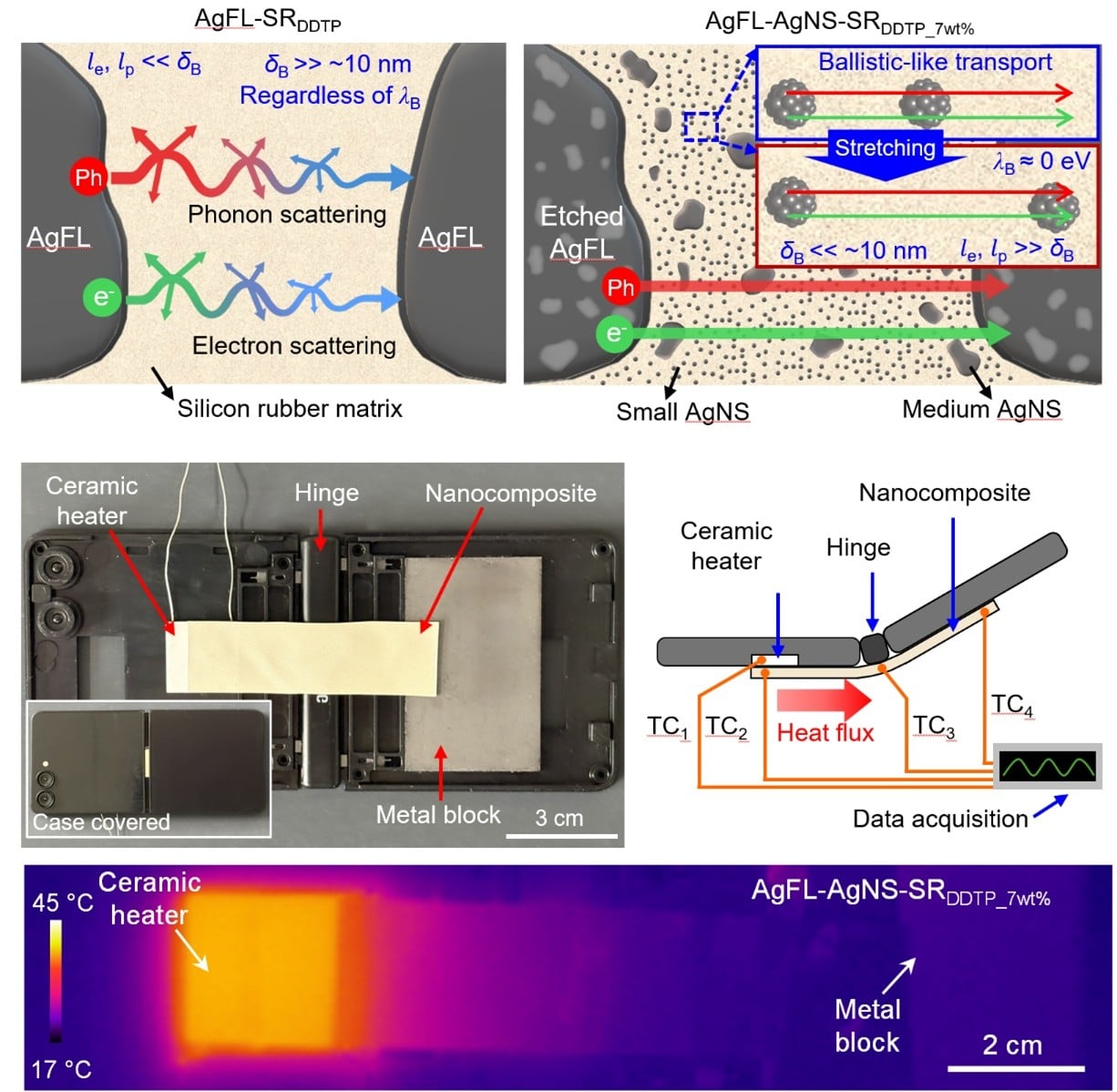
▲ Schematic of Electron and Phonon Transports in Nanocomposites and Demonstration of Heat Dissipation in Foldable Phones
A joint research team led by Professors Seunghyun Baik and Joonmyung Choi from the School of Mechanical Engineering of Sungkyunkwan University (SKKU) has developed a new nanocomposite material whose electrical and thermal conductivities increase as it is stretched, successfully applying it to stable heat dissipation for foldable phones.
Smartphones and electronic devices generate significant heat during operation, which can cause performance throttling or shorten device lifespan if not properly cooled. Next-generation flexible electronics that bend or stretch face particular challenges because heat cannot easily escape during deformation. Typically, stretching a material increases the distance between embedded particles, which reduces both thermal and electrical conduction. However, the research team designed a material that overturns this conventional understanding.
The research team uniformly dispersed 3.4-nanometer (nm) silver particles—tens of thousands of times thinner than a human hair—at ultra-narrow gaps of just 4.1 nanometers within stretchable silicone rubber. By narrowing the inter-particle distance below 10 nanometers, electrons move through barriers via a phenomenon known as "quantum tunneling." Consequently, even when the material is stretched, it exhibits a "ballistic-like transport between fillers" where heat flows directly without additional scattering upon stretching, leading to enhanced thermal conductivity.
Furthermore, the team demonstrated that by precisely tuning the inter-particle spacing and the chemical properties of the rubber, this material can serve as a "thermal switching material" that controls heat flow upon stretching. Professor Joonmyung Choi carried out computational simulations to verify the microscopic mechanism, demonstrating that polymer chains align in the direction of strain, allowing heat to travel much more efficiently.
Professor Seunghyun Baik stated, "This study is of great significance because it discovered a unique physical phenomenon where thermal conductivity increases upon stretching through the precise control of nanoscale energy barriers, and it demonstrated successful application to heat management in flexible electronics such as foldable phones."
The research, corresponding-authored by Prof. Seunghyun Baik with Research Prof. C. Muhammed Ajmal and researcher Seongsu Cheon as co-first authors, was published online on August 24, 2026, in Advanced Functional Materials, a leading international journal in materials science.
This work was supported by the Basic Science Research Program through the National Research Foundation of Korea (NRF) funded by the Ministry of Education, the NRF grants funded by the Korea government (MSIT and MOE), the Korea Institute of Science and Technology (KIST) Institutional Program, and the Start up Pioneering in Research and Innovation (SPRINT) through the Commercialization Promotion Agency for R&D Outcomes (COMPA) grant funded by the Korea government (MSIT).
Advertisement