


Published in the urban studies journal Cities, the study shows that personal stakes and policy efficacy increase citizens’ willingness to co-design
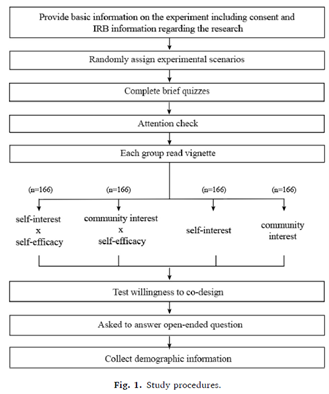
Flow of the survey experiment, in which 664 Korean adults were randomly assigned to four groups of 166. After a short quiz on public hearings and an attention check, each group read a scenario that differed by the facility’s location (“in front of my home” vs. “in my city”) and by whether respondents had received an encouraging message designed to boost their participation self-efficacy. Respondents then reported their willingness to co-design, explained their choice in an open-ended question, and provided demographic information.
: Hemin Choi, Yongjin Ahn, Not in my backyard, but in my City: Experimental evidence on what motivates citizens to co-design, Cities, Volume 179, 2026,107595,ISSN 0264-2751, https://doi.org/10.1016/j.cities.2026.107595.
Sungkyunkwan University (SKKU) Professor Yongjin Ahn of the Department of Public Administration, in a joint study with Professor Hemin Choi of the Department of Urban Policy and Administration at Incheon National University, has experimentally identified what motivates citizens to take part in designing contested facilities amid local conflict.
The study has been published in Cities, a leading journal in urban studies. In a survey experiment with 664 Korean adults centered on a proposed treatment facility for people with mental illness or drug dependency, respondents were more willing to co-design—that is, to join a public hearing and offer input on the facility’s design—when the facility was described as being built in front of their home rather than elsewhere in their city, and when they had received an encouraging message designed to boost their confidence in participating.
The findings suggest that the personal stakes long seen as a driver of NIMBY (“Not In My Backyard”) opposition can instead fuel constructive engagement when a credible participation pathway exists. The researchers recommend that local governments go beyond appeals to the public good and build residents’ confidence to participate, for example by explaining participation procedures clearly and offering low-barrier channels for input.
Meanwhile, Professor Ahn presented the findings at the 21st Korea–China Governance Research Forum, held on October 31, 2026, at East China University of Political Science and Law in Shanghai. Co-hosted by SKKU’s Sungkyun Institute of China Studies and the School of Government at Peking University, the forum was held under the theme “Cities and Rural Areas in East Asia from a Governance Perspective.”
※ Paper Title: Not in My Backyard, but in My City: Experimental Evidence on What Motivates Citizens to Co-Design
※ Journal: Cities
※ Link: https://www.sciencedirect.com/science/article/pii/S0264275126008279?dgcid=author
※ Citation: Hemin Choi, Yongjin Ahn, Not in my backyard, but in my City: Experimental evidence on what motivates citizens to co-design, Cities, Volume 179, 2026,107595,ISSN 0264-2751, https://doi.org/10.1016/j.cities.2026.107595.
Advertisement