

By giving a maple-seed-inspired robot the ability to plan ahead, researchers improved its flight accuracy without adding motors or mechanical complexity.
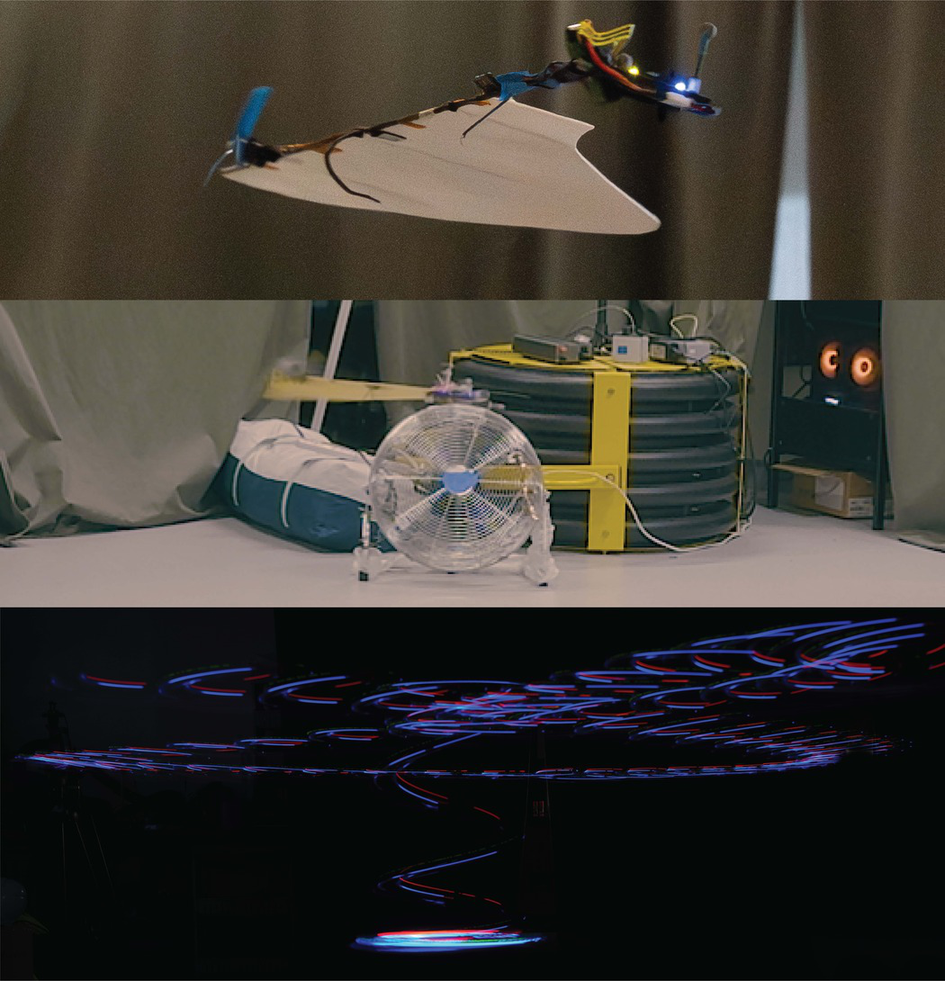
A maple-seed-inspired flying robot with only a single spinning motor in action; Carrying a payload (top), holding steady against wind (middle), and tracing a figure-eight path mid-flight, captured as light trails (bottom).
SUTD
A flying robot with just one moving part may sound simple. Controlling one precisely is anything but.
Most conventional drones rely on several rotors to control how they rise, turn and move. A robot with only one actuator has far fewer ways to correct itself when it drifts off course, encounters a disturbance or reaches the physical limits of what its motor can achieve.
Researchers from the Singapore University of Technology and Design (SUTD) have developed a control method that enables such a minimalist flying robot to anticipate its next movements and track complex paths more accurately. The approach, described in the study “Nonlinear Model Predictive Control of Single-Actuator Monocopters using Hybrid Rotational Dynamics and INDI” published in IEEE Transactions on Robotics, was demonstrated on SAM, short for Samara Seed-Inspired Single-Actuator Monocopter.
Inspired by the autorotating motion of a falling maple seed, SAM spins rapidly to generate lift and remain airborne while using just one actuator for both lift and directional control. Its compact, lightweight design comes with an engineering trade-off: with only one actuator controlling its motion, precise trajectory tracking becomes particularly difficult.
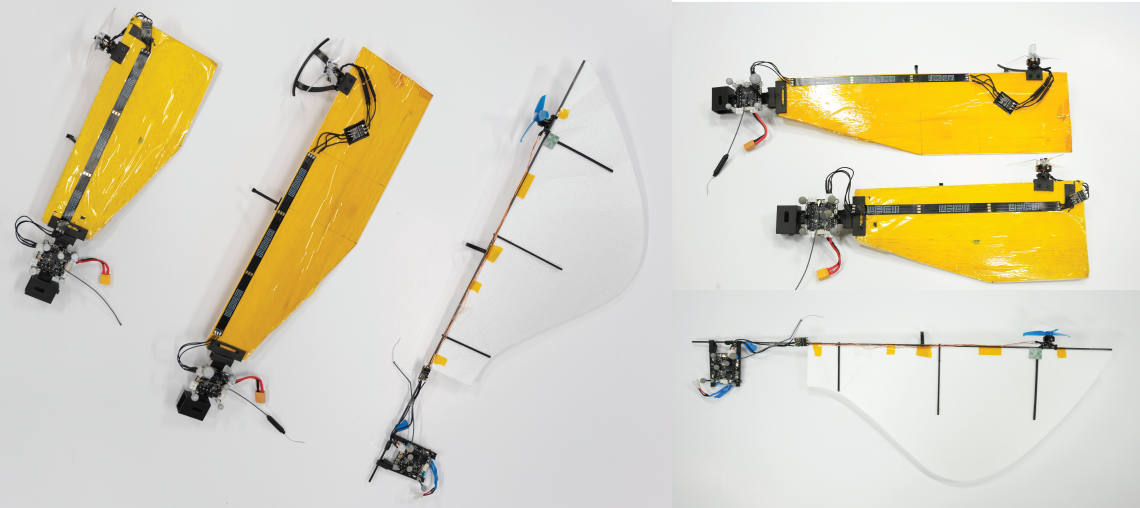
The three wing sizes tested in this study, shown side by side: a compact short-wing and a longer wing, both made of wood wrapped in yellow tape, plus an ultra-light foam version built to be as light as possible.
SUTD
At the centre of the approach is Nonlinear Model Predictive Control (NMPC). Rather than waiting for SAM to drift away from its intended path before correcting it, NMPC predicts how the robot is likely to move over the next few moments and plans its control actions accordingly. The researchers combined this with Incremental Nonlinear Dynamic Inversion (INDI), which uses real-time feedback to make rapid corrections when the robot encounters disturbances or modelling errors.
The team also developed a hybrid model that better captures the interaction between SAM’s rapid spinning and tilting motions, giving the predictive controller a more physically consistent representation of how SAM moves.
“This work reflects SUTD’s approach to engineering: we start from a real physical principle, in this case the passive spinning motion of a maple seed, and combine it with advanced control to make the system useful. The challenge is not simply to build a small flying robot, but to understand how design, dynamics and computation can work together within a highly constrained system,” said Professor Foong Shaohui, Associate Head of SUTD’s Engineering Product Development pillar.
To test the method, the researchers conducted flight experiments using three versions of SAM: short-wing, long-wing and ultralight-wing variants. Each presented a different challenge, from lower lift efficiency and wing flexing to limited thrust and control authority.
The short- and long-wing SAMs were tested on circular, figure-eight and elevated circular paths, including trajectories that at certain points demanded more actuator input than the platform could physically provide. They were also tested under fan-generated wind disturbances. The ultralight-wing SAM was evaluated on a circular trajectory and while carrying a 5 g payload.
Across the experiments, the proposed NMPC+INDI approach outperformed the Differential Flatness-Based Controller with INDI used as the benchmark. Positional root-mean-square error was reduced by up to 39.5% for the long-wing SAM and 37.2% for the short-wing version. The ultralight-wing SAM recorded velocity error reductions of up to 43.5%.
“With only one moving part, SAM looks mechanically simple, but that simplicity makes control extremely challenging,” said Dr Emmanuel Tang, lead author of the study. “Because the whole system depends on one actuator, every motor command has to be planned and timed precisely. Our work shows that by giving the robot a predictive planning horizon, we can make this severely underactuated system fly more accurately, even when it faces difficult trajectories, wind disturbances or added payloads.”
The findings suggest that better control could make mechanically simple aerial robots more capable without adding motors or moving parts. In the longer term, platforms of this kind could support applications such as environmental sensing and climate monitoring, particularly where compactness and scalable deployment are important.
“This work reflects SUTD’s approach to engineering: we start from a real physical principle, in this case the passive spinning motion of a maple seed, and combine it with advanced control to make the system useful. The challenge is not simply to build a small flying robot, but to understand how design, dynamics and computation can work together within a highly constrained system,”
Professor Foong Shaohui, Associate Head of SUTD’s Engineering Product Development and Principal Investigator
The technology remains experimental. Flight tests were conducted indoors using an OptiTrack motion-capture system and offboard computation. Future work will explore reducing the platform’s reliance on external motion capture and moving more computation onboard, important steps towards making such systems more practical outside the laboratory.
“The appeal of SAM is that it combines extreme mechanical simplicity with the passive stability of a spinning maple seed. This makes it an unusual aerial robot: efficient, lightweight and potentially scalable, but also very difficult to control. By improving how such a minimal platform can be guided, we are opening the door to future aerial systems that could be deployed in large numbers for tasks such as environmental sensing and climate monitoring,” added Prof Foong.
Advertisement