
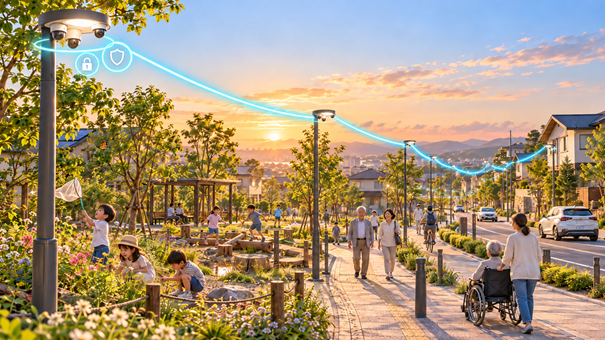

Public-safety infrastructure combining streetlight-based FMPS and AI output governance.
Figure 1. Concept image of the public space envisioned by FMPS.
A paper by Professor Yusaku Fujii of the School of Science and Technology, Gunma University, “Governing AI Outputs in the Fully Sensed Society: Is Output Governance Sufficient for Social Acceptance?”, has been published in the international journal Smart Cities. The study examines privacy protection and social acceptance by combining Fully Monitored Public Space (FMPS), a concept for comprehensively observing public space, with governance of AI outputs.
FMPS proposes integrating compact cameras and smartphone-class processing and communications into existing streetlights. By supporting post-incident tracking, identification, and apprehension, the approach aims to create deterrence and substantially reduce street crime. Encrypted video, AI output governance through VRAIO + GLO, and independent auditing are combined to discourage unauthorized use. By taking advantage of scheduled streetlight replacement and proceeding through phased demonstrations, the project aims toward a society in which children can again play outdoors safely and people can move freely through public spaces.
Key Points
• Goal and vision: Public spaces comprehensively observed so that children can play outdoors safely and people can move freely. The concept is intended as public infrastructure with substantial social value.
• Safety and security: Recording and cross-camera tracking can support identification and apprehension after an incident. The proposal aims to deter street crime by creating an expectation that escaping identification will be difficult.
• Potentially low-cost deployment: The concept uses existing streetlight networks, inexpensive cameras, and smartphone-class processing and communications, ideally integrated into scheduled streetlight replacement.
• Privacy protection: Encrypted recordings are combined with VRAIO + GLO. Independent recording and auditing, together with effective sanctions, are intended to make unauthorized use unattractive.
• Phased implementation: Development and trials can begin in a limited area, such as a school route or residential district, and measure safety, privacy, acceptance, reliability, and total cost.
The World and Social Value Envisioned
• Freedom for children to play and explore: Children should be able to go outside, become absorbed in play, and discover the world with less fear of crime.
• Safer journeys to and from school: The concept aims to reduce anxiety about dangerous encounters, bullying, and violence between home and school.
• Freedom of movement in public space: People should be able to enjoy everyday travel and outdoor activity with greater confidence.
• Faster location of missing people: The infrastructure could support legitimate searches for abducted children and other missing persons.
• Social value commensurate with investment: Reducing victimization and fear while expanding freedom in public space may justify substantial social investment, while affordability remains an important design goal.
Tracking, Deterrence, and Human Oversight
• Post-incident tracking and identification: Incidents are recorded and movement can be reconstructed across successive cameras. Authorized human review and AI-assisted tracking could support investigation and apprehension.
• Deterrence: People who wish to avoid arrest may hesitate to offend if they expect that tracking and identification are likely. The magnitude of any crime-reduction effect must be tested empirically.
• Detection and notification: Future edge-AI functions could detect possible danger and trigger warnings or notifications to guardians, police, or security services.
• Validation and safeguards: Tracking errors, false detections, and crime-reduction effects must be measured, with human confirmation and procedures designed to avoid serious harms such as wrongful identification.
Streetlights and Existing Technology
• Streetlights as the observation grid: FMPS proposes moving from scattered cameras toward coverage dense enough to hand off tracking from one camera to the next.
• Two or three cameras per light where needed: Neighboring fields of view would be connected, with local obstacles and blind spots assessed during design.
• Affordable components: Low-cost camera modules and smartphone-class processing and communications provide a practical starting point; required image quality and performance must be confirmed by prototyping.
• Local encrypted storage: Video can be stored at each light for a defined period and retrieved only when legitimately required, avoiding continuous centralized transmission.
• Lifecycle evaluation: Deployment should measure installation, communications, maintenance, operation, auditing, and other total costs.
Development Built on More Than Two Decades of Work
• 2002 — e-JIKEI Network concept: The original idea was that ordinary households could use widely available home computers and inexpensive cameras to watch the public space in front of their homes—not primarily for themselves, but for the safety of the community.
• 2004–2005 — early implementation: PC-based community-security software was distributed free of charge. From 2005, a community trial in Maebashi, Japan, used 30 cameras at 20 homes in a neighborhood of about 300 households.
• From household cameras to dense camera networks: The work progressed toward large numbers of inexpensive stand-alone cameras, encrypted recording, and systems suited to organized municipal deployment.
• Privacy protection in parallel: The research addressed both unauthorized access by outsiders and possible misuse by authorized administrators, including encryption, access control, disclosure of camera operation, and complete recording of browsing history.
• 2016 — streetlight-integrated coverage: The possibility that network cameras could eventually be incorporated into every streetlight was explicitly proposed. FMPS extends this line of work by making coverage density and continuous tracking central design requirements.
• AI era — VRAIO: VRAIO extends the long-running concern with accountable information use by governing what AI-derived information may leave the system, for what purpose, and under what auditable rules.
Privacy Protection and AI Output Governance
• Encrypt recordings: The responsible municipality or other legitimate authority manages encryption keys so that equipment and communications providers cannot freely view footage.
• Define permitted purposes: Rules specify who may obtain what information, for what purpose, concerning which target and time range, and to whom it may be released.
• GLO declarations: GLO provides a common form for declaring the purpose, content, rule conformity, and grounds for an output.
• VRAIO external-output governance: An independent Recorder checks declarations against rules and links declarations and release decisions to tamper-resistant records without needing to hold decryption keys or view the underlying footage.
• Independent audits and effective sanctions: Spot audits can compare declarations with actual outputs, detect misuse, and identify responsibility. The expected cost of detection and sanction should exceed the expected benefit of misuse.
What the Current Study Establishes—and the Next Step
The Smart Cities paper presents the conceptual, institutional, and evaluation design for applying VRAIO to FMPS and examining social acceptance. It does not report results from a new FMPS field deployment.
The next step is a carefully bounded demonstration—for example, along a school route or in a limited residential area. The area, period, and purpose should be limited, with public explanation, local consultation, independent ethics review, auditing, complaint handling, and stopping criteria. Safety outcomes, tracking and detection accuracy, privacy risks, public acceptance, reliability, and total cost should all be measured.
[END]
Publication and Research Support
Y. Fujii, “Governing AI Outputs in the Fully Sensed Society: Is Output Governance Sufficient for Social Acceptance?”, Smart Cities, Vol. 9, No. 10, 168, 2026.
Full paper: https://www.mdpi.com/2624-6511/9/10/167
Research support: JSPS KAKENHI Grant-in-Aid for Challenging Research (Exploratory), 26K21972.
Contact
Research: Professor Yusaku Fujii, School of Science and Technology, Gunma University
Email: [email protected]
Research website: http://www.e-jikei.org/fujii/fujii.htm
Press contact: General Affairs / Public Relations, School of Science and Technology, Gunma University
Tel: +81-277-30-1895
Advertisement