

Researchers at National Taiwan University have uncovered a hidden nonequilibrium self-assembly pathway that enables the formation of highly oriented soft quasicrystals. By controlling molecular interactions and navigating metastable structural transformations, they achieved dodecagonal quasicrystals with remarkable orientational alignment over millimeter-scale regions, demonstrating a new strategy for controlling the large-scale organization of complex soft matter.
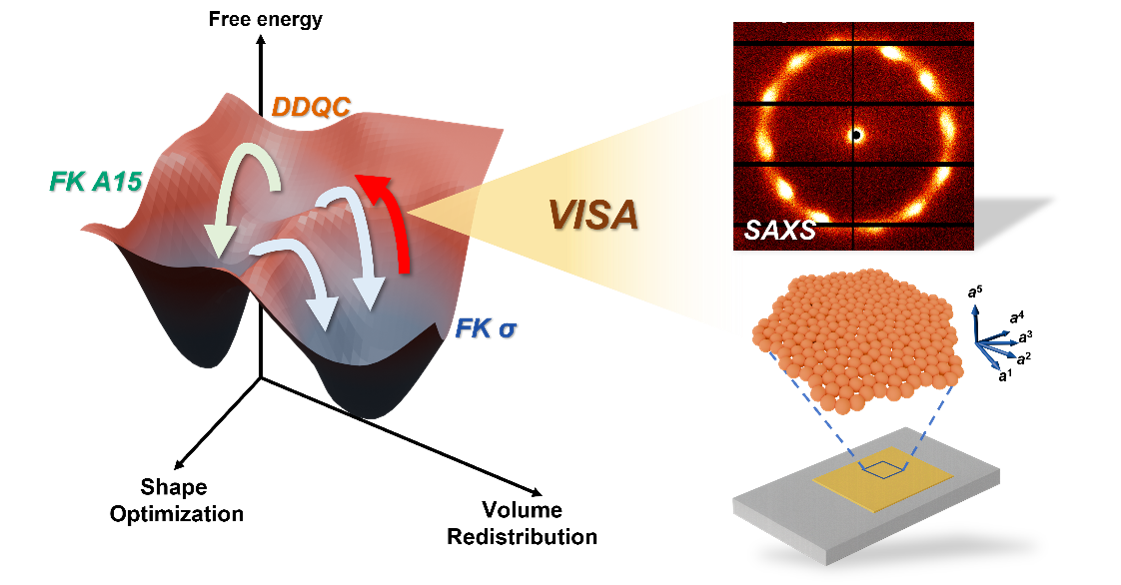
Schematic illustration of the energy landscape governing molecular self-assembly. Dodecagonal quasicrystals (DDQCs) can transform into Frank–Kasper A15 or σ phases through different pathways involving shape optimization and volume redistribution. Vapor-induced self-assembly (VISA) enables a reverse transformation toward highly aligned, face-on DDQCs with twelvefold symmetry over millimeter-scale regions.
National Taiwan University
Molecules can spontaneously organize into complex, ordered structures through a process known as self-assembly. Among these structures, soft quasicrystals are particularly fascinating because they display unusual patterns that do not repeat regularly like conventional crystals. However, producing such structures with a uniform orientation over large areas remains a major challenge.
In a recent study published in the Journal of the American Chemical Society, researchers at National Taiwan University discovered that the same molecules can follow different assembly pathways depending on temperature and molecular interactions. By tracking how their structures changed over time, the team found that an initially formed twelvefold quasicrystal gradually transformed into different ordered structures under different conditions. These findings revealed how molecular rearrangements determine which structures eventually form.
Building on this discovery, the researchers developed a strategy called vapor-induced self-assembly (VISA) to access a normally difficult-to-reach pathway. By carefully controlling vapor treatment and cooling, they guided the molecules through a reverse structural transformation, allowing them to form highly oriented quasicrystals while suppressing the formation of competing orientations.
The result was a highly aligned soft quasicrystal extending over millimeter-scale regions, with its unusual twelvefold pattern oriented uniformly across the material. This demonstrates that controlling how molecules assemble, rather than simply what structures they form, can provide a powerful way to create complex materials with large-scale structural order.
"By exploring assembly pathways that are normally difficult to access, we can guide molecules toward highly ordered structures that conventional methods struggle to produce," says co-corresponding author Chien-Lung Wang, professor of chemistry at National Taiwan University.
Prof. Chien-Lung Wang’s email address: [email protected]
Advertisement