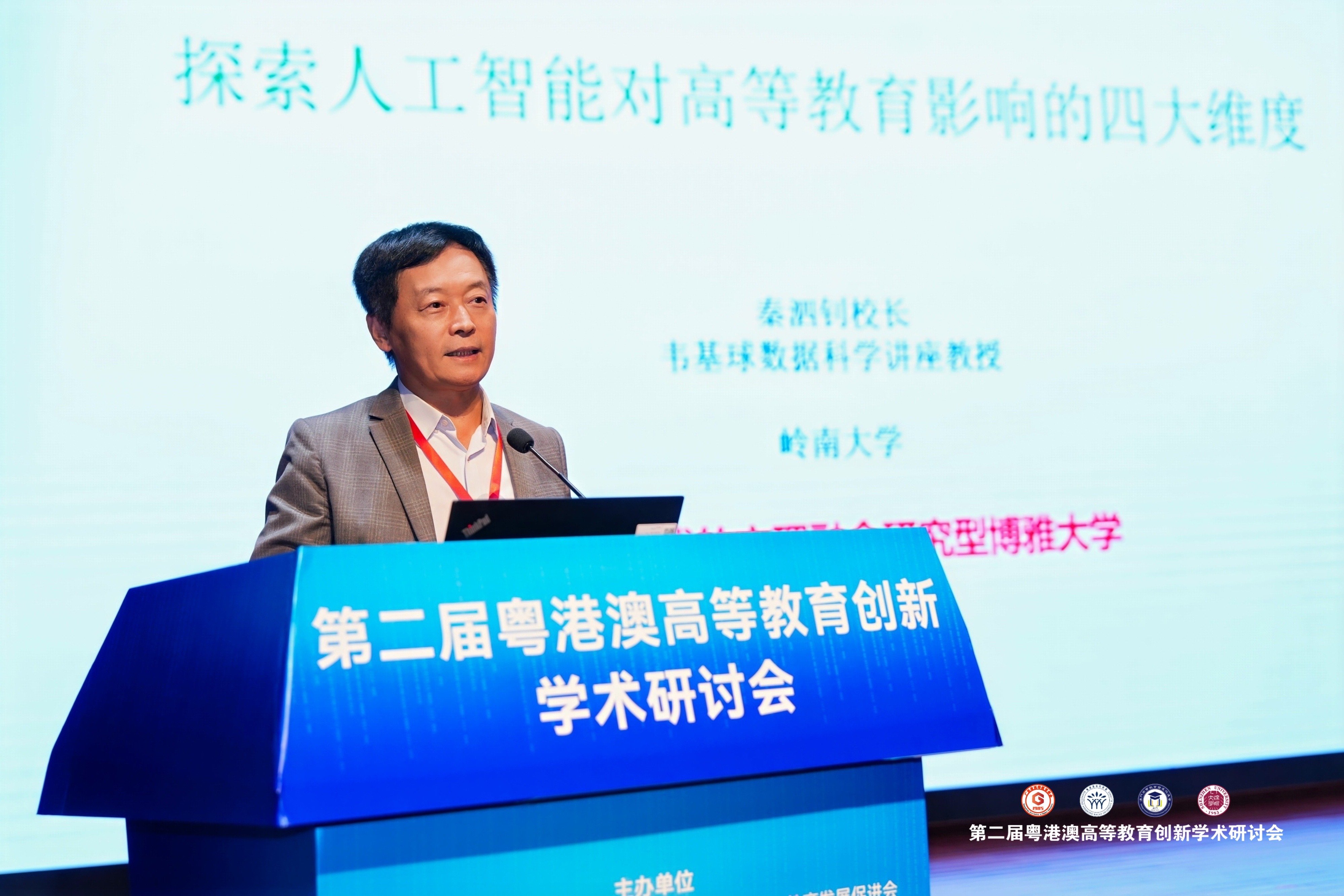
President S. Joe Qin delivers a keynote address titled "Exploring the Four Dimensions of AI’s Impact on Higher Education".
Prof S. Joe Qin, President and Wai Kee Kau Chair Professor of Data Science at Lingnan University, was invited to attend the symposium and delivered a keynote address titled "Exploring the Four Dimensions of AI’s Impact on Higher Education".
President Qin pointed out that generative artificial intelligence is profoundly reshaping the landscape of global higher education. Against this backdrop, Lingnan University is comprehensively advancing its strategic transformation, aiming to become a "research-intensive liberal arts institution comprehensive in arts and science in the digital era". Drawing upon Lingnan’s digital transformation practices, President Qin systematically elaborated on the four dimensions through which AI impacts higher education:
First, the revolution in teaching methodologies. Empowered by AI-driven education, Lingnan has spearheaded the development of the "IDEAL Gen.AI" platform, which has generated over 12,000 learning activities to date, driving the transition from traditional teaching to intelligent instruction.
Second, the innovation of curriculum and content. Educators should proactively introduce cutting-edge AI skills and topical issues to replace obsolete teaching materials. Assessment systems must be reformed simultaneously to evaluate both students’ capacity to complete tasks with the aid of AI and their competence to work independently.
Third, the restructuring of majors and disciplines. Universities should establish interdisciplinary programmes combining "AI+" with industry knowledge to cultivate talents for roles that are less susceptible to AI substitution. To this end, Lingnan has established the School of Data Science and introduced "Generative AI" as a core compulsory course for all undergraduate students.
Fourth, the establishment of a sound value system. As AI inherently carries value biases, universities bear the responsibility to educate students to build correct values rooted in Chinese culture. President Qin emphasised that studying classics, strengthening critical thinking, and fostering higher-order cognitive skills are crucial to countering ‘technological value bias.
President Qin also cited recent research data indicating that the employment rate for junior programming engineers in sectors heavily impacted by AI has dropped by approximately 20 per cent. He urged universities to approach major selections prudently from an educational ethics perspective, ensuring students do not face immediate unemployment risks upon graduation.
"In the era of artificial intelligence, humans remain at the core. We must learn to coexist and collaborate with AI", President Qin emphasised. He further noted that the higher education sector must uphold its humanistic characteristics amidst the technological wave, nurturing talents equipped with global perspectives, sound value judgements, and AI-collaborative capabilities.
As one of the eight government-funded universities in Hong Kong SAR, Lingnan University is renowned for its liberal arts education and has actively advanced its "liberal arts + technology" and "AI+" development strategies in recent years. In the Times Higher Education (THE) Asia University Rankings 2026, Lingnan ranked 84th in its debut appearance. In addition, Lingnan University secured the global first place in "SDG 4: Quality Education" of the United Nations Sustainable Development Goals, and continues to dedicatedly promote the digitalisation of higher education in the Guangdong-Hong Kong-Macao Greater Bay Area.
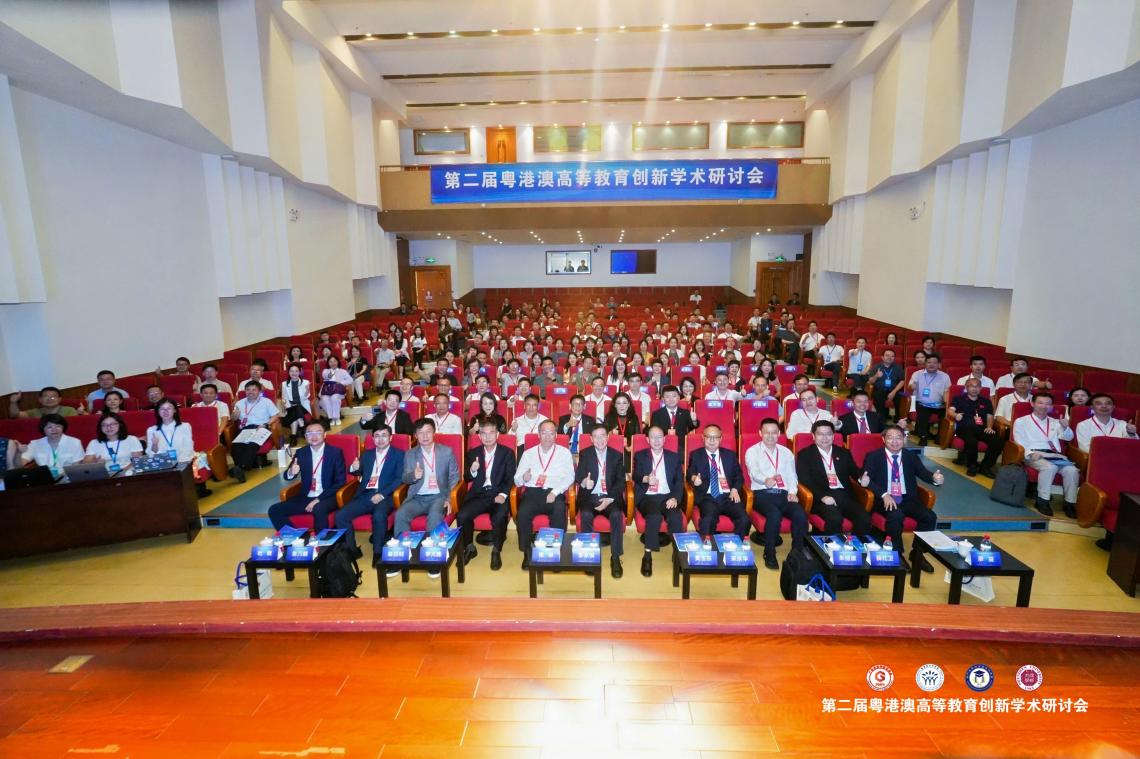
Lingnan University President S. Joe Qin attends 2nd GBA Higher Education Innovation Symposium.