
Researchers have developed an AI system that automatically figures out where an inspection photo was taken inside a building by matching it to the building's digital model, with no GPS or manual tagging required. The system achieved under two meters of location error and dramatically outperformed existing AI approaches.
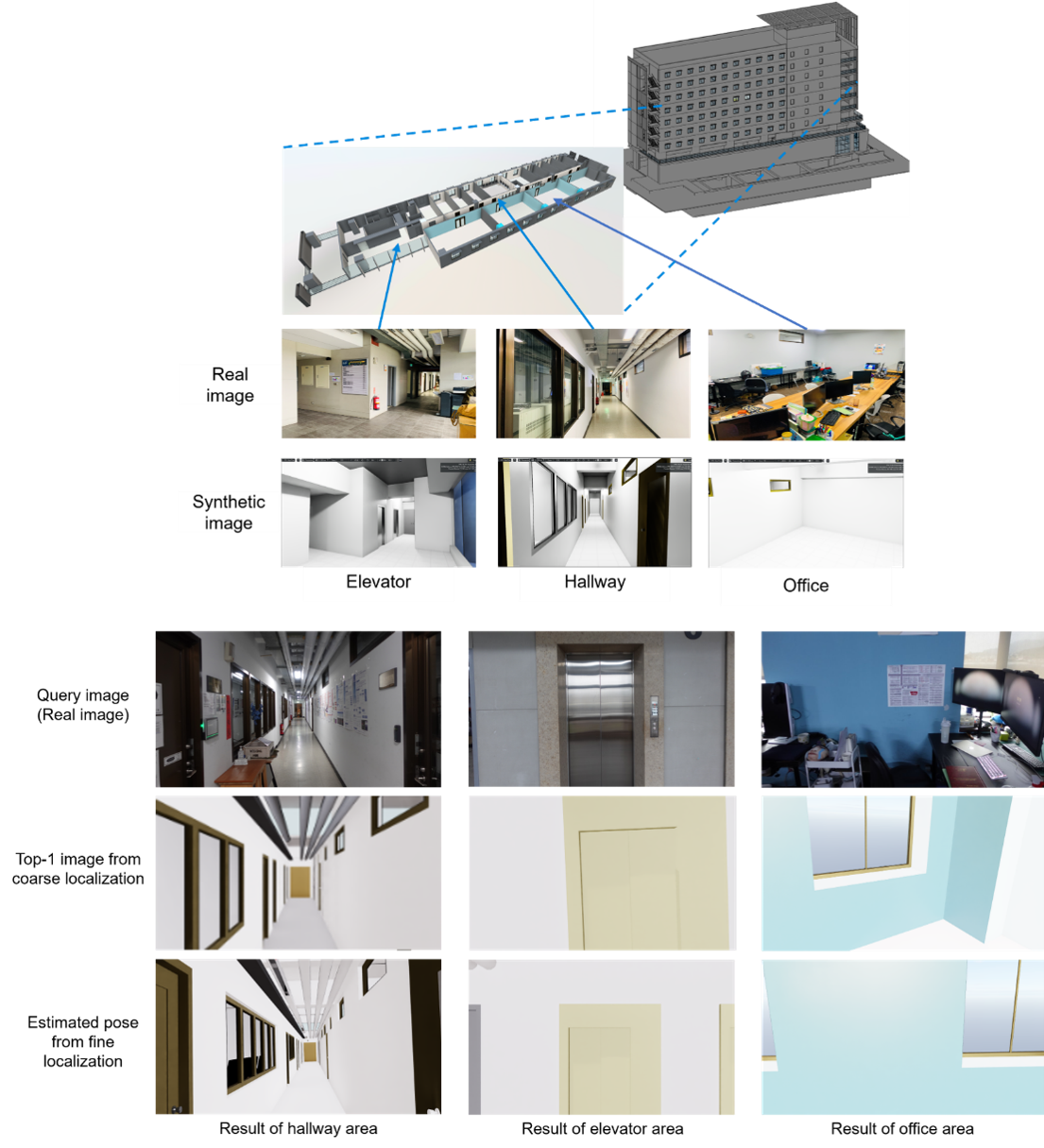
The system was tested across three indoor environments in a real research building, including a hallway, elevator lobby, and office space (top). For each real inspection photo, the AI identifies the most similar view from the building's digital model and precisely pinpoints where the photo was taken in three-dimensional space (bottom).
Automation in Construction
When a building inspector takes a photo of a cracked wall, a leaking pipe, or a faulty ceiling panel, that image carries almost no information about where exactly it was taken. There's no GPS signal indoors, and manually recording locations is slow, error-prone, and easily forgotten. As a result, thousands of inspection photos sit in folders with no spatial context, making it hard to track problems over time or link them to the correct part of a building's maintenance records.
The same challenge applies in high-tech facilities such as semiconductor fabrication plants, where inspectors regularly photograph cleanroom ceilings, pipe racks, cable trays, and mechanical systems, and where unplanned downtime from missed or mislocated faults carries enormous costs.
A research team from National Taiwan University, in collaboration with Delta Electronics, has developed an automated system that solves this problem. The system takes an ordinary inspection photo and figures out precisely where inside a building it was taken, without any special hardware, GPS, or manual input from the inspector. The study is published in Automation in Construction.
The key idea is to compare the real photo against a large library of virtual images generated from the building's digital blueprint, known as a Building Information Model, or BIM. Rather than trying to match photos pixel by pixel, which often fails because real photos look very different from computer-generated ones, the system focuses on the structure of the scene.
It identifies the walls, doors, windows, beams, and pipes visible in both the real photo and the virtual images, and builds a kind of relationship map called a scene graph that describes how these elements connect to each other spatially.
Because this structural "fingerprint" remains consistent whether the image is a real photo or a computer rendering, it bridges the gap between the two worlds far more reliably than appearance-based matching. High-tech facilities are particularly well suited to this approach, as their layouts are precisely documented in BIM from the outset and their dense infrastructure provides rich, stable visual landmarks for the system to work with.
The process works in stages. First, a coarse search quickly narrows down thousands of virtual views to a small shortlist of candidates that look structurally similar to the real photo. Then a finer geometric alignment step calculates the exact position and angle of the camera in three-dimensional space.
Tested in a real research building across three different types of spaces, a hallway, an elevator lobby, and an office, the system successfully identified the correct location in over 90% of cases in the hallway and office environments. The final location estimate landed within roughly two meters of the true position, and the camera orientation error was reduced by more than a third compared to the best existing AI method.
The practical payoff is significant across both building and high-tech facility inspection. Inspectors no longer need to manually note where they are or later try to recall which room or equipment bay a photo came from.
Every image can be automatically linked to the right place in the digital model, making it possible to track the condition of specific walls, equipment, or critical infrastructure over time, compare current conditions against the original design, and generate much richer maintenance records, all without expensive sensors or additional infrastructure.
"This work brings us closer to a future where every photo taken during a building or facility inspection is automatically anchored to the digital model, turning unstructured image archives into a spatially organized, searchable record that supports smarter and more efficient facility management," says corresponding author Prof. Jacob J. Lin in the Department of Civil Engineering at National Taiwan University.
Prof. Jacob J. Lin's email address: [email protected]
Advertisement