

The resilience of grassland ecosystems is dependent more on which species are lost and in what order, rather than the total number of species lost
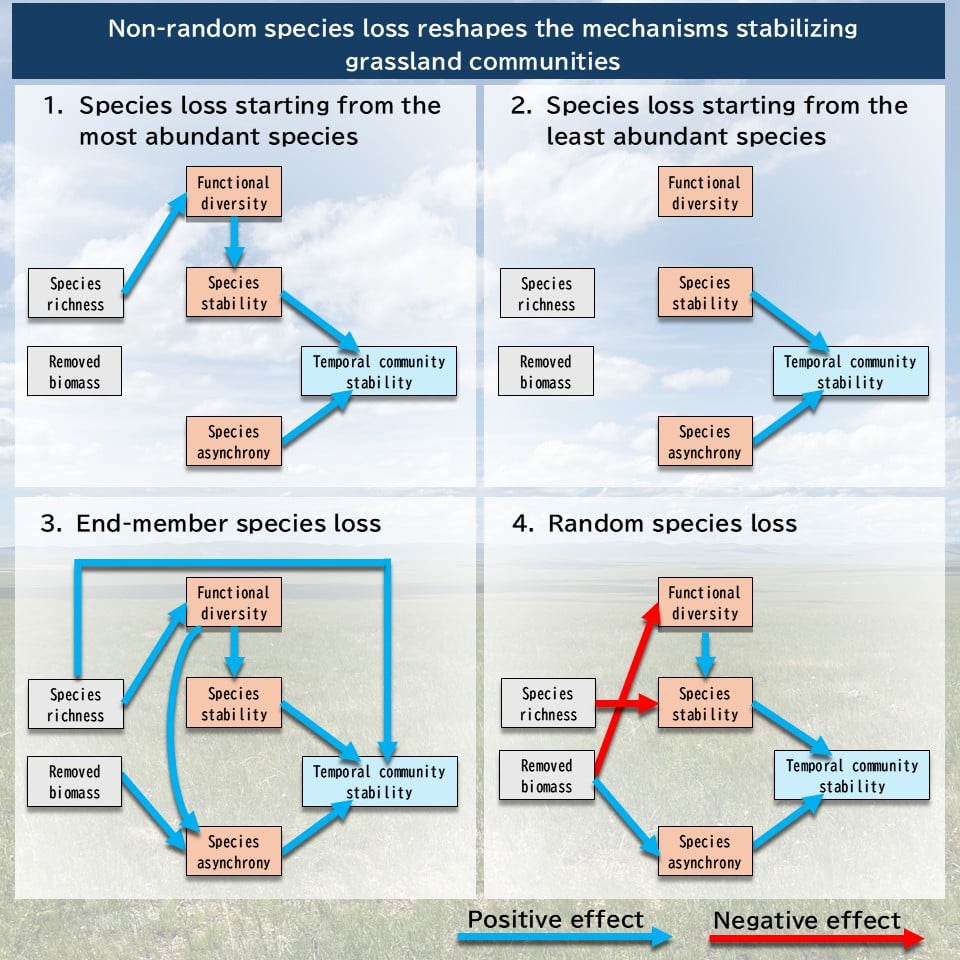
The scenario-specific figure illustrates how grassland stability is shaped not simply by how many species are lost, but by which species are lost first: different loss sequences reorganize functional diversity, compensatory dynamics, and species stability in distinct ways.
YOKOHAMA National University
Grasslands account for roughly 40% of the terrestrial ecosystems and are paramount to global food security.
Wild grasslands provide food for livestock and habitat for pollinators and act as a carbon sink in the era of climate change. Maintaining the health of native grasslands is a critical component of protecting the human food supply and sustaining biodiversity in the face of rising global temperatures and changes in weather patterns.
Community temporal stability measures the ability of grasslands to maintain productive growth over the long term despite changes in the environment. As a rule, grasslands are more stable when more plant species are present, because different species respond differently to climatic fluctuations, allowing declines in some species to be offset by the persistence or growth of others.
Many research studies have analyzed the effects of species loss on the stability of grassland communities; however, many of these experimental designs do not reflect mature or natural grassland conditions. Because of this, the processes linking biodiversity and stability are well established, but the consequences of non-random species loss, from, for example, grazing or climate change, are not well understood.
To address this issue, a group of researchers from YOKOHAMA National University designed a study to investigate how different species-loss sequences affect the stability of grasslands to identify pathways through which community stability is maintained. Notably, this design differs from previous studies that analyze how species stability and/or species asynchrony promote grassland stability.
The team published their study on June 29 in the Journal of Ecology.
“Most biodiversity experiments assume random species loss, but in the real world species are often lost non-randomly under pressures such as grazing and climate variability. We asked whether different species-loss sequences change not only community stability itself but also the processes that support it, such as functional diversity, compensatory dynamics and species stability,” said Takehiro Sasaki, professor in the Faculty of Environment and Information Sciences at YOKOHAMA National University in Yokohama, Japan.
First, the group investigated how community stability responds to experimentally imposed species loss scenarios. The team then assessed the ecological pathways responsible for affecting grassland stability. The researchers tested four hypotheses, each corresponding to a species loss scenario defined by the order of species removal. These removals were based on the abundance of the species in the grassland, which reflects different patterns of species loss that are often observed under grazing pressure, climate variability or a combination of the two.
Overall, the team didn’t find any differences in grassland community stability regardless of the order of species removal. More importantly, however, the team did find that pathways linking species loss to community stability differed depending on the order of species removal.
“Grassland communities can appear surprisingly stable in the short term even when species are lost, but the processes supporting that stability can change dramatically depending on which species are lost first. In other words, it is not just how many species disappear that matters, but who is lost and in what order. This means that random species-loss scenarios may miss important ecological consequences of real-world, non-random biodiversity change,” said Sasaki.
For example, in the scenario where highest-abundance species were lost, functional diversity declined, which reduced species stability and decreased grassland stability. The researchers found that, in this scenario, species asynchrony served as the main driver of stability, whereas species richness contributed less. In another tested scenario, however, losing the lowest-abundance species had a minimal effect on stability. In this case, grassland stability was instead correlated with species asynchrony and species stability.
Despite this, not all grasslands are alike, and the research team plans to investigate other regions over longer periods of time to see if their results hold up over the long term and across the world.
“Our experiment covered only three years, so we now want to know how non-random species loss reshapes stability over longer timescales and under broader climatic variation. Ultimately, our goal is to build a more realistic framework for predicting when biodiversity loss will erode ecosystem stability, so that conservation and grassland management can focus not just on species richness, but also on the species and functional roles that matter most for maintaining stable ecosystems,” said Sasaki.
###
YOKOHAMA National University (YNU) is a leading research university dedicated to academic excellence and global collaboration. Its faculties and research institutes lead efforts in pioneering new academic fields, advancing research in artificial intelligence, robotics, quantum information, semiconductor innovation, energy, biotechnology, ecosystems, and smart city development. Through interdisciplinary research and international partnerships, YNU drives innovation and contributes to global societal advancement.
Advertisement