
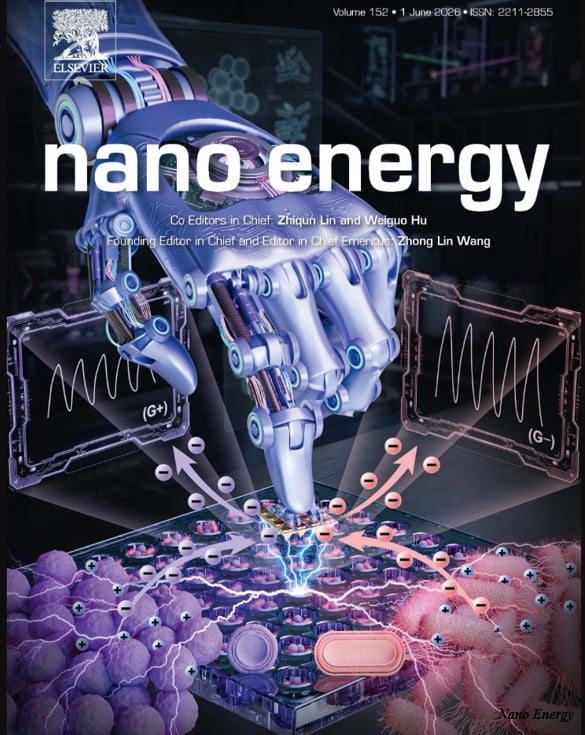

Researchers have developed a robotic platform that identifies Gram-positive and Gram-negative bacteria through touch-based electrical signals, without staining or chemical labels. Selected as a cover article in Nano Energy, the study achieved rapid classification within 0.62 seconds and 90.93% accuracy.
Illustration of the robotic triboelectric sensing platform for bacterial identification. The robotic gripper brings a flexible sensor into contact with bacterial samples, generating electrical signals that reflect differences in bacterial surface properties.
Nano Energy
Fast identification of bacteria is important in healthcare, food safety, environmental monitoring, and infection control. One of the most common first steps is Gram classification, which separates bacteria into Gram-positive and Gram-negative groups. This information can help guide early treatment decisions and safety responses. However, conventional Gram staining requires several chemical steps, trained personnel, and manual interpretation. This study was recently selected as a cover article in Nano Energy, highlighting its potential impact in rapid bacterial sensing and automated biomedical analysis.
A research team led by Prof. Zong-Hong Lin at National Taiwan University has developed a robotic sensing platform that identifies bacteria through touch. The system uses a flexible sensor mounted on a robotic gripper. When the robot gently contacts a bacterial sample, the surface of the bacteria produces a small electrical signal. Because Gram-positive and Gram-negative bacteria have different cell wall structures, they generate different signal patterns.
The team tested representative bacteria including Escherichia coli, Staphylococcus aureus, Staphylococcus epidermidis, and Pseudomonas aeruginosa. By combining signals from two sensing materials and analyzing the patterns with a computer model, the system achieved 90.93% accuracy in distinguishing Gram-positive and Gram-negative bacteria. The response time was only 620 milliseconds.
This approach offers several practical advantages. It does not require staining reagents or additional labels, and the robotic platform reduces the need for direct human handling of bacterial samples. The method is also non-destructive, meaning it may be useful for future systems that need repeated or automated monitoring.
The researchers envision that this touch-based sensing strategy could contribute to faster point-of-care diagnostics, automated microbiology workflows, and safer bacterial monitoring in healthcare and environmental settings. Further development could expand the platform to broader pathogen panels, including antibiotic-resistant bacteria and other clinically important microorganisms.
“By turning a simple touch into an electrical fingerprint, our system offers a faster and safer way to identify bacteria without chemical labels,” says co-corresponding author Zong-Hong Lin, professor and vice chair in the Department of Biomedical Engineering at National Taiwan University.
Prof. Zong-Hong Lin's email address: [email protected]
The lab of Prof. Lin linked to https://linzhatnthu.wixsite.com/suerte/research
Advertisement