
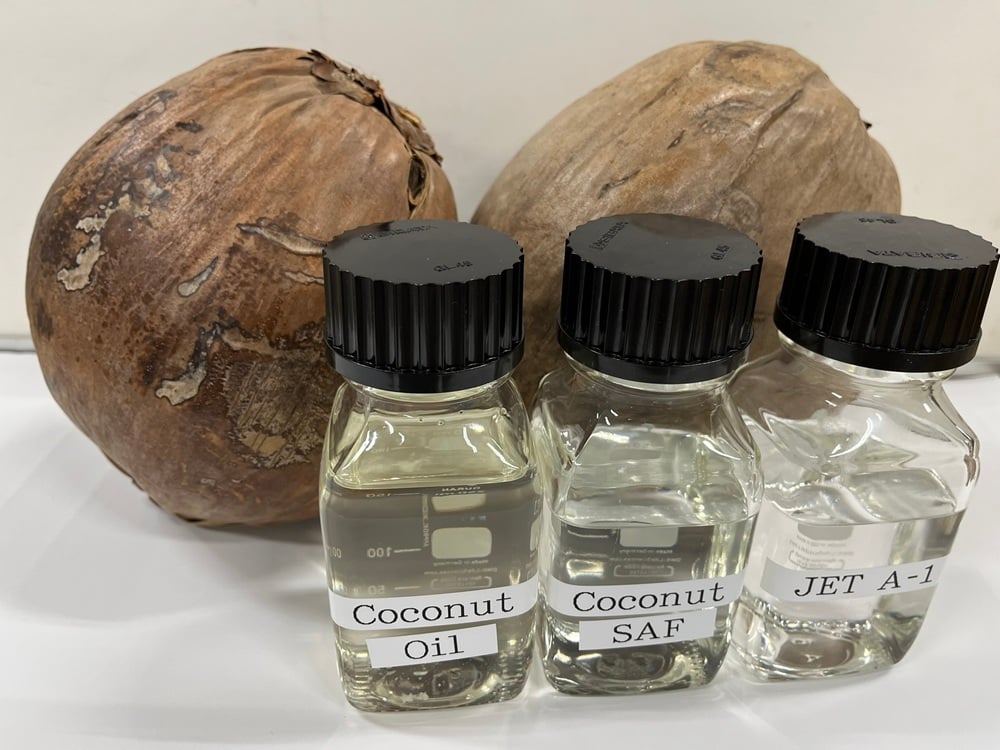

Original coconut-blend fuel performed similarly to jet fuel with reduced hydrocarbon emissions
Coconut oil is processed into SAF, which is chemically similar to the commonly used jet fuel JET A-1.
Osaka Metropolitan University
With airlines and consumers increasingly concerned about carbon, nitrogen, and hydrocarbon emissions, biofuels have emerged as a green alternative. Among these, those made from coconut oils are particularly attractive as they have fatty acid chain lengths similar to the hydrocarbon chain lengths required for jet fuel, suggesting that they could make effective fuels with minimal processing.
Now, using a unique co-solvent method, a team from Osaka Metropolitan University has created a coconut oil-based fuel that could be added to jet fuel without lowering performance.
The co-solvent method combines coconut oil extracts with acetone and alcohol. This process allows fuel to be produced under ambient temperature and pressure, reducing energy consumption and ensuring purity during manufacturing. They created two biofuels that could potentially be added to conventional jet fuel: FAME using methanol; and FAEE using ethanol.
To investigate the ideal blend, they varied the ratio of FAME and FAEE with Jet A-1, a conventional jet fuel. The researchers wanted to find the ideal ratio that balanced fuel consumption, thermal efficiency, and exhaust gas emissions using a small turbojet engine.
They found that despite increases in fuel consumption as the biofuel blending ratio increased, which was likely due to differences in the heating values of the two fuels, thermal efficiency remained comparable to that of Jet A-1.
Their trials also showed a decrease in hydrocarbon emissions as well as no significant changes in CO₂ or NO emissions, two pollutants that are largely responsible for the carbon and nitrogen footprints of airlines.
“The experiments showed that our fuel blend can operate in existing gas turbine engines without major loss of efficiency or engine performance, and without increasing emissions,” Dr. Huynh Phuong Uyen Nguyen of the Graduate School of Sustainable System Sciences summarized.
The findings could be especially important for Asian countries. In Southeast Asia, approximately 30% of harvested coconuts are discarded because they do not meet commercial standards, creating a potential source for biofuel production, especially as the region is at risk of fuel shock.
“In the future, we want to improve fuel consumption performance and establish technologies for operating engines on 100% biofuel,” Dr. Ogawa said. “Looking ahead, we also want to advance the practical application of this fuel by improving its long-term storage stability, material compatibility, and environmental impacts through life cycle assessment.”
The study was published in Fuel.
Declaration of competing interest
The authors declare that they have no known competing financial interests or personal relationships that could have appeared to influence the work reported in this paper.
###
About OMU
Established in Osaka as one of the largest public universities in Japan, Osaka Metropolitan University is committed to shaping the future of society through the “Convergence of Knowledge” and the promotion of world-class research. For more research news, visit https://www.omu.ac.jp/en/ and follow us on social media: X, Instagram, LinkedIn.
Advertisement