


Researchers at the University of Osaka and collaborators developed an ultra-wideband (UWB) radio-based positioning method for electric vehicle wireless charging. By combining signal travel times, phase differences, and calibration, the system accurately estimates the position and orientation of a vehicle's charging coil relative to a charging pad. Laboratory experiments using a scaled-down vehicle mockup achieved median errors of 2.32 millimeters and 0.25 degrees, a promising step toward automated wireless charging for self-driving vehicles.
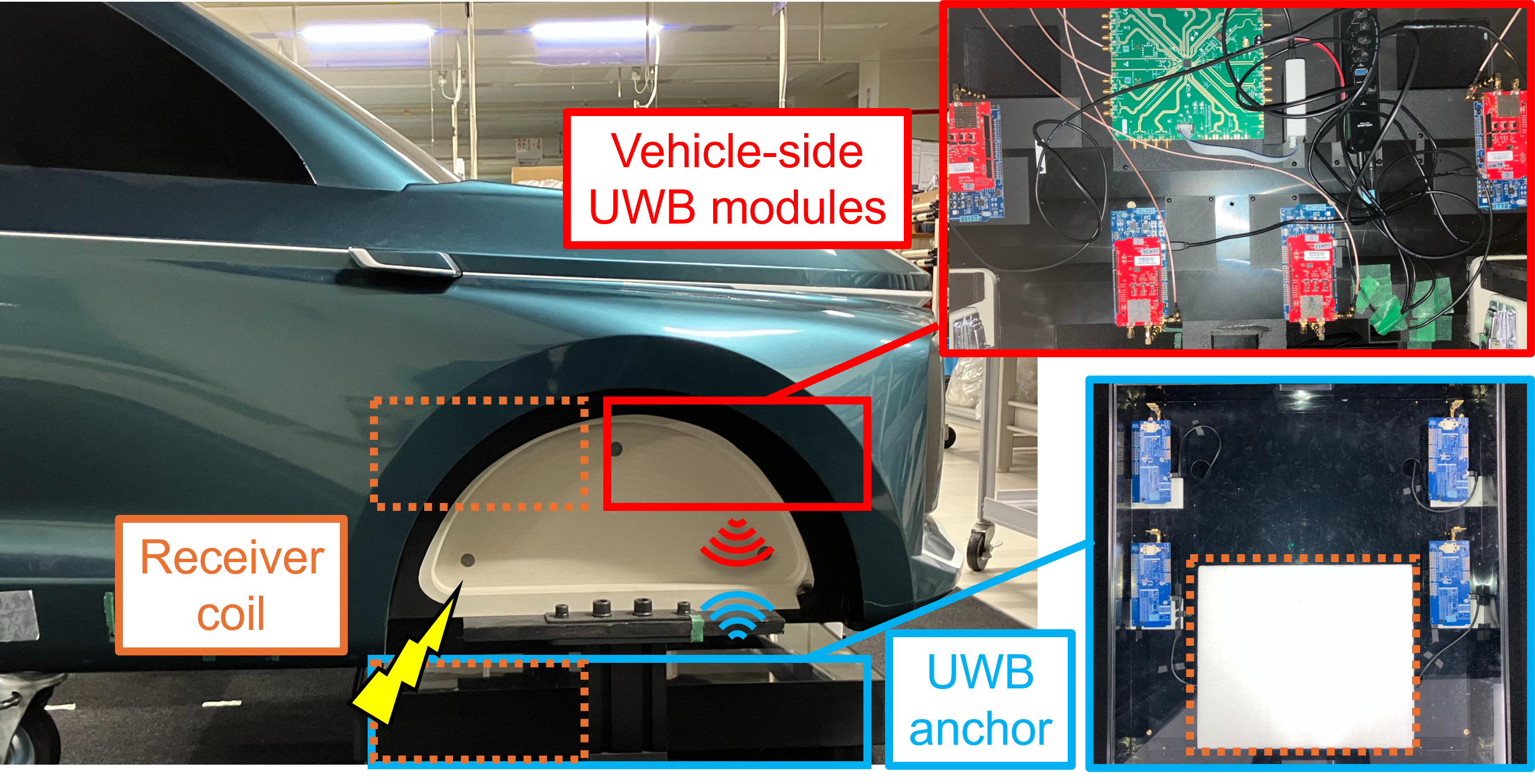
Fig. 1
Experimental setup for UWB-based alignment in wireless electric vehicle charging. Four synchronized UWB modules are mounted around the receiver-coil region of a scaled vehicle mockup (red), while a ground-side UWB anchor unit with four antenna elements is positioned around the charging pad (blue). The system combines radio-signal travel times and phase differences to estimate the receiver coil’s planar position and heading relative to the pad. Insets show the vehicle-side modules and the ground-side anchor unit.
CC BY, Credit must be given to the creator., 2026 Ryotaro Hada et al. Licensed under CC BY 4.0.
Researchers at the University of Osaka have developed a radio-based positioning method that could help electric vehicles align precisely with wireless charging pads.
Osaka, Japan –Imagine parking your electric vehicle (EV) and charging it without plugging in a cable. Wireless charging makes this possible, but efficient charging requires precise alignment between the vehicle's receiver coil and the charging pad. Researchers at the University of Osaka, working with TOKAI RIKA CO., LTD. and the University of California San Diego, have developed a technology that could help vehicles do just that. Using ultra-wideband (UWB) radio signals, the same short-range wireless technology used in some digital car keys, the system accurately determines where the vehicle's charging coil sits over a wireless charging pad and which way the vehicle is facing. This study was published in the IEEE Open Journal of Vehicular Technology on August 26, 2026.
Wireless EV charging transfers electricity from a ground-mounted pad to a coil beneath the vehicle. However, if the coil is a few centimeters off-center or the vehicle is misaligned, charging efficiency can decrease, potentially increasing charging time. Existing magnetic positioning systems generally work best when the coil is close to the pad, while cameras can struggle with rain, dirt, or poor lighting.
The team developed a two-step positioning method combining radio-signal travel times with phase differences. Travel times first give the vehicle's approximate location; phase differences, which are tiny shifts in how the radio waves arrive at each device on the vehicle, then refine its position and orientation. Signal distortions specific to each installation are measured in advance and corrected.
As illustrated in Figure 1, four UWB devices mounted around the vehicle's receiver coil communicate with antennas near the charging pad. Movie shows how the resulting positioning information can be displayed to guide the vehicle into proper alignment.
In laboratory experiments with a scaled-down vehicle mockup, the method achieved median position and orientation estimation errors of just 2.32 millimeters and 0.25 degrees, respectively, based on repeated measurements at a fixed stopping position. Without the phase-bias correction, the median position error was about five times larger.
The technology could support more convenient and efficient wireless charging, particularly for autonomous vehicles and robotaxis that must recharge without human assistance. Further testing with full-sized vehicles, outdoors and during actual power transfer, is needed.
“Turning a computational method into a working system required considerable trial and error. We hope this research will lead to a future where EVs charge simply by parking, much like smartphones placed on wireless chargers,” says Ryotaro Hada, the first author of the study.
###
The article, “Toward Precise Pad-to-Coil Alignment in EV Inductive Charging With UWB,” was published in IEEE Open Journal of Vehicular Technology at DOI: https://doi.org/10.1109/OJVT.2026.3725689
Movie
Caption: Visualization of coil alignment for wireless electric vehicle charging. The left panel shows the vehicle and parking bay, while the right panel provides a close-up view of the receiver coil relative to the ground charging pad. Colored guidelines and arrows illustrate corrections to the vehicle’s position and heading. The lightning symbol represents the intended charging state once the coils are aligned.
License:CC BY
Usage restriction: Credit must be given to the creator.
Credit: 2026 Ryotaro Hada et al. Licensed under CC BY 4.0.
About The University of Osaka
The University of Osaka was founded in 1931 as one of the seven imperial universities of Japan and is now one of Japan's leading comprehensive universities with a broad disciplinary spectrum. This strength is coupled with a singular drive for innovation that extends throughout the scientific process, from fundamental research to the creation of applied technology with positive economic impacts. Its commitment to innovation has been recognized in Japan and around the world. Now, the University of Osaka is leveraging its role as a Designated National University Corporation selected by the Ministry of Education, Culture, Sports, Science and Technology to contribute to innovation for human welfare, sustainable development of society, and social transformation.
Website: https://resou.osaka-u.ac.jp/en
Advertisement