
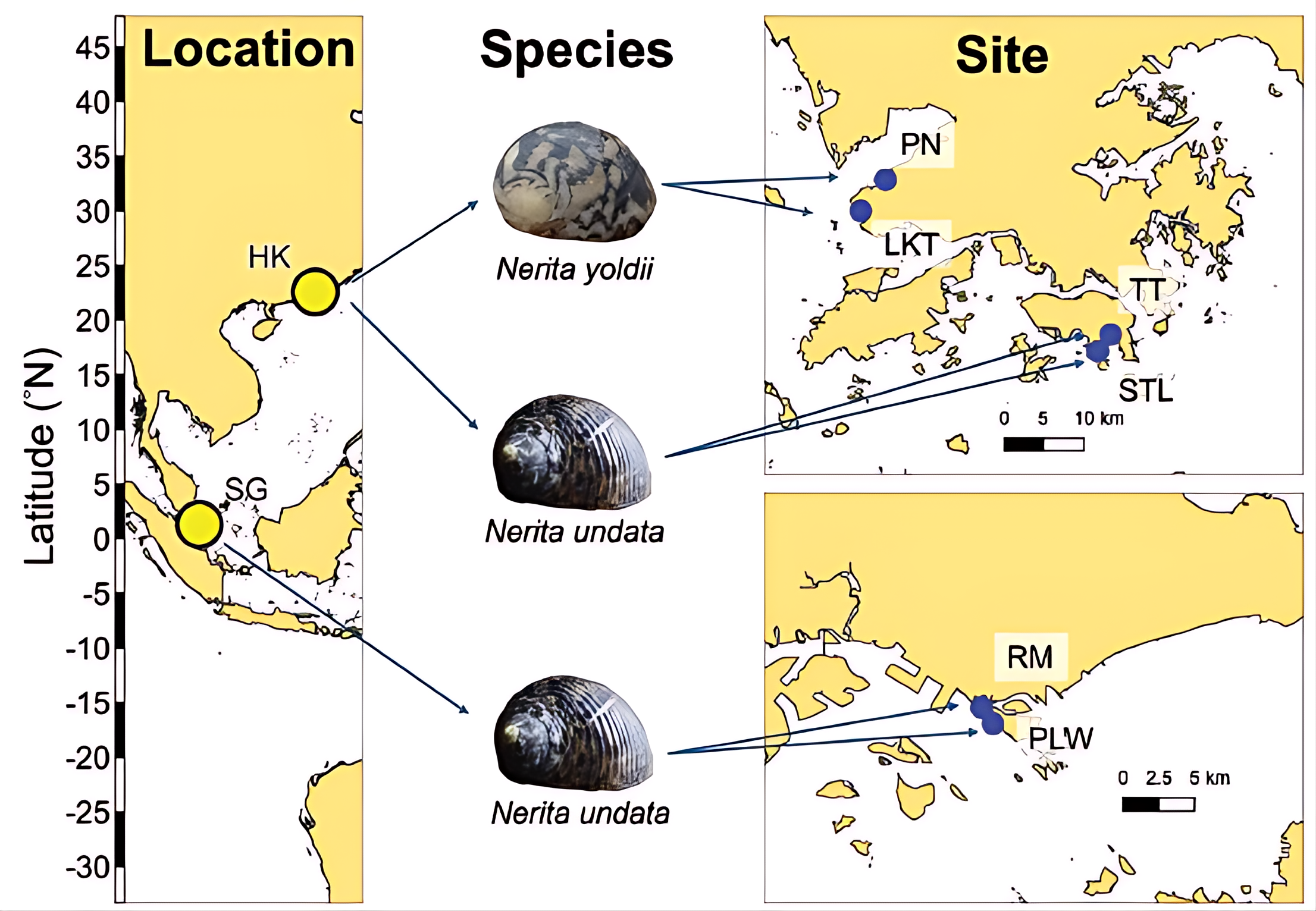
The research team selects six rocky shore sites in the Hong Kong SAR and Singapore: Tai Tam, Stanley, Lung Kwu Tan, and Pak Nai in Hong Kong, and Palawan Beach and the Rimau coast in Singapore. A hundred and twenty-six adult tropical intertidal snails of similar size (62 Nerita undata and 64 Nerita yoldii, both belonging to the family Neritidae) were collected and brought to the laboratory for analysis.

Prof Tommy Hui Tin-yan, the first author of the paper and the Assistant Professor of the Division of Science at Lingnan University, with the research team.
With global warming and extreme weather intensifying, can animals raise their thermal tolerance to cope with a continuously warming environment? A joint research project run by theDivision of Science at Lingnan University and an international research team carried out practical testing on tropical intertidal snails that live under the scorching sun. The team simulated the real-world conditions of coastal rocks heating up under intense sunlight in the Hong Kong SAR and Singapore, and discovered that the maximum temperature of some rocks has approached the upper physiological thermal limit of these intertidal snails. Since this can cause cardiac arrest and an inability to maintain normal physiological functions, it means that their thermal tolerance may not be able to increase indefinitely as the environment continues to warm, and extreme heat in the future may increase their risk of mortality. The research findings have been published in internationally renowned academic journal The Biological Bulletin.
The research team, from the Division of Science of Lingnan University, the University at Buffalo, New York, the National University of Singapore, and The University of Hong Kong, focused the study on rocky shore snails in the genus Nerita—tropical intertidal snails with high thermal tolerance—so as to understand how they cope with the stress of extreme heat on tropical rocky shores exposed to the blazing sun for prolonged periods. The team selected six sites in the Hong Kong SAR and Singapore: Tai Tam, Stanley, Lung Kwu Tan and Pak Nai in Hong Kong, and Palawan Beach and the Rimau coast in Singapore. Temperature loggers were deployed to monitor the actual surface temperature of the rocks continuously for approximately one month.
The team collected 126 adult tropical intertidal snails of similar size on the six rocky shore sites, 62 Nerita undata and 64 Nerita yoldii, both belonging to the family Neritidae, and brought them to the laboratory for analysis. Using a programmable water bath to simulate the natural conditions of rocky shores in the Hong Kong SARand Singapore heating up during low-tide exposure, the team attached infrared photocoupler sensors to the shells of the snails. This allowed real-time monitoring of their heart rates and body temperature responses during the heating process, thereby estimating their upper physiological thermal limit and metabolic performance.
The results revealed that the snails’ heart ratesaccelerated as their body temperature rose, showing an increased metabolic rate. However, when the body temperature reached approximately 40 to 45 degrees Celsius, their heart rates began to plunge sharply. The team hypothesised that when organisms are exposed to extreme heat for prolonged periods, they may reduce energy consumption by lowering their heart rates and metabolic levels. The test also found that when the snails’ body temperature rose to approximately 47.7 to 51.4 degrees C, their hearts stopped beating, and they could not maintain normal physiological functions. This indicates that this temperature range is close to the upper physiological thermal limit, and thermal tolerance may not increase indefinitely with continuously rising temperatures.
The team pointed out that rock temperatures in the Hong Kong SAR, where the maximum recorded temperature is around 50 degrees C, are lower than those in Singapore. Temperatures in rock crevices and shaded microhabitats were generally below 42 degrees C, providing a thermal buffer zone for the snails to shelter and cool down. Their thermal tolerance in the experiment increased as environmental temperatures rose, but in the hotter climate of Singapore, the maximum rock surface temperature reached 57 degrees C, and even the crevices and shaded areas used for sheltering recorded temperatures exceeded 55 degrees C—comparable to the upper physiological thermal limit they recorded. Analytical results showed that although the overall thermal tolerance of the Singapore population was higher than that of theHong Kong SAR, it did not increase further in the hotter habitat, which indicates that some tropical organisms may already have approached their upper physiological thermal limit, and more frequent extreme heatwaves in the future may raise their mortality risk.
Prof Tommy Hui Tin-yan, the first author of the paper and Assistant Professor of the Division of Science at Lingnan University, explained that so-called physiological thermal tolerance refers to an organism’s capacity to withstand higher body temperatures without dying. Tropical intertidal snails typically move away from sun-exposed areas to shelter during low tides. However, as extreme weather intensifies, they will have less time to forage for microalgae and biofilms on rock surfaces. Consequently, they must expend energy to maintain physiological functions while simultaneously reducing energy intake due to restricted foraging, creating a vicious cycle of increased expenditure and decreased replenishment, which exacerbates the stress and risks to their survival.
Prof Hui further explained, “Many people assume that organisms will adapt naturally to climate warming. However, the results of this study demonstrate that even tropical intertidal snails that live under the blazing sun long-term and possess exceptionally strong thermal tolerance may not be able to cope with rising temperatures indefinitely. Whether in the Hong Kong SAR or Singapore, as habitats become increasingly hot, the buffer zone between the actual environmental temperature and the upper physiological thermal limit becomes narrower. Organisms may need to pay a higher energetic cost to maintain basic physiological functions, which limits their capacity to adapt to even hotter temperatures.”
Prof Hui noted this study’s findings also offer insights for human society. Global warming will extend the duration of high temperatures, which may prolong the time humans spend sheltering from the heat inside air-conditioned rooms. This intensifies global warming through a higher power consumption, and impacts other economic activities such as agriculture, construction, and logistics. The high consumption and intensified warming parallel the vicious cycle faced by tropical intertidal snails. The impact of extreme heat on ecosystems is far greater than we imagine, and society should not assume that humans can adapt to global warming over the long term. Therefore, the challenges brought by climate change are no longer a distant threat, and taking more robust climate action is a matter of urgency.