
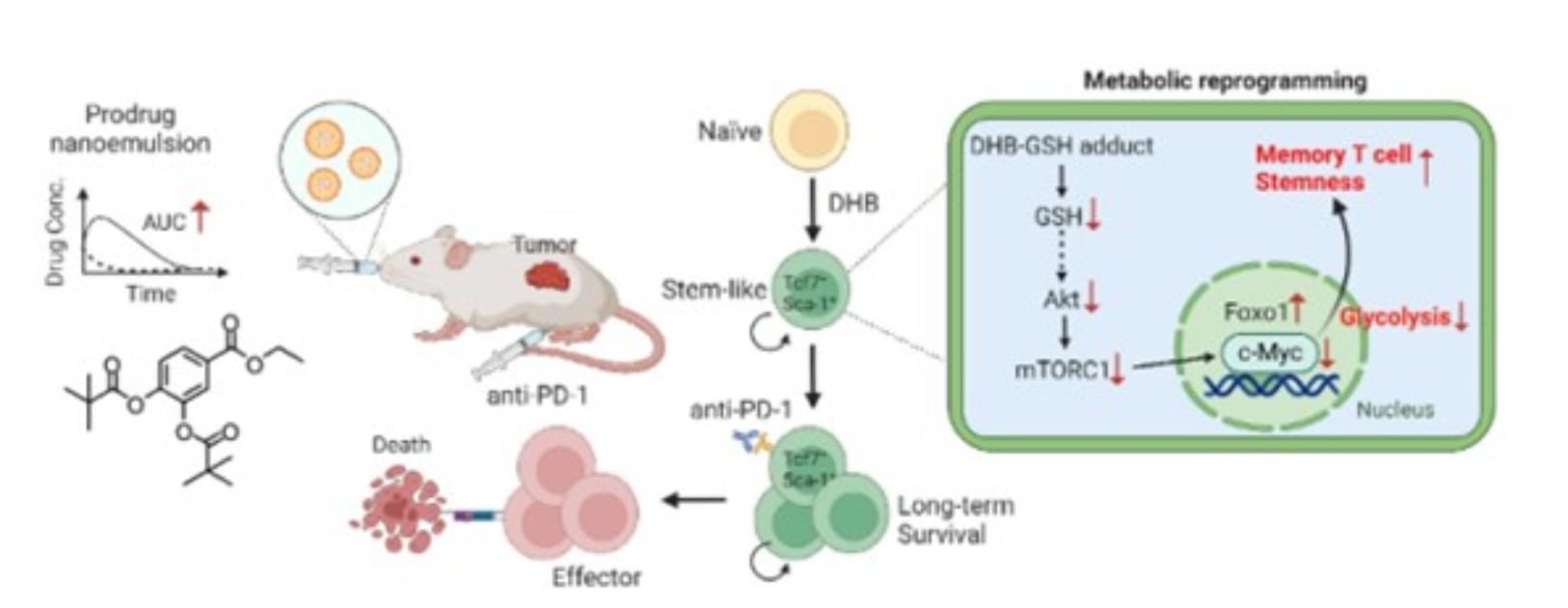

• Engineered a DHB prodrug-based oral nano-emulsion with enhanced bioavailability, dramatically improving the efficacy of immune checkpoint blockade therapy
The gut microbial metabolite DHB promotes the formation of antigen-specific, stem-like CD8+ T cells by suppressing glycolysis and modulating the Akt-mTORC1-Myc pathway. Oral nano-emulsion formulation of DHB significantly improves its bioavailability, demonstrating potent anti-tumor efficacy when combined with immune checkpoint inhibitors.
Han, K., Cho, Y.S., Takahashi, M. et al. Oral nano-delivery of a gut microbial metabolite enhances T cell stemness for cancer immunotherapy. Nat. Nanotechnol. (2026). https://doi.org/10.1038/s41565-026-02235-9
A joint research team—led by Professor Young Seok Cho from the School of Medicine, alongside Professor James J. Moon from the University of Michigan—has successfully developed the world’s first oral, microbiome-based nanomedicine. By leveraging natural metabolites produced by gut bacteria, the new drug significantly enhances the ability of immune cells to attack cancer cells. This breakthrough study was published in the latest issue of Nature Nanotechnology, one of the world's premier journals in nanoscience and medicine.
In recent years, "immunotherapy" (such as anti-PD-1 drugs) has emerged as a revolutionary treatment option that reawakens the body’s own immune system to fight cancer. However, its effectiveness has been limited because only a small fraction of patients respond positively. To overcome this challenge, the research team focused on the connection between gut microbiome and immunity. They discovered that a microbial metabolite called 3,4-dihydroxybenzoic acid (DHB) acts as a powerful immune booster, safely driving the body’s defenses against tumors.
The study revealed that DHB strongly promotes "stemness" in CD8+ T cells—the primary immune cells responsible for destroying cancer. Normally, T cells become exhausted and lose their fighting power due to overactive sugar breakdown processes (glycolysis). DHB blocks this metabolic exhaustion and turns on a survival switch, enabling T cells to stay active and attack cancer cells over longer periods.
Despite its promise, natural DHB presented a major obstacle: once ingested, it rapidly breaks down and disappears from the body within minutes. To solve this, the team applied advanced nanotechnology. They chemically modified DHB into a stable prodrug and further encapsulated it into an oleic acid-based oral nano-emulsion (named Prodrug 201).
This oral nanomedicine drastically extends the time the drug stays in the bloodstream, boosting its overall absorption rate (bioavailability) by 14.3 times. In animal models with colorectal cancer, melanoma, and breast cancer, the oral nanomedicine effectively directed refreshed, stem-like T cells right into the tumor sites, leading to dramatic tumor shrinkage. When combined with immune checkpoint blockade therapy, it completely eradicated tumors in test models and created long-term immune memory to prevent cancer recurrence.
"This study unveils the molecular secret of how gut microbial metabolite regulate our immune system and successfully translates that knowledge into a convenient, oral medication through nanotechnology," said Professor Young Seok Cho, who led the research. "By converting previously untapped microbial resources into a safe and scalable nanomedicine, this work builds a critical foundation for commercializing next-generation microbiome-based cancer immunotherapies."
Advertisement