

SUTD researchers have found that older adults are most open to embracing social chatbots that feel authentic and socially engaging but not too human, offering clear lessons for designers of AI companions.
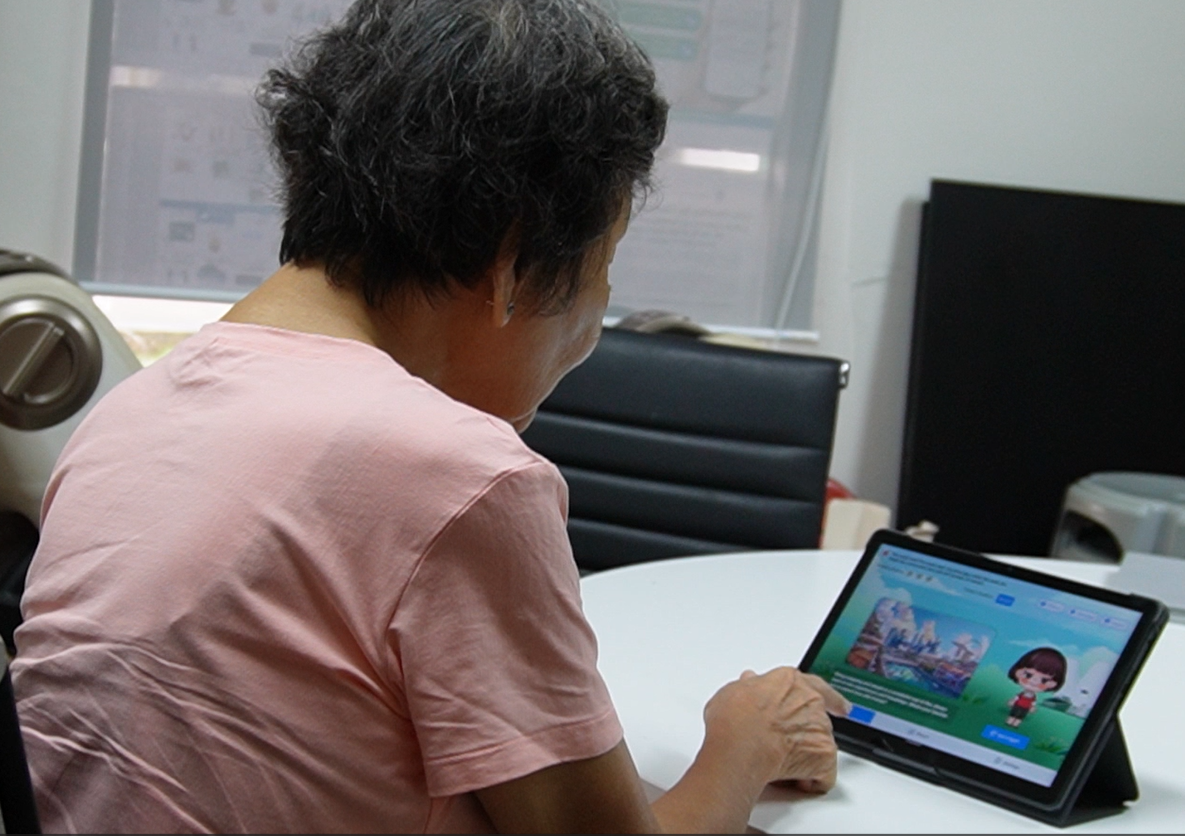
An older adult from one of the community collaborators interacting with the AI chatbot, Ami Chat.
SUTD
Loneliness in later life is more than an emotional burden. Studies estimate that between 17 and 47 percent of older adults aged 60 and above in Singapore are socially isolated, with almost 8 percent experiencing loneliness. Alarmingly, the health toll of such conditions has been compared to smoking 15 cigarettes a day.
As artificial intelligence (AI) chatbots grow more capable and conversational, they are increasingly viewed as a scalable, low-cost source of companionship that could complement human relationships. But how willing are older adults to embrace AI chatbots?
To address this, researchers from the Singapore University of Technology and Design (SUTD) invited 140 community-dwelling older adults aged 60 to 89 to interact with Ami Chat, a social chatbot that the research team developed. The researchers then surveyed the participants’ attitudes and intention to use a social chatbot in daily life. This study, which highlights the use of design, AI and technology, was published in “Factors influencing older adults' intention to use social chatbots: Examining technology acceptance, anthropomorphism, authenticity, and artificial intelligence social interaction”.
“We were motivated by the growing use of AI chatbots among older adults yet significant lack of empirical research on what drives this demographic to adopt them, especially for companionship,” said Professor Yow Wei Quin, who led the research team. “We developed Ami Chat to ensure it was specifically tailored and age-friendly for older adults, and relatable for users in the Singapore context.”
Powered by a large language model, the chatbot speaks and listens instead of requiring typing. Enlarged buttons and simple gestures keep navigation easy, while its cartoon avatar, a warm-hearted Singaporean woman, replies in short, colloquial phrases.
In the study, the researchers extended the Senior Technology Acceptance Model (STAM), which links adoption to factors such as perceived ease of use and health, with three socio-relational measures: anthropomorphism (how human-like the chatbot seems), authenticity (how genuine and responsive it feels), and AI social interaction intensity (AISI), which captures how closely an exchange resembles conversation with a friend.
"We developed Ami Chat to ensure it was specifically tailored and age-friendly for older adults, and relatable for users in the Singapore context."
Professor Yow Wei Quin, Singapore University of Technology and Design
STAM factors explained 26 percent of the variation in older adults’ intention to use the chatbot, while the socio-relational measures accounted for a further 27 percent. Participants were most inclined to adopt Ami Chat when they felt confident and supported in using it, when the chatbot seemed authentic, and when interactions felt reciprocal and close.
The chatbot’s human-likeness told a different story, however. Once the closeness of the interaction was accounted for, participants who perceived the chatbot as more human-like reported lower intention to use it.
“Being socially engaging is not the same as being human-like,” said Prof Yow. “People may want chatbots that interact well, but not chatbots that pretend to be people.”
Health also shaped adoption in an unexpected direction. Older adults who rated their health less positively expressed stronger intention to use the chatbot, a pattern linked mainly to difficulty concentrating and lower life satisfaction.
“Those who are less satisfied with their quality of life may be more motivated to explore technologies that could provide conversation or support,” she shared.
The findings serve as practical guidance for developers to build chatbots that remember past conversations and adapt to a user’s preferences, keep interfaces simple, and resist the urge to maximise human-likeness. The aim is a system that communicates naturally and responds well while remaining clearly recognisable as a chatbot. How the technology is introduced matters too.
“Introductions should provide hands-on technical support, clear tutorials, and accessible guidance to ensure users feel confident in their ability to operate the technology,” Prof Yow added. “These insights are essential for creating effective, scalable AI companions that can combat loneliness and support the well-being of ageing populations.”
The team acknowledges that the study captured first impressions from a single session in a controlled setting, and that intention to use is a proxy for, rather than proof of, sustained adoption. Since the study’s publication, Ami Chat has been rebranded Ami-Go, and the next phase of the research will follow older adults using Ami-Go over longer periods in everyday settings.
Ami-Go has also been integrated with Ami-Able, the dual-language cognitive training programme developed by Prof Yow’s lab, into a platform now nearing the completion of its initial testing.
Advertisement