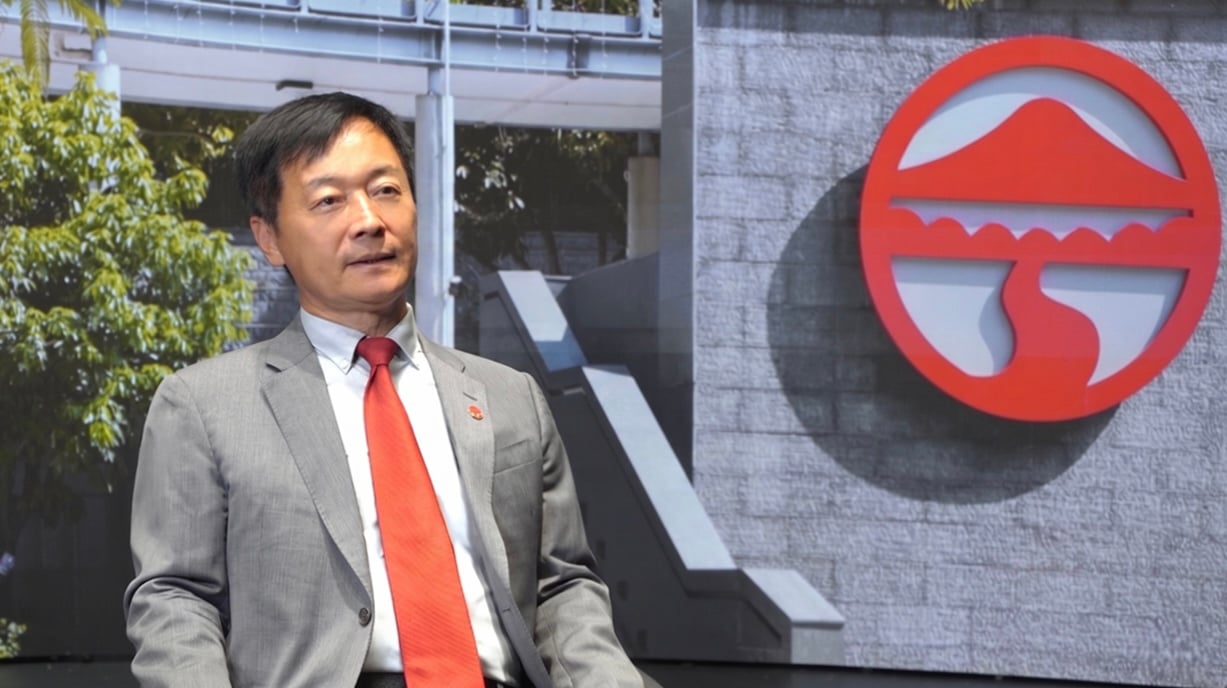
Prof S. Joe Qin, President and Wai Kee Kau Chair Professor of Data Science at Lingnan University.
President Qin said that the release of Hong Kong’s First Five-Year Plan, which devotes considerable attention to policy measures relating to the development of the Northern Metropolis, education, talent development, and innovation and technology research, sets out a comprehensive plan for Hong Kong’s development over the next five years. President Qin considers this an important practical step for Hong Kong to integrate more actively into the overall development of the country, aligning with the direction of the National 15th Five-Year Plan, while the 2026 Policy Address further sets out concrete policy measures to progressively implement the relevant development directions. The two documents are closely interconnected and can make full use of Hong Kong’s strengths and achieve complementary advantages, particularly by strengthening collaboration in higher education, innovation and technology, and talent development, thereby making better use of Hong Kong’s unique advantages and contributing to long-term high-quality economic development.
(1) Support for the expansion and enhancement of post-secondary education
President Qin welcomes the HKSAR Government’s announcement to increase the number of University Grants Committee (UGC)-funded research postgraduate places by approximately 30 per cent, from the current 7,200 to 9,600 by the 2030/31 academic year, as well as to gradually increase the annual quota of the Hong Kong PhD Fellowship Scheme by 400 places from the 2027/28 academic year, reaching 550 places in the 2029/30 academic year.
He pointed out that postgraduate students are an important force in driving knowledge innovation and research development. At Lingnan, for example, six outstanding PhD students from the Chinese Mainland, France, Russia, the US and Bangladesh have been awarded the Hong Kong PhD Fellowship Scheme in the new academic year, marking a record high for the University. In addition, Lingnan has for two consecutive years been the Hong Kong higher education institution receiving the highest number of awards and gold awards at the Silicon Valley International Invention Festival. With the expansion of post-secondary education, Lingnan will be able to further increase postgraduate participation in interdisciplinary research projects integrating the liberal arts and technology, including “liberal Arts + technology” and “AI +”, enabling young scholars to work closely with professors in research, innovation and development, address real-world challenges, and nurture more research-oriented talent for the HKSAR and the country.
(2) Support for the Hong Kong Artificial Intelligence Research and Development Institute to Advance Upstream Research
As a member of the Board of Directors of the Hong Kong Artificial Intelligence Research and Development Institute, Prof Qin welcomes the HKSAR Government’s support for the Institute in using high-performance computing to support cutting-edge research, accelerate innovation breakthroughs, enhance original research capabilities and research outputs in artificial intelligence, and promote the translation of research outcomes in the HKSAR and the Chinese Mainland. He also welcomes the injection of HK$1 billion into the Artificial Intelligence Subsidy Scheme to further support artificial intelligence research and innovation breakthroughs.
President Qin pointed out that to seize the opportunities presented by the development of artificial intelligence, Hong Kong should continue to advance upstream research and the translation of research outcomes, while also placing greater emphasis on education and talent development to establish an AI development system connecting research, education and applications across society. As a member of the Board of Directors, he said he would bring Lingnan’s practical experience in AI education, talent development and research over the past several years to the work of the Hong Kong Artificial Intelligence Research and Development Institute, contributing to Hong Kong’s AI development at different levels, from upstream research to AI education and talent training.
Prof Qin said that Lingnan has more than three years of practical experience in “AI +” education and is among the first universities in Hong Kong to comprehensively integrate AI elements across different disciplines. Since 2023, all students, faculty and staff at Lingnan have had free access to ChatGPT, with DeepSeek subsequently added as an option, actively promoting AI literacy among students, faculty and staff. Since the 2024/25 academic year, the University has made generative artificial intelligence a core course for all first-year students, systematically developing their ability to coexist and collaborate with AI and encouraging young people to use AI responsibly.
In nurturing outstanding talent, Lingnan’s first cohort of approximately 15 students in the “Samuel C.C. Ting Elite Class”, named after Nobel Prize-winning physicist Prof Samuel C.C. Ting, has been formed in the 2026/27 academic year. The students will participate in artificial intelligence training provided by global companies and receive priority access to cutting-edge research projects, developing talent with AI expertise, research capabilities and innovative thinking.
In terms of research infrastructure, the computing performance of the High-Performance Computing (HPC) Data Centre, Lingnan HPC NexT, is comparable to that of the world’s top 100 supercomputers. Its powerful computing capacity can reduce the computing time required for some artificial intelligence research projects from several months to just a few hours, helping researchers accelerate the research process. The second phase of the Lingnan HPC NexT has also introduced Hong Kong’s first most efficient energy-saving spray cooling system, further enhancing its computing performance and energy efficiency.
Prof Qin pointed out that Hong Kong’s AI development requires the simultaneous advancement of research, education and talent development, while making AI training accessible to people across different sectors. Building on Lingnan’s experience in AI education, research and talent development accumulated over the past several years, the University will further extend this experience to broader AI training and nurture AI talent at different levels.
(3) Accelerating the development of the Northern Metropolis University Town
President Qin welcomes the HKSAR Government’s efforts to accelerate the development of the Northern Metropolis University Town and promote the integration of Hong Kong’s areas of academic strength in post-secondary education with industry. He particularly noted that the Hung Shui Kiu University Town will begin the allocation of campus sites in 2026, with institutions supported to move in from 2027 to 2028.
He said that, as the university closest to the Hung Shui Kiu University Town, Lingnan has in recent years actively expanded collaborations with renowned institutions in the Chinese Mainland and overseas, including exchanges and collaborative programmes with Tsinghua University’s Xinya College and Peking University (PKU)’s Yuanpei College. For example, in the summer of 2026, Lingnan and Tsinghua University’s Xinya College jointly organised the “LUXY Lab”, nurturing future leaders with creative thinking and a sense of social responsibility. The University also jointly organised the “Lingnan-Yuanpei STEM Summer Academy” with Yuanpei College of PKU in the summer of 2026 for the third consecutive year, enabling young people from Beijing and Hong Kong to integrate cutting-edge scientific innovation with the humanities and transform creative thinking into commercially viable solutions with social responsibility.
In addition, Lingnan has been committed to accelerating innovation collaboration among the government, industry, academia, research and investment sectors. In August 2026, the University established the innovation and entrepreneurship accelerator “LU Xcelerator” (LUX), with “AI + X” as its core focus. The platform explores applications of Agentic AI across different industries and combines Lingnan’s strengths in data science and interdisciplinary research to advance high-end research, innovation and the translation of research outcomes. Lingnan has also signed MoUs with the Qianhai Shenzhen-Hong Kong Youth Innovation and Entrepreneur Hub and iFLYTEK (Hong Kong), promoting start-up incubation, investment matching and the commercialisation of research outcomes.
In terms of patents, Lingnan scholars were granted six times as many patents in the HKSAR, Chinese Mainland and the US in the 2025/26 academic year as in the previous year, marking a record high for the University. The University has also secured funding from the National Natural Science Foundation of China, the Environment and Conservation Fund, the Lantau Conservation Fund and the Innovation and Technology Commission, supporting research teams in taking research outcomes from the laboratory into practical applications.
Prof Qin said that as the Northern Metropolis University Town develops, Lingnan will actively establish partnerships with more leading research institutions and industries, extending its strengths in research areas including artificial intelligence and data science to the development of the Northern Metropolis.