
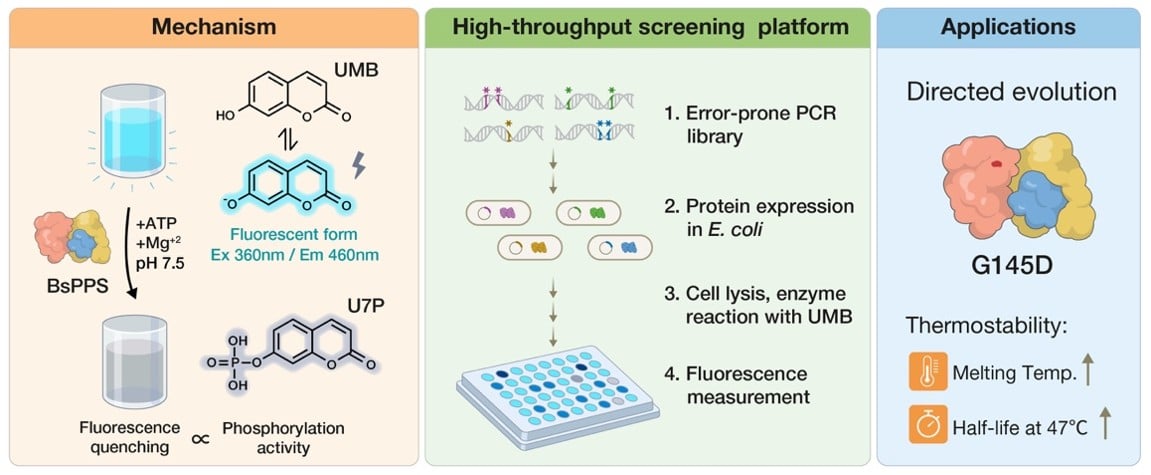

The lab at National Taiwan University has developed a simple fluorescence-based method to rapidly test the activity of an enzyme that phosphorylates phenolic compounds. This new platform makes it much easier to screen thousands of enzyme variants and provides a practical tool for exploring and improving phenolic compound–phosphorylating enzymes.
BsPPS phosphorylates the fluorescent phenolic compound umbelliferone (UMB), converting it into a much less fluorescent product. This fluorescence decrease provides a rapid readout of enzyme activity and enables high-throughput screening of BsPPS variants, leading to the identification of the more thermostable G145D variant.
National Taiwan University
Many natural plant compounds have promising health-related properties, but their poor water solubility can limit how effectively they are absorbed and used. In the previous work, researchers discovered an enzyme from Bacillus subtilis, called phenolic phosphate synthetase (BsPPS), that can attach phosphate groups to a broad range of phenolic compounds. This modification can help make these compounds more water-soluble and support the development of improved nutraceuticals and related products.
To make BsPPS more useful and explore other related phenolic compound–phosphorylating enzymes, a rapid and convenient method for measuring enzyme activity is needed. This is particularly important because BsPPS represents a newly characterized group of enzymes capable of phosphorylating diverse phenolic compounds. Conventional analytical methods such as HPLC can accurately measure the products, but they are too slow and labor-intensive for screening thousands of samples.
In this study published in Food Chemistry, researchers therefore developed a fluorescence-based screening method using umbelliferone (UMB), a small fluorescent compound, as an indicator of BsPPS activity. UMB normally produces a strong fluorescent signal. When BsPPS adds a phosphate group to UMB, producing umbelliferone 7-phosphate (U7P), its fluorescence decreases markedly. By measuring this decrease with a standard microplate reader, scientists can quickly estimate how active the enzyme is.
The measurement conditions were systematically optimized and confirmed that the method was accurate, reproducible, and suitable for testing many samples in parallel. Scientists further combined the assay with directed evolution, a technique in which many slightly different versions of an enzyme are generated and screened for useful properties.
Using this approach, thousands of BsPPS variants were screened, and a variant called G145D was identified that retained more activity after heat treatment than the original enzyme while maintaining similar catalytic performance.
Overall, this fluorescence-based assay provides a practical platform for rapid screening and engineering of BsPPS. More importantly, it also supports the future exploration of related phenolic compound–phosphorylating enzymes and facilitates the development of improved biocatalysts for producing water-soluble phosphorylated derivatives of plant-derived bioactive compounds.
“By turning enzyme activity into an easily measurable fluorescence signal, we can examine thousands of enzyme variants much more efficiently, accelerate the development of improved biocatalysts, and facilitate the exploration of phenolic compound–phosphorylating enzymes,” says corresponding author Nan-Wei Su, professor of agricultural chemistry at National Taiwan University.
Prof. Nan-Wei Su‘s email address: [email protected]
Advertisement