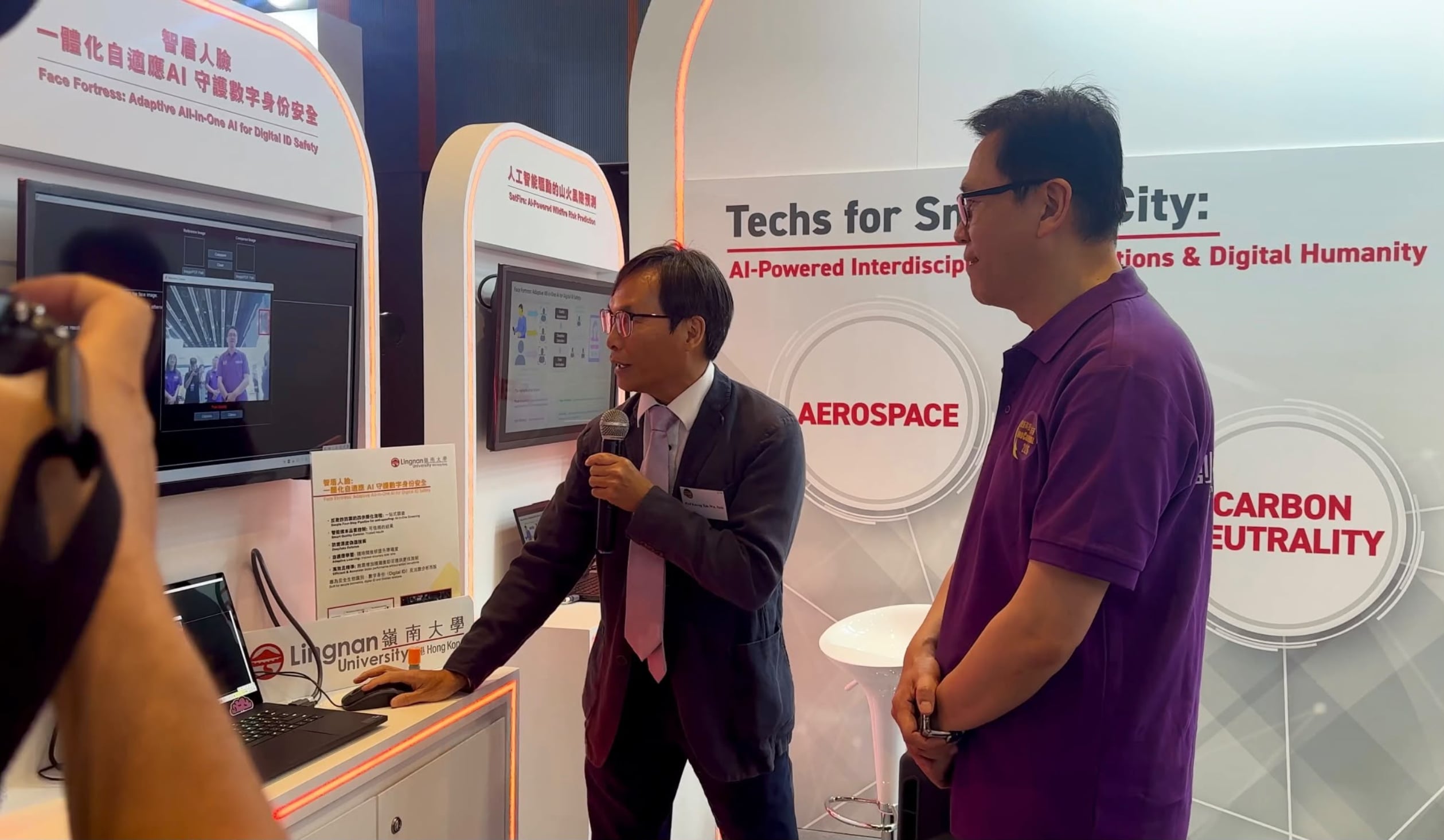
Prof Sun Dong (right), Secretary for Innovation, Technology and Industry of the Hong Kong SAR Government, visits Lingnan University’s exhibition booth and sees how Face Fortress, an AI-powered facial verification system developed by Prof Sam Kwong Tak-wu (left) , Associate Vice-President (Strategic Research), Dean of the School of Graduate Studies, and J.K. Lee Chair Professor of Computational Intelligence at Lingnan University, uses AI to screen facial images and detect deepfakes.
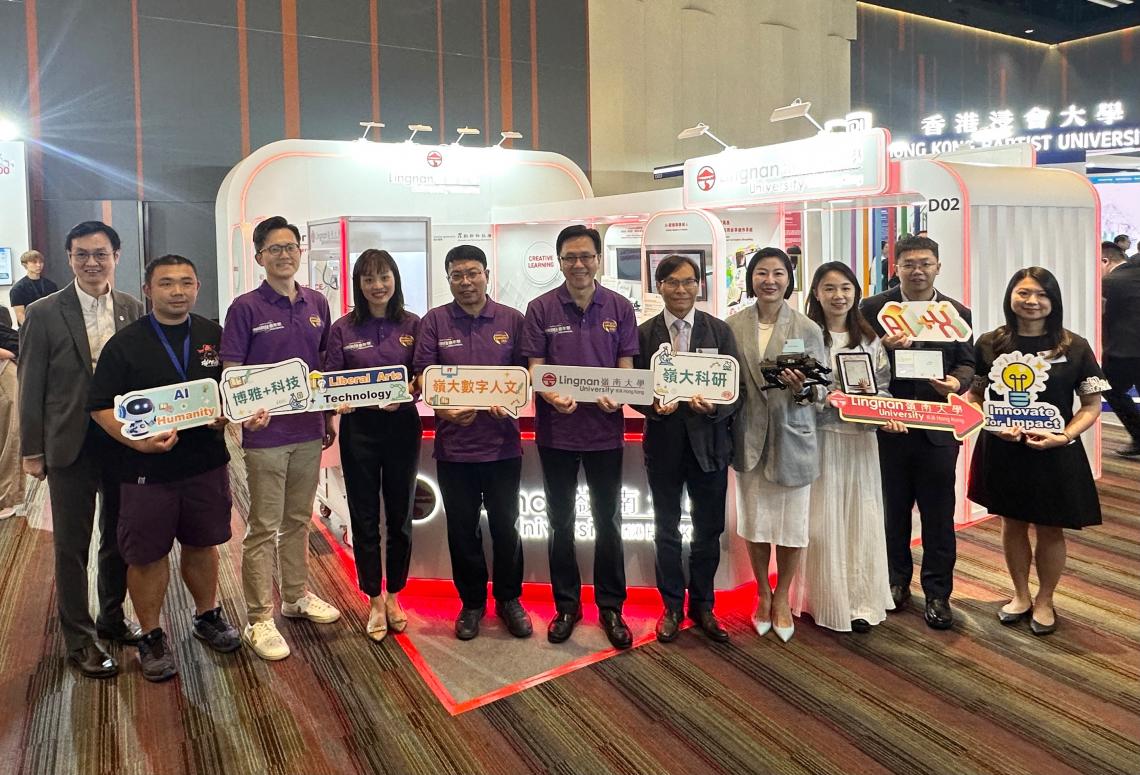
Lingnan University shows five interdisciplinary innovations at booth D02 of InnoCarnival 2026: digital identity verification, aerospace technology, carbon neutrality, wildfire risk prediction, and creative education. Through interactive displays, the exhibits demonstrate how AI and other advanced technologies can be applied across different professional fields to address practical needs in everyday life and urban development. (Pictured centre: Prof Sun Dong, Secretary for Innovation, Technology and Industry of the Hong Kong SAR Government.)
This year’s InnoCarnival theme is “Lead with I&T, Dream to Fly High”. At booth D02, Lingnan University is presenting five interdisciplinary innovations in digital identity verification, aerospace technology, carbon neutrality, wildfire risk prediction, and creative education. Through interactive displays, the exhibits demonstrate how AI and other advanced technologies can be applied in different professional fields to address practical needs in everyday life and urban development.
Developed by Prof Sam Kwong Tak-wu, Face Fortress addresses the growing threat of digital identity fraud involving deepfake technology that creates synthetic faces to impersonate real people. Reliable facial verification is essential in education, finance, and public services, where identity checks play an important role in maintaining security. The system first automatically assesses the quality of facial images based on factors such as clarity, lighting, and angle, filtering out blurred or substandard images. It then uses algorithms to detect whether an image contains a synthetic face before proceeding to facial recognition. This two-stage verification process strengthens the reliability of identity checks.
Unlike conventional approaches that require multiple systems to be integrated, Face Fortress combines image quality screening and deepfake detection into a single workflow, helping to improve operational efficiency. Currently used by Lingnan as one of the methods for screening fake academic qualifications, it demonstrates the practical application of AI in the University’s daily administrative operations.
In line with this year’s aerospace thematic zone, “Lead with I&T Dream to Fly High”, Lingnan is also showcasing the Carbon Emissions Source Database developed by Prof Li Jia, Director of the Lingnan University Shenzhen Research Institute(LUSZRI) and Associate Professor (Presidential Early Career Scholar) of the Wu Jieh Yee School of Interdisciplinary Studies. This provides high-precision ground data for national space missions, and has been used to cross-reference remote-sensing images captured by the Multi-Spectral Imaging Carbon Observatory (MUSICO), the aerospace research instrument developed under the leadership of The Hong Kong University of Science and Technology (HKUST) and used on the Tiangong Space Station. The comparison identifies the intensity and distribution of emissions from various power and industrial facilities, providing important research support for the nation’s goals of carbon peaking and carbon neutrality.
Lingnan is also presenting three other interdisciplinary innovations, demonstrating the applications of AI in environmental management, creative education, and filmmaking: TS-SatFire, an AI-powered wildfire risk prediction system developed by Prof Sam Kwong Tak-wu, combines satellite imagery with real-time weather data to predict wildfire risks. It uses low-cost algorithms to continuously scan large geographical areas, activating more advanced AI only when a high wildfire risk is detected, thereby substantially reducing computational costs.
StorySketcher, an AI-powered, child-led storytelling platform developed by Prof Xu Xian, Assistant Professor of the Department of Digital Arts and Creative Industries, transforms children’s drawings into complete and original written stories and turns them into videos. The platform makes storytelling fun while stimulating children’s narrative creativity, logical thinking, and language expression.
CineSim, a film production simulation and educational software system led by Prof Tobby Kan Shiu-tao, Assistant Professor of Teaching of the Department of Digital Arts and Creative Industries, enables students and creators to learn filmmaking, lighting, and cinematography in a computer-simulated environment without physical equipment, overcoming the limitations imposed by traditional film sets and equipment. CineSim recently won the Technological or Digital Innovation of the Year award at the Times Higher Education Awards Asia 2026, widely regarded as the “Oscars of higher education”. It emerged as sole winner from more than 500 competing entries.
Lingnan has actively promoted interdisciplinary research centred on its “AI +” strategy in recent years, and aims, through the five projects showcased at InnoCarnival 2026, to give the public direct insights into how intelligent technologies can be applied to fraud prevention, everyday learning, urban development, and environmental governance. The interactive exhibits also seek to deepen public understanding of innovation and technology, and to encourage young people to explore opportunities in the innovation and technology sector.