

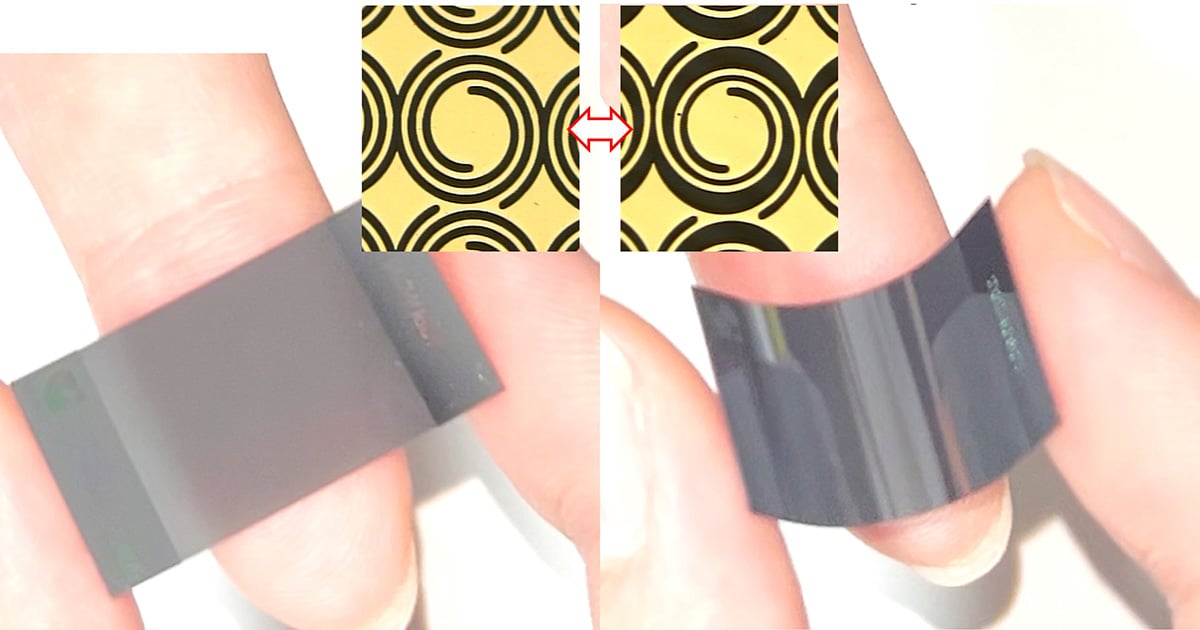

A recently developed flexible and stretchable silicon material can have its response to terahertz waves mechanically tuned, making future terahertz bands more resistant to mechanical impacts.
The flexible terahertz metamaterial
Optica
Researchers at the Osaka Research Institute of Industrial Science and Technology (ORIST), in collaboration with the University of Osaka and Tohoku University, have developed a flexible and stretchable silicon material whose response to terahertz waves can be mechanically tuned. By etching microscopic spiral springs into silicon, the team made the fragile material bendable and stretchable.
Terahertz waves, whose frequencies lie between those of microwaves and light, hold potential for material inspection and future wireless communications. Silicon is used to fabricate low-loss optical components in terahertz bands. However, these components are rigid and can be easily broken by mechanical impact.
"The key was to build flexibility into the silicon structure itself," said Dr. Hidemasa Yamane, a senior research scientist at ORIST. "The tiny springs allow the structure to bend and stretch, while the same silicon network also provides optical functionality for terahertz waves."
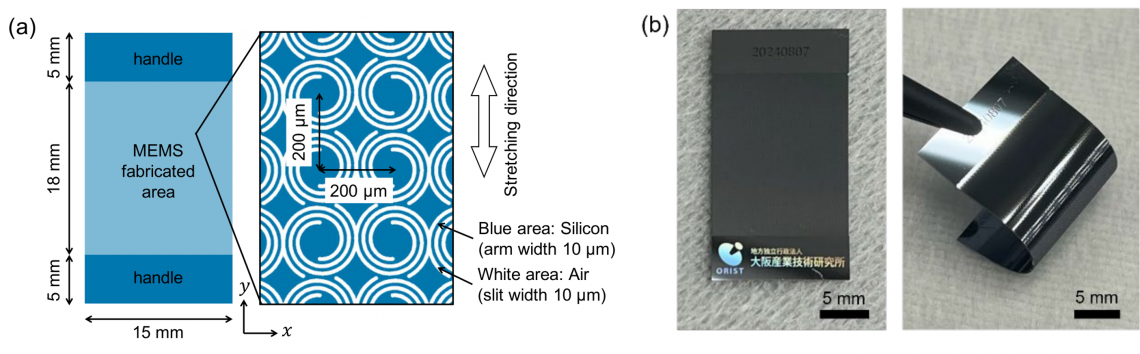
Flexible and stretchable silicon fabricated using microelectromechanical systems (MEMS) micromachining. (a) Sample layout and spiral-spring pattern with a 200-µm pitch and nominal arm and gap widths of 10µm. (b) Flat and bent samples. Bending illustrates mechanical flexibility, and the terahertz measurements were performed under uniaxial stretching.
Optica
Using microelectromechanical systems (MEMS) fabrication techniques, the researchers etched spiral-shaped gaps through a 200-µm-thick silicon wafer, forming spring arms about 10 µm wide. The resulting silicon structure is self-supporting and does not require polymer or metal backing. Its effective refractive index, which is determined by the relative proportions and arrangement of silicon and air, can be changed by deformation.
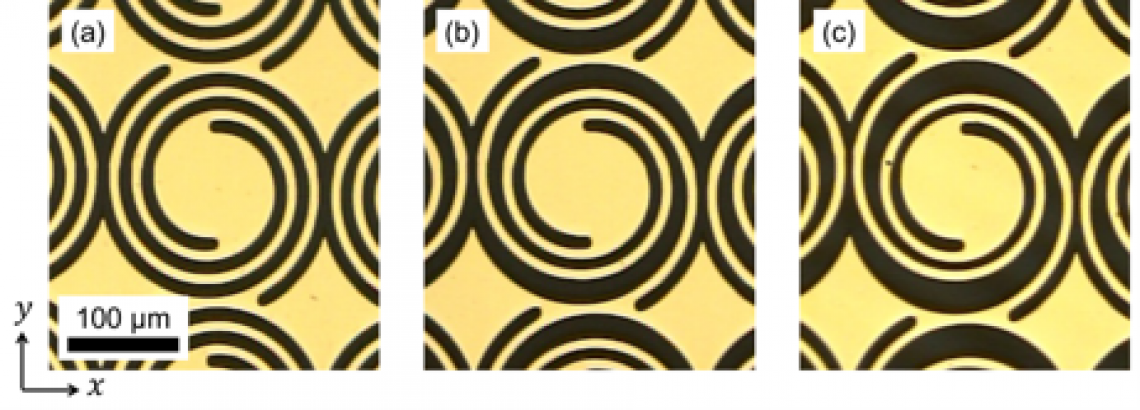
"When we pull on the structure, the gaps between the silicon arms broaden," Yamane explained. "Increasing the proportion of air reduces the effective refractive index. We can therefore change the phase delay of terahertz waves by changing how much the structure is stretched."
Optical micrographs of spiral springs at (a) relaxed length, (b) 7.3% elongation, and (c) 12.6% elongation. The dark regions are the through-etched air gaps. Stretching along the y-direction widens these gaps, changing the silicon-to-air ratio and structural anisotropy.
Optica
Terahertz time-domain spectroscopy demonstrated that elongating the pattern by 12.6% reduced the effective refractive index by approximately 6% for polarization perpendicular to the stretching direction. For polarization parallel to this direction, the reduction was 8%. These different responses show that deformation can tune the birefringence of the material, defined as the difference in the effective refractive index for the two polarizations.
"Mechanical deformation opens a new avenue for terahertz silicon photonics," said Prof. Masayuki Fujita of Tohoku University and the University of Osaka. "Further study will lead to the development of tunable terahertz integrated circuits using MEMS technology."
This study was published in Optica and was supported by the Japan Society for the Promotion of Science (JSPS) KAKENHI grant and the Japan Science and Technology Agency (JST) CREST funding program.
Advertisement
Advertisement