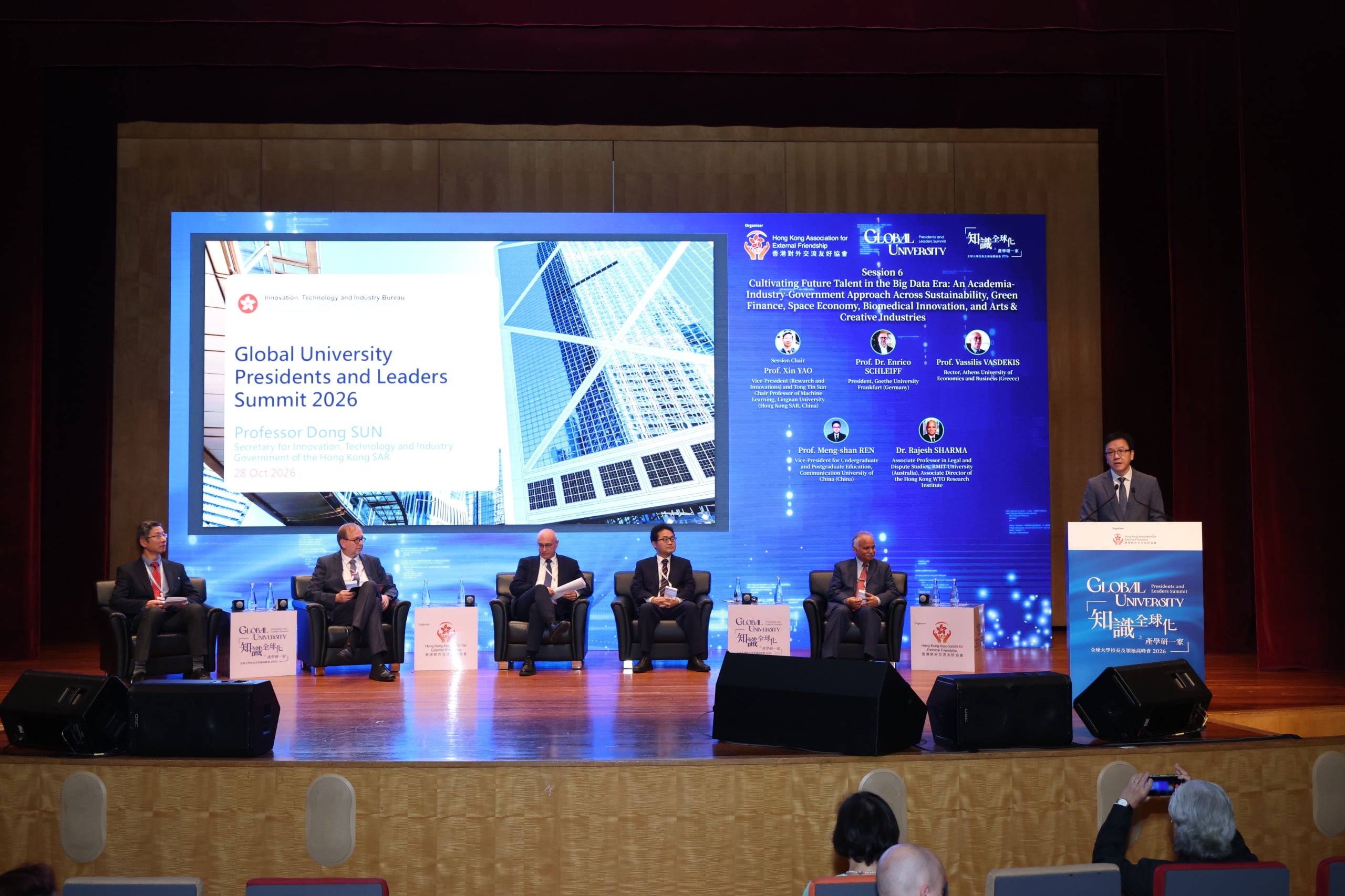
Prof Sun Dong (right), Secretary for Innovation, Technology and Industry of the Government of the Hong Kong Special Administrative Region and the speakers participating in Panel Session 6.
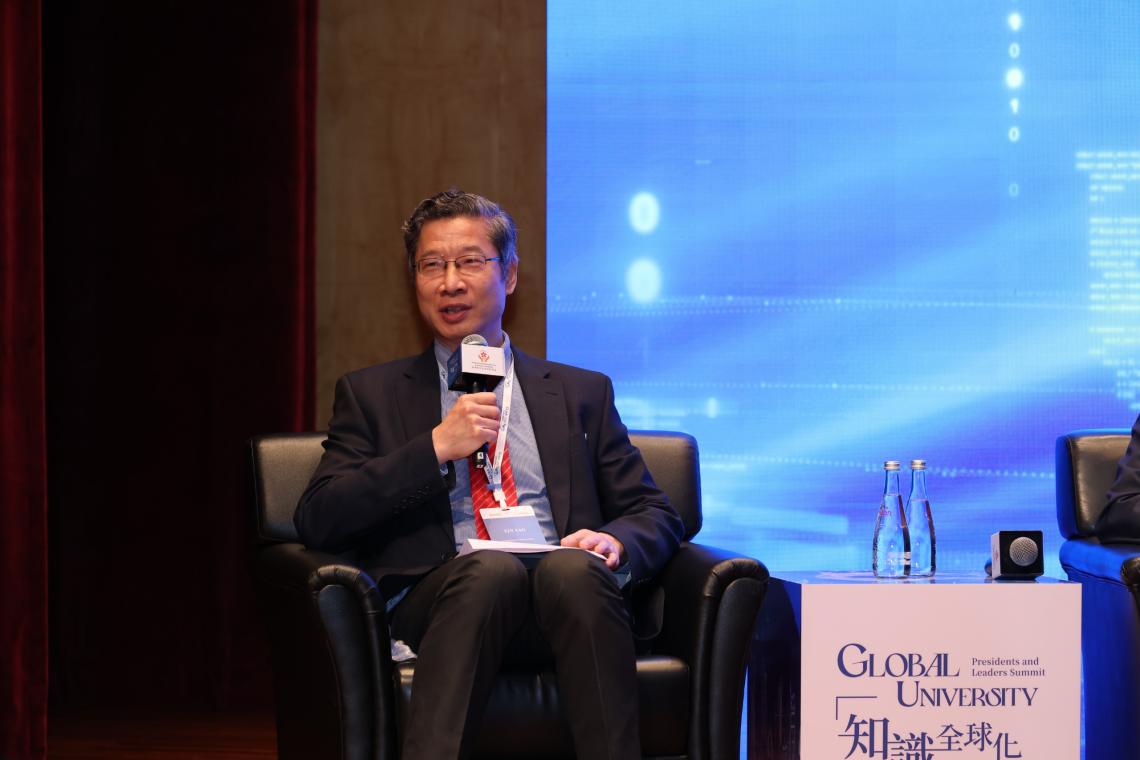
Prof Xin Yao, Vice-President (Research and Innovation) and Tong Tin Sun Chair Professor of Machine Learning at Lingnan University, chairs Panel Session 6 at the Global University Presidents and Leaders Summit 2026. Prof Yao raises five key questions concerning AI and big data to stimulate debate with higher education leaders from Australia, the Chinese Mainland, Germany, and Greece.
Panel Session 6 was entitled “Cultivating Future Talent in the Big Data Era: An Academia-Industry-Government Approach Across Sustainability, Green Finance, Space Economy, Biomedical Innovation, and Arts & Creative Industries”. The speakers included Prof Enrico Schleiff, President of Goethe University Frankfurt, Germany; Prof Vassilis Vasdekis, Rector of the Athens University of Economics and Business, Greece; Dr Rajesh Sharma, Associate Professor in Legal and Dispute Studies at RMIT University, Australia; and Prof Ren Mengshan, Vice-President of Communication University of China.
As AI models continue to advance in knowledge processing, analysis, and content generation, Prof Yao raised five key questions to stimulate the discussion: what and how universities should teach when AI models may possess knowledge and capabilities that surpass those of professors; how higher education institutions can effectively cultivate and assess students’ critical thinking; whether traditional classrooms remain appropriate in the AI era; how graduates can continue learning, adapt to technological changes, and stay employable after leaving university; and whether universities are currently producing graduates who meet society’s needs.
The discussion also examined innovative applications of big data across different fields. With the rapid development of digital technologies, AI, cloud computing, and data analytics, the collection and analysis of vast amounts of information can support decision-making, innovation, and long-term development. Speakers also explored how collaboration between academia, industry, and government could nurture talent capable of harnessing data in environmental sustainability, green finance, the space economy, biomedical innovation, and the arts and creative industries, addressing climate change, advancing scientific discovery and healthcare development, and encouraging cultural creativity and industrial transformation.
Participants noted that the widespread use of data across industries also raises important issues concerning data governance, personal privacy, technology ethics, and digital inclusion, for which all parties must share responsibility. Universities should combine curriculum design, interdisciplinary learning, and industry-academia-research engagement, supported by appropriate government policies, to strengthen talent development and innovation. This would enable students from different disciplines to acquire the relevant knowledge and skills to address complex challenges in real-world working environments.
Organised by the Hong Kong Association for External Friendship (HKAEF), the GUPLS 2026, themed “Globalisation of Knowledge – How University Education Should Respond to Rapid Global Development and Community Needs”, provides an international platform for academic leaders and experts from around the world to exchange views and explore the future direction of higher education.