

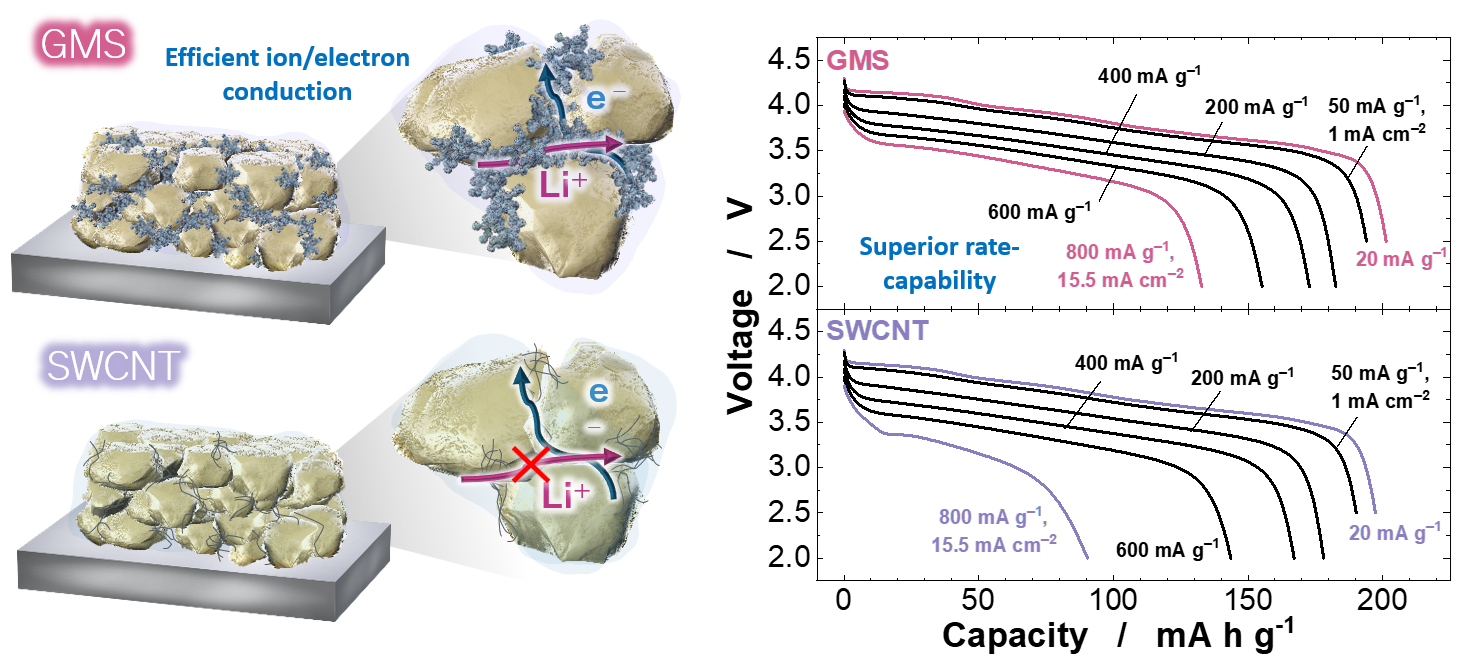

Graphene mesosponge proves highly effective in improving energy and power densities in commercial lithium-ion batteries.
Graphene mesosponge (GMS), with its unique mesoporous architecture, facilitates three-dimensional electron and ion transport in high-loading, densely packed lithium-ion-battery electrodes.
YOKOHAMA National University
Making more efficient, longer-lasting lithium-ion batteries has been a challenge for researchers because adding more mass to the batteries restricts how fast the electricity and lithium ions can move. To overcome this challenge, a research team has added graphene mesosponge to batteries to improve how the battery conducts fast discharge. Their results show that graphene mesosponge is highly effective in improving the energy and power densities in commercial lithium-ion batteries.
Their research was published in the journal Advanced Energy Materials on October 8, 2026.
With a goal of building a cleaner, more sustainable society, scientists are working to develop more powerful lithium-ion batteries. These batteries are used to power items ranging from smartphones and laptops to electric vehicles. With the current commercial lithium-ion batteries, the positive electrode, restricts the batteries’ energy density. Scientists are focused on creating high-performance positive electrode active materials that can achieve higher battery energy density.
Scientists have explored the use of pure nickel oxide as an electrode candidate for high-energy lithium-ion batteries. However, the battery degrades because high voltage stresses the materials with the nickel atoms making it harder for the battery to charge and discharge.
To achieve a higher battery energy density, scientists are studying ways to increase the active materials in the battery while reducing the parts of the composite electrode, such as conductive additives and polymer binders, that do not store electricity. But adding too much active material to the battery electrode while minimizing the conductive additives and polymer binders results in inefficient batteries where electricity cannot flow freely through the material. “Achieving efficient electron and ion transport in high-loading, densely packed electrodes remains a major challenge for high-energy-density lithium-ion batteries,” said Naoaki Yabuuchi, a professor at YOKOHAMA National University.
To address this challenge, the research team studied three different carbon materials, acetylene black, single-walled carbon nanotube, and graphene mesosponge, characterizing and comparing these materials as a possible conductive additive for battery applications. They discovered that graphene mesosponge performs as a functional conductive additive that tailors electrode microstructure through its sponge-like mesoporous framework. By adding just a small amount of graphene mesosponge, the team observed the formation of three-dimensional electron- and ion-conducting networks that contribute to more efficient batteries. The graphene mesosponge provides this improvement because of its porous framework which allows the electrolyte to move deeply into the parts of the battery where energy is stored. “The porous GMS architecture forms a three-dimensional electron- and ion-transport network, with electrolyte retained within its mesopores facilitating ion transport and resulting in superior rate capability,” said Yabuuchi.
The team used FIB-SEM tomography, a 3D imaging technique, to further demonstrate that graphene mesosponge forms a more uniformly distributed internal structure for a battery electrode. The graphene mesosponge features a three-dimensional sponge-like nanoscale structure, that allows electrons to move more freely inside the battery. The team views the use of functional conductive additives like graphene mesosponge to offer a promising strategy for maximizing battery performance under practical operation conditions. “Our results demonstrate that graphene mesosponge is a transformative conductive additive for simultaneously improving energy and power densities in practical lithium-ion batteries through rational microstructural design of dense composite electrodes,” said Yabuuchi.
With the team’s results showing that graphene mesosponge emerges such a promising conductive additive for high-energy and high-power lithium-ion battery electrodes, their work continues. “Our ultimate goal is to achieve fast-charging capability with a graphite negative electrode, thereby enabling the development of practical lithium-ion batteries that combine high energy density, high power density, and fast-charging capability,” said Yabuuchi.
The research team includes Yosuke Ugata, Rei Matsumoto, Sera Sato, and Naoaki Yabuuchi from YOKOHAMA National University; Jaejin Lim and Yong Min Lee from Yonsei University; Hiroshi Ueda, Atsuo Omaru, and Kosuke Ishii from 3DC corporation.
The research is supported by Japan Society of the Promotion of Science and Japan Science and Technology Agency.
###
YOKOHAMA National University (YNU) is a leading research university dedicated to academic excellence and global collaboration. Its faculties and research institutes lead efforts in pioneering new academic fields, advancing research in artificial intelligence, robotics, quantum information, semiconductor innovation, energy, biotechnology, ecosystems, and smart city development. Through interdisciplinary research and international partnerships, YNU drives innovation and contributes to global societal advancement.
Advertisement
Advertisement